
In a society with true democratic priorities, cutting funding for public schools would be an unconscionable act. In the United States, funding for schools and educational curricula have been significantly reduced. In addition to an ominous financial situation, public education has faced threats and tangible acts of censorship (i.e. book banning and curricula cutting), in order to cast out topics that discuss democratic concepts, diverse cultural histories and pluralistic identities. This is antithesis of educational reform, which teachers and administrators of public schools have worked long and hard to achieve.
Philadelphia’s Fairhill Elementary School was one of two-dozen schools that were forced to close in 2013, because of state and federal budget cuts. The decision was made by the Philadelphia School Reform Commission (PSRC), an ironic title for an organization focused on diminishing the comprehensive impact of public schools. The commission, which dissolved in 2017, concentrated on expanding problematic charter schools rather than making key reforms to the existing public school system (see: “The Myth of Charter Schools”).
A photoblog titled, The Death of Philadelphia’s Public Schools, documents the public schools that have closed in Philadelphia. In their post on Fairhill Elementary School, they note that the school is in a neighborhood with a large demographic of Latino/a/x residents, especially from Puerto Rico and the Dominican Republic. The school’s architecture consists of foreboding and uninviting features such as a towering bland brick facade with a fenced in perimeter. However, the institutional bleakness is juxtaposed with vibrant mural depicting a pastoral scene of Latin American culture and identity.
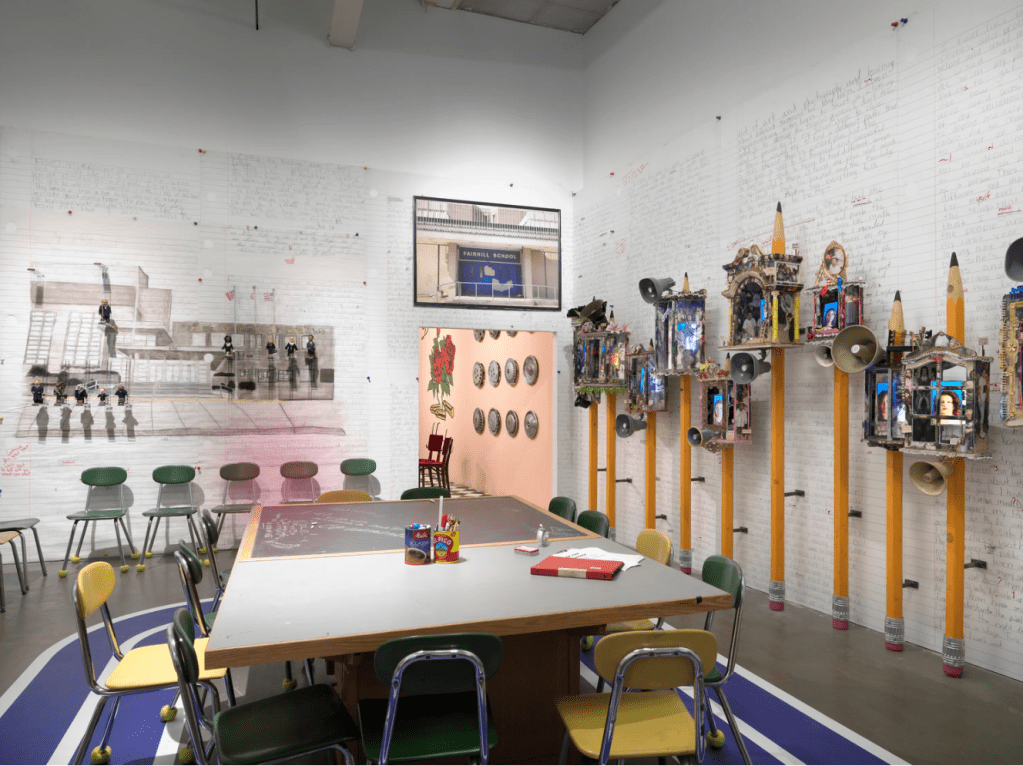
Contemporary artist Pepón Osorio was commissioned by Temple University’s Tyler School of Art to create ReForm, an installation that addressed the district’s closing of Fairhill Elementary School. Osorio wanted his work to reflect the school’s intrinsic connection to the community. Urban public schools are often built within a central location, so that they are accessible to the students and their families who live in the community they serve. Osorio noted that the building had become a metaphor for the state of public education. Its vacant shell was the antithesis of what education entails, which is a vessel for critical, creative and communal action and development. The building, destined to become an urban ruin, is indicative of the overarching neglect to make sustainable reforms to the public education system.
Most consequently, Osorio learned that the school, which was located within the heart of the community, left an enormous void among an intergenerational population. Teachers, students, parents and alumni all mourned the loss of Fairhill Elementary School. They even created a vigil for the school. Osorio realized that an artwork addressing the school’s closure would have to envelop the social and emotional aspects of public education, rather than just a scathing critique of bureaucracy’s impact on the educational system.
The ReForm installation is a pertinent collaboration between Osorio and alumni and supporters of the school. The work reflected both the pride of being associated with the Fairhill community, as well as the urgency to push back against marginalization and erasure. The activist driven approach Osorio et al engaged in, is notably connected to pedagogical theory and practice. One particular philosophy, advanced by educational theorist Elliot Eisner, is “resistance to closure,” which is a concept that advocates for learning to focus on enduring forms of inquiry, nuance and curiosity. When implemented in the curricula, this theory entails an array of experiential processes and qualitative assessments, rather than standardized metrics and objectives. Resistance to closure also refers to the will of the public to oppose the strict institutional hierarchy that impacts their quality of life.
As an example of experiential learning, ReForm manifests itself through many forms and engaging processes. There is the more typical installation-type of display, which resembles Osorio’s signature mode of creating immersive spaces based on collective identity, memory and communal spirit. There were also numerous interactive and participatory elements involved in the making and presentation of ReForm.
Prior to the fulfillment of the installation, Osario collaborated with community members, and twelve former Fairhill students, who called themselves Bobcats after their school mascot. The result of the artistic process was a recreation of a classroom environment with salvaged items from the school. One of the items is a water fountain with a sign that warns not to drink from it, which signifies ecological issues that public schools deal with (i.e. lack of clean circulated air and drinking water). There are also the archetypal metal bars, which are supposedly used for forced entry prevention and vandalism deterrence. However, the larger revelation is that they resemble a prison, hence the principle of the “school-to-prison pipeline.” This aspect is addressed by a Bobcat, who explains that the options presented to them due to the school boards’ callousness and strict regulatory governance were either death or jail.
The focal point of the installation is a poignant series of videos, which projected the images and voices of the school’s advocates, who offer stark messages about issues impacting students, such as the need for safe social and environmental spaces where they can thrive and experience truly democratic concepts. Each video was encased in a shrine made from objects that held significance to the school and broader community. The shrines were affixed to large sculptural pencils with handwritten personal reflections on mural-sized ruled notebook paper in the background.
ReForm highlights the importance of art as a pedagogical vehicle for critical thinking, community building and emotional expression. It is a pertinent work of art to reflect on as public education continues to face grave consequences of bureaucratic and ideological actions. In fact, the acceleration of attacks on public education has reached its zenith under Trump’s presidency. The impact of the Trump administration’s large-scale defunding of public education has spurred on detrimental consequences, which journalist Mark Lieberman describes in an article for Education Weekly: “Dozens of school districts canceled plans to upgrade buildings, purchase library books, contract with mental health providers and help middle and high schoolers apply to college.” Art education is unfortunately one of the most threatened and targeted subjects in the curricula, and in too many instances, public schools are devoid of courses in the humanities.
ReForm is a microcosm of a bigger system, but it is precisely indicative of the large-scale issues that support the need for widespread educational reform. This type of reform does not require reinventing anything significant, or scrapping many of the institutional programs and curricula already in place. We have had insight into the framework for progressive and democratic education for centuries. Our pivot to substantial educational reform should be rooted in what nineteenth-century Swiss educator Johann Heinrich Pestalozzi defined as an approach from the “head, heart and hands.” The heart is the foundation of this experiential learning methodology. This means that emotional development, moral education and empathy are what drives the other holistic aspects; the head, which refers to critical thinking and problem-solving, and hands, which address practical skills and real-world application of the entire educational process. The arts and humanities paramount to this approach because they are representative of how social and emotional experiences can uplift and motivate us to enact tangible societal transformations.

