
This piece was initially published on , on a blog called Rhino Horn Group, which I had been maintaining until around 2019. I am republishing it with additional information and insight. Kevin Sampson passed away on March 18, 2026.
Kevin Sampson had an enormous talent for creating powerful works of art that are empowered and beloved by his community. Sampson, a self-taught artist, found an early penchant for drawing while he was a law enforcement officer in the City of Newark, New Jersey. His adeptness at drawing the human figure led him to become a composite sketch artist for the Scotch Plains Police Department. Sampson was the first Black uniformed police composite sketch artist in the country. Later, Sampson’s skills at forensic sketching would be utilized in Wanted, a project by artist and activist Dread Scott that created mock police wanted posters that expose the racial profiling used by law enforcement agencies. I wrote about Wanted in a prior Artfully Learning post.
I also featured Sampson in Artfully ARThur, after he was rendered as an animated character in the PBS television series Arthur. In the show, Sampson acts as a mentor to one of the series’ main characters, who struggles to find artistic inspiration. True to form, Sampson helps the character and whoever watches the episode, find inspiration from within themselves through an artistically engaged interaction with their surrounding environment.
Sampson’s artwork is replete with conscientious themes and concerns. He created intricate mixed-media vessels from found objects that have personal significance to either himself or the subjects in his work. These vessels convey symbolic messages that express the collective consciousness of heterogeneous populations and cultural backgrounds. He also painted large murals with similar socially conscious themes.
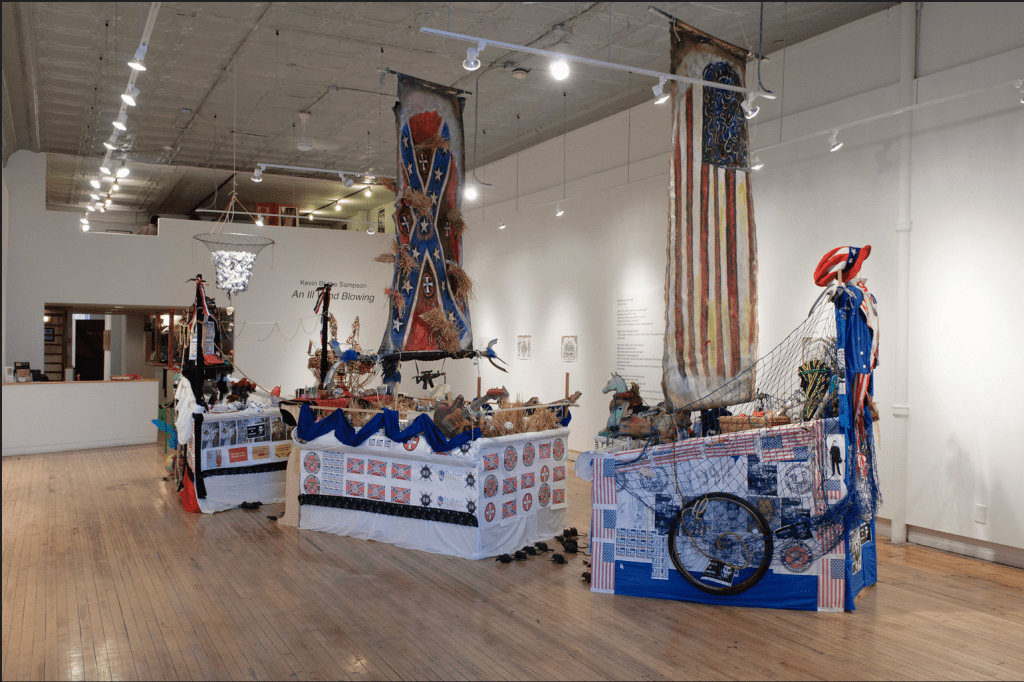
In 2013, Sampson’s installation at the Intuit: The Center for Intuitive and Outsider Art in Chicago, An Ill Wind Blowing, encapsulated the frustration of a nation and the broken American dream. The ship’s three sections represent the glaring social, cultural and economic divide of the United States. Each portion of the vessel symbolized the aforementioned elements. One section has imagery indicative of the large corporations and their influence on society, another depicts the social elite and a third section illuminates class struggle and racial disparity. Sampson made the vessel not only to air his grievances. He included a large metal basket/fishing net, where visitors could jot down their frustrations on a sheet of paper, crumple it up, and throw it in.
Sampson was consistently concerned with the well-being of those around him, and he was incredibly outgoing in offering his skills and experiences as teaching artist. For more than three decades, he mentored local school students, and prompted them to think flexibly and purposefully about their place in the world through transforming quotidian objects into fantastical works of art.
Kevin and I had the opportunity to speak about his work in 2016. The transcript of our conversation is copied below.
Do you consider yourself a socially engaged and/or Humanist artist?
As I understand Humanism, it’s about giving value to humanity by working in concert with human values, all the while understanding that all humans are to be treated with the same understanding and respect.
If this is the case, then this does apply to how I live and work. I am a community based artist, one that feels a responsibility to that community and people in general. As an African American it is a natural fit, as I seek to highlight the hopes, dreams, and problems of the (world) community as a way of staying in the fight, for the rights of all.
Do you consider the figure to have a vital role in your art?
Rarely, most of my world uses other means to feature the human condition. I tend to construct vessels, which illustrate a political thought or a spiritual connection, to either this world or the world beyond.
What is your artistic studio process like?
I am not a studio based artist. I live with my work, meaning that I don’t have a set place to work. I work all over my house. I don’t set aside time for the studio, instead I work outside, inside and all around the town. I am a process orientated artist; I work by reading by my constant contact with the public. When I finally construct my work it is already done in my head. And I rarely have the need to see my own work after it is done.
Do you feel that contemporary art should have a commitment to issues that affect our daily lives?
I have been teaching for over thirty years, and one of the things that I do, is make my students read the news, to follow it religiously. To become acquainted with social issues and causes particularly if they are artists of color. I do feel as though the world is sorely in need of protest and commitment to the many issues that affect this world. But I don’t expect every artist to have this commitment. But I do like it when they do.
You take on very direct issues in your work, what are some specific reasons that you’ve chosen to address and create a visual dialog for these issues?
I am the son of a civil rights leader, my father Stephen Sampson who was a self taught historian drilled into my siblings and my head commitment to civil rights of all. So it’s in my DNA and my father haunts me daily and keeps whispering in my ear his desire that I continue to fight for African Americans in particular and all people in general. Its just how I roll, religion and politics are interlinked in my head through the history of the African American.
Your work often has a prophetic vision of the future. Can you describe how you react and interpret the current state of the world into your sculpture and drawings?
What I really try to do is to create “spirit Necklaces of a vanquished peoples magic,” meaning that through my work, with out being too obvious, I attempt to create objects of power that show the problems of the world, while offering artistic solutions that cause these problems to transcend their circumstances. I attempt to create beauty where this is none as well as retrieving objects discarded by my community in an effort to give this objects (which hold memory) a new life…a new voice.
Discover more from Artfully Learning
Subscribe to get the latest posts sent to your email.
 Artfully Learning
This is very interesting and you have compelled me to look into this artist further.
LikeLike
Glad to hear that, Steven! I hope you find the breadth of Kevin’s work to be compelling!
LikeLiked by 1 person