
Every so often, I think about how Nona Faustine would respond to the myriad of issues inflected on our collective culture. Nona’s thoughts, opinions and insights were a very welcome part of my daily social media scrolling and engagement. Her presence obviously extended well beyond the digital realm, but seeing her posts elicited a range of responses, mostly the feeling of being unified within a community of like-minded artists, albeit with very different identities and life experiences. Nona was a very open individual. She shared intimate details of her life and her family history in her social media posts, writing and her powerful body of artwork. All of these aspects composed an encapsulating portrayal of her life and work. Even if you never had the opportunity to meet Nona, you knew her through those aforementioned avenues.
Nona was bold in her artistic processes and her unwavering love and concern for her community. She took significant risks in order to communicate the vital message of racial and gender equality. In many instances, her own body was the medium for symbolic reflections on the history of Black women in the United States. I first encountered Nona and her art when I was working as a gallery manager at Smack Mellon. We organized an exhibition of work from her renowned “White Shoes” series in 2016. I remember the day both Nona and the photographs arrived. They were undeniably captivating and she was passionate about the communicative and perspicacious role they have when publicly displayed. I had the honor of installing her work and then speaking with many eager and inquisitive gallery visitors about it each day the show was on view.
The “White Shoes” series reveals the unseen and underrepresented history of New York City with regards to its role in upholding slavery and the mistreatment of Black bodies throughout colonial history. Nona made herself physically and legally vulnerable in producing these photographs. She took tangible risks taking nude self-portraits at the site of former locations significant to the slave trade throughout the city; such as the intersection of Wall Street and Pearl Street, where an official slave market operated between 1711 and 1762. Posing naked in a public space in heart of the modern day financial capital of the world, was risky, but for Faustine, telling the history of Black women’s peril outweighed the risks to her own safety (thankfully she was incredibly deft in her covert operation).
New York City is one of the most hectic places on Earth, and it is quite easy to overlook things within its cluttered and frenzied landscape. However, by looking at artwork about the city, we are able to slow down time and discover the nuanced nature of the urban landscape and its people. Through her photographic technique and conceptual mindset, Faustine was adept at both freezing time and connecting past and present moments. “White Shoes” is a strong example of how an artwork opens our eyes to lesser known narratives and prompts critical observations and empathetic understandings about the plight of marginalized human beings.
The impetus behind creating the “White Shoes” series was the excavation of an African Burial Ground in Manhattan in 1991. This was a highly publicized discovery, but the overall impact and representation of African American and Black individuals in New York’s colonial history has been significantly whitewashed. Faustine’s “White Shoes” is a lesson in history, a valid marker for neglected sites and a memorial for marginalized individuals who were victims of white colonialist supremacy.
In addition to her exposé on slavery, Nona was an avid documenter of Black women and the varied role of the matriarch. “Young Mothers,” which is the title of her first series of photographs, depicts young women she knew and met in her community. She also photographed domestic scenes in her family apartment in Flatbush, Brooklyn as a symbolic reference to the dangers Black women face in daily life. This is exemplified in her 2016 portrait Say Her Name, which was created as a tribute to Sandra Bland, a Black woman who died in police custody in 2015. In her composition Faustine photographed herself laid out in a funeral setting with her mother sitting beside her.
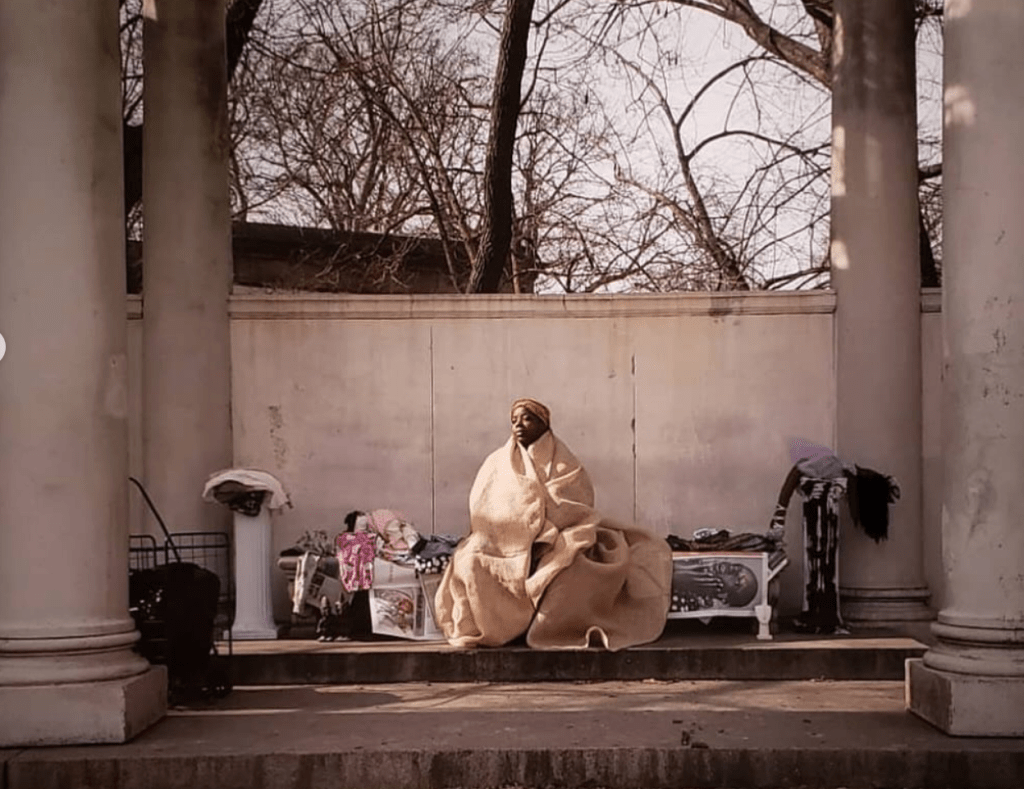
In the 2019 composition Demeter’s Morning, Faustine applies the mythological essence of Demeter, the Greek goddess of fertility, agriculture and the harvest, to the experiences of modern day women. One of the most recalled tales of Demeter was her walking the far corners of the Earth in search of her daughter Persephone, who was abducted by Hades. Due to Demeter’s absence, the caretaking of the land ceased, leading to suffering among the mortals. In her search for her daughter, Demeter disguised herself as an old woman to search for Persephone and was mistaken for a beggar and therefore ignored and treated poorly. Faustine recreates the mythological form of Demeter in disguise, and takes a self-portrait in a public plaza that has neoclassical architectural elements. In this visual interpretation of the myth, Faustine addresses a demographic of homeless older Black women who were impacted by the 2008 recession, and acknowledges their humanity even further by likening them to a goddess.
The actions that women take in shaping the fabric of culture is a timeless endeavor, which is exceptionally communicated and upheld in Nona Faustine’s artistic legacy. Because she valued love, empathy and connectivity, these qualities were the basis of her art and social life. The world is a brighter and more fearless place because of how she eloquently graced and contributed to it.
Discover more from Artfully Learning
Subscribe to get the latest posts sent to your email.

