
Since its nationwide inception during the 1970s as the “food stamp program,” the Supplemental Nutrition Assistance Program (SNAP) has been a lifeline for more than forty-million Americans. Roughly one out of eight people in the country rely on the vital food assistance program. With SNAP being affected due to the current government shutdown, millions of individuals and families across the United States will experience a drastic increase of food insecurity. Coupled with the growing presence of food deserts, this represents a grave moment in our nation’s ongoing hunger crisis.
The loss of SNAP led me to think about how artists have addressed hunger and food insecurity issues. From volunteering in kitchens to leading food growing workshops and opening up pop-up food stands; artists have facilitated efforts to feed communities and inspire sustainable practices that neighborhoods can implement to feed individuals and groups.
Alison Knowles’ conceptual art practice progressed from making paintings to making salads and sharing meals in a sociocultural and creative format. As a facilitator of participatory art forms, Knowles creates scores, which are in effect a written (sometimes also visual) manual created by an artist, which can then be performed by anyone who follows it. The scores suggest issues of labor and ritual, but also revel in the joy and playfulness around an experience. Knowles’ work intends to make art more accessible, and honors the cultural value of preparing a meal.
In ideal situations, access to food would be plentiful, equal and equitable. But in many circumstances, food is exceptionally hard for many people to access, due to lack of infrastructure. There are too many communities without supermarkets within walking distance and environmental pollution that impacts the soil and makes growing food difficult. Artist initiated projects put forth pragmatic solutions for addressing food security, such as Swale, a public artwork and a floating edible landscape on a reclaimed barge that traversed across New York City’s waterways between 2015 and 2019; with a permanent floating garden that is in the process of being realized. Swale describes itself as a floating forest, a symbolic and tangible response to the food desert crises in numerous urbanized communities.
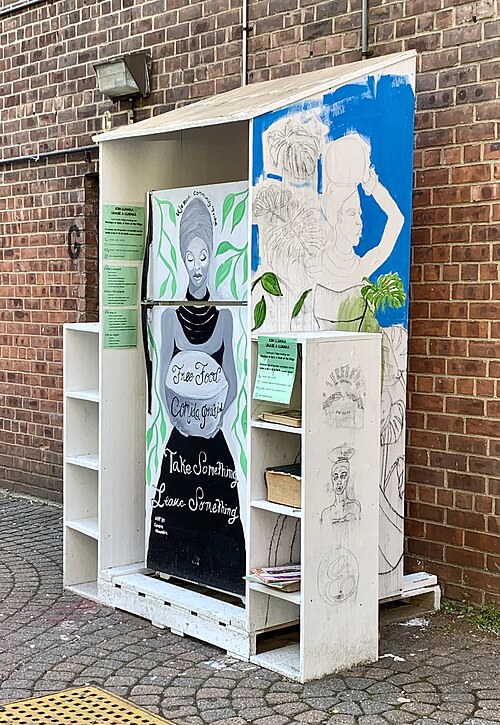
Community fridges are another form of mutual aid that provides public access to food and other vital materials (such as PPE for healthcare mitigation). Community fridges are volunteer run efforts, and can practically be placed anywhere there is access to electricity. Many are located outside of a store in partnership with small business owners, or an institution like a library or community center. Starting one generally involves minimal costs, and many times includes in-kind support like monetary and physical donations, to ensure the procurement and upkeep of the fridges and items within them.
An example of how community fridges and mutual food aid work is ongoing at Collective Focus, a community center in the heart of Brooklyn’s Bedford-Stuyvesant neighborhood. The center is volunteer operated and facilitated by a group of artists including Briana Calderón Navarro and Sarah Rooney, who have provided the local and surrounding community with tens of thousands of dollars worth of free food and other essential items like clothing. Additionally, starting in the summer of 2025, Navarro initiated a Community Fridge Revitalization Tour, which focuses on the upkeep and aesthetic design of existing fridges in Brooklyn.
At a time when the federal government has slashed funding and diverted its focus away from addressing humanitarian issues, the need for creative responses looms large. Creating tangible experiences from out of raw materials and ideas is something that art bestows on those who partake in it. The artist and creative community has been heeding the call, and working alongside communities to envision solutions to a slew of issues that too often get neglected or diluted by policymakers.
Discover more from Artfully Learning
Subscribe to get the latest posts sent to your email.
 Artfully Learning
There is so much creative work being done! Yet I fear governments will subvert the effort by using it to deny need. Still, challenging the greed remains imperative.
LikeLike