
I sent a shortened version of this post out to my Artfully Learning newsletter subscribers, so if you are a subscriber you have probably read the first few paragraphs already. If not, please feel free to subscribe to my mailing list where I share additional art and educational information and opportunities.
I have not written much about what is currently going on in the Levant, so this is my contribution to the gut wrenching discourse I have seen posted across various online and print media platforms.
To say that it has been horrific watching acts of violence and terror continue raging on in Israel and Gaza is a gross understatement. As a writer, words currently escape me. I do not have the bandwidth to discuss my many complicated thoughts and feelings on a grand scale and public forum. Therefore this blog post will not go into nuances or attempt to dissect every excruciating detail and account of the pain, loss and dehumanization that has been going on for far too long. The amount of misinformation, rash generalizations, performative radicalism and inequitable social justice that I see posted on social media is enough for me to keep away from engaging in that kind of discourse, which I believe is detrimental to any kind of healing and peace process that needs to happen. The trauma that Palestinians, Israelis and those within the Jewish and Palestinian diasporas are experiencing will tragically endure for generations. Check in on your friends, family and neighbors who are a part of these communities because they are not OK.
While I have not felt the impetus to write a conceptual take on contemporary events, I have revisited a piece I wrote earlier this year about artwork depicting life in Gaza called “What Art Can Teach Us About Healing.” The art was made by school aged children from UNRWA (United Nations Relief and Work Agency) schools in Gaza. They created drawings on paper and students from the Chelsea Community Hospital School (CCHS) in London transposed the drawings onto ornate ceramic plates that they made in their ceramics class. The work was then installed in a London hospital and caused somewhat of a controversy, eventually leading to its censorship (which you can read all about in the post). Rather than letting emotions get the best of us due to conflicting perspectives and age-old ideological variances, I discuss the value behind the artwork and why it is important to view and discuss works of art that may be contrary to our own opinions and experiences.
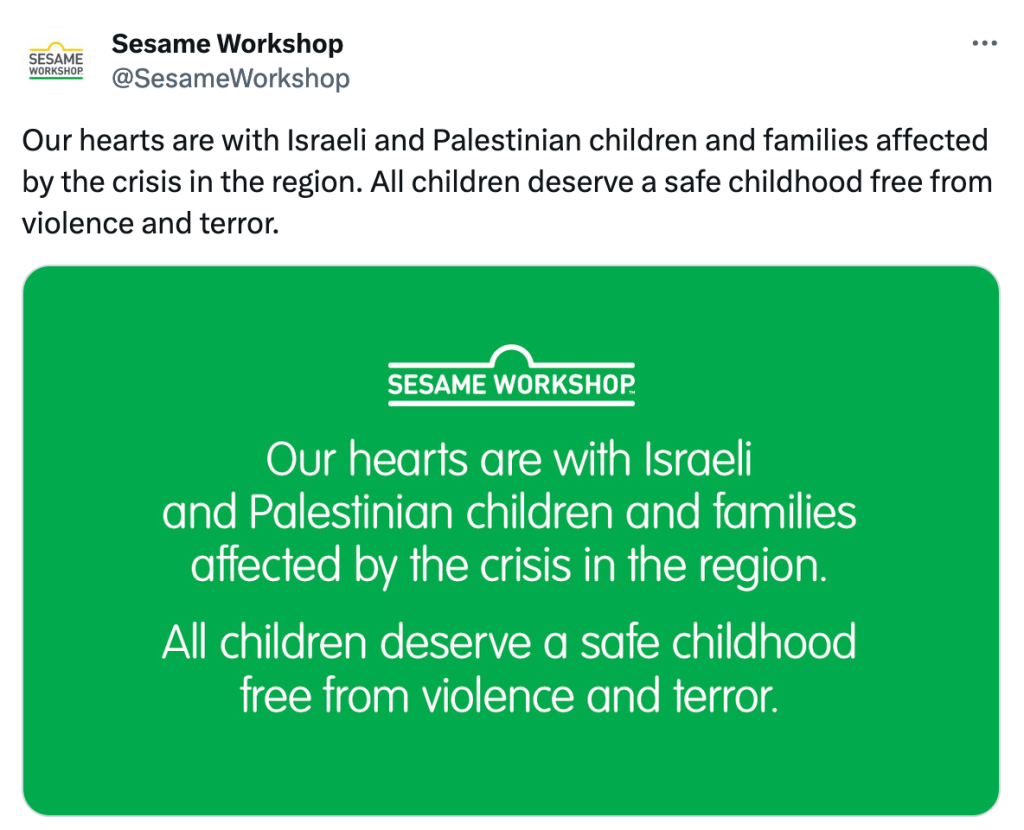
Despite your own stance on cultural/social/political issues, which as humans it is impossible not to have, I think there are several universal truths that we all can acknowledge. I did mention my avoidance and skepticism of social media lately, however, the following tweet from Sesame Workshop (the organization behind Sesame Street) is the crux of what weighs most heavily on my heart, and must be said and repeated because this simple, basic tenet of humanity seems to have been lost among the torrent of keyboard warriors. Here is the tweet: “Our hearts are with Israeli and Palestinian children and families affected by the crisis in the region. All children deserve a safe childhood free from violence and terror.”
That recent tweet echoes a key excerpt from James Baldwin’s 1980 essay “Notes on the House of Bondage,” in which he writes: “The children are always ours, every single one of them, all over the globe; and I am beginning to suspect that whoever is incapable of recognizing this may be incapable of morality. Or, I am saying, in other words, that we, the elders, are the only models children have. What we see in the children is what they have seen in us–or, more accurately perhaps, what they see in us.”
As educators, parents/guardians, siblings, friends and neighbors, we all play an integral part as stewards and nurturers of our collective world. We owe it to the children to exhibit empathy and moral guidance, so that they can experience the joys that should be associated with childhood.
Art education is an incredible resource that enables us to grapple with the intellectual capacity, emotional wherewithal and critical thinking necessary to address cultural/political/social issues like the violence and dehumanization in the Levant. As I mentioned in my post about the children’s drawings from Gaza, I gleaned some valuable insight about Palestinian culture from viewing the children’s drawings, especially culinary traditions. The drawings inspired me to research the various breads and baking methods common throughout the Middle East. This led to further realizations that Jewish and Arab diasporas share many relevant cultural practices.

Courtesy of the artists.
Other great resources for gaining insights into Israeli and Palestinian culture include the research done by American educator Betsey Coleman, artwork by street artist JR and Rechov Sumsum and Shara’a Simsim, the Israeli and Palestinian adaptations of the popular children’s television show Sesame Street. In 2012 while on a Fulbright in Israel and Palestine, Coleman created a digital guide to arts and cultural organizations that reflect the diversity within the cultural sector and strengthen multicultural collaboration among artistic communities in Israel and Palestine. ‘Other great resources for gaining insights into Israeli and Palestinian culture include the research done by American educator Betsey Coleman, artwork by street artist JR and Rechov Sumsum and Shara’a Simsim, the Israeli and Palestinian adaptations of the popular children’s television show Sesame Street.
In 2012 while on a Fulbright in Israel and Palestine, Coleman created a digital guide to arts and cultural organizations that reflect the diversity within the cultural sector and strengthen multicultural collaboration among artistic communities in Israel and Palestine.
In 2007, street artists JR and Marco began the Face 2 Face project, an outdoor guerilla photography exhibition made up of mural sized portraits of Israelis and Palestinians that are pasted face to face on both sides of the West Bank Wall, which physically separates Palestinian and Israeli cities. JR recounts the impetus behind the project stating that:
“We decided to go together to the Middle‐East to figure out why Palestinians and Israelis couldn’t find a way to get along together. We then traveled through the Israeli and Palestinian cities without speaking much. Just looking to this world with amazement. This holy place for Judaism, Christianity and Islam. This tiny area where you can see mountains, sea, deserts and lakes, love and hate, hope and despair embedded together. After a week, we had the exact same conclusion: these people look the same; they speak almost the same language, like twin brothers raised in different families. A religious covered woman has her twin sister on the other side. A farmer, a taxi driver, a teacher, has his twin brother in front of him. And he is endlessly fighting with him.”
Rechov Sumsum and Shara’a Simsim resemble Sesame Street in its production design, use of puppetry and educational curriculum centered around progressive pedagogy. The main pedagogical goals of both shows is to portray content that supports exhibiting mutual respect for cultural diversity, empowering child-centered social and emotional awareness and developing and advancing academic knowledge (i.e. reading, writing, bilingual learning in Hebrew and Arabic, science and mathematics). The shows’ strong focus on camaraderie, making cross-cultural connections and exhibiting empathy was a direct response to sectarian tensions within the region.
At the time of my writing this post, I read an account written by a friend who is a rabbi. He has understandably been having a hard time grieving for all the devastation he has had to bear witness to. This rabbi mentioned he was crying and deeply grieving the situation at hand in Israel and Gaza, but that he would stop in fifteen minutes to lead a group of preschoolers in songs of prayer. After this session, he posted an update mentioning that one of the three year olds entered the room and immediately gave him an emphatic hug. When the rabbi asked what he did to deserve the hug, the child said in a practical manner, “it is how you feel better, Rabbi!”
Expressions of empathy are a key component to finding solutions that benefit the breadth of human civilization. Art teaches us to consider multiple perspectives and make deep and detailed observations with our eyes, mind and heart. It is crucial to nurture these facets from a very early age so that we maintain a well-rounded connection to one another and the culture at large. It is evident from the aforementioned narrative that children are genuinely inquisitive, socially conscious and willing to take on the weight of the world. It should behoove us to nurture their sensibilities by providing ample opportunities for them to express their visions of love and understanding through creative endeavors like singing, dancing and working with art materials. The children of today’s global conflicts are already faced with immense burdens that some people never experience in a lifetime. We owe it to them to find peaceful, equitable and sustainable solutions so that their generation and subsequent generations of children inherit a world where their sole focus can be being kids.
References, Notes, Suggested Reading:
Baldwin, James. “Notes on the House of Bondage,” The Nation, 1 November 1980. https://www.thenation.com/article/archive/notes-house-bondage/
Discover more from Artfully Learning
Subscribe to get the latest posts sent to your email.
 Artfully Learning
I commend you Adam. I am old now and it seems we as a species, with our internicine conflicts, whether in the family, in social systems, or on a global scale, are just consistently intent, without ever acknowledging it, on destroying the innocence and trust of children. They are our only hope for the future. We are a species that eats our young.
LikeLiked by 1 person