
I was an avid video game player throughout my adolescent years. In fact, if you asked my friends and family to describe how I preferred to spend the afternoons and evenings outside of school, the answer would likely be in front of the computer or one of the several video game consoles I owned. I preferred adventure strategy games that required solving puzzles, exploring vast environments and making interdisciplinary connections between the game’s narrative and a variety of subjects in order to advance the plot. Video games can be pedagogical when they impart information and activities through an embodied learning process, making education a playful and explorative endeavor. Rather than taking a pedantic discourse or a linear approach to narrative gameplay, strategy games are a great medium to prompt an open-ended inquisitiveness that motivates additional scholarship. In my case, I was compelled to delve further into science, history and literature in order to develop a more profound understanding of what was being referenced in many of my favorite games’ storylines.
Although art, and most recently fitness, has superseded my passion and time for video games, when I think about gaming I get very nostalgic. I keep telling myself that one day a game will come along that draws me back into the realm. Such a game is The Master’s Pupil, a strategic adventure game that is set inside of the eyes of nineteenth century Impressionist painter, Claude Monet. In this game we control a humanoid figure who engages in side-scrolling movements through Monet’s biological eyes as well as his mind’s eye, in order to assist him in completing his works of art. The game subtly references Monet’s biography to hone in on the challenges he faced that affected his livelihood. These trials and tribulations are associated with great personal losses such as the death of his wife Camille, and the struggle he had with cataracts, which led to an impairment of his vision. The gameplay gets increasingly more difficult as Monet experiences these traumas. Although the puzzles can be frustrating to an out of tune gamer like myself, it is efficacious when you complete them and are presented with a finished work of art. As an art historian, with a background in playing these types of games, The Master’s Pupil is invigorating because I really feel as if I am a part of the creative process. Seeing a variety of Monet’s works (from his early to late periods) come together in such a conceptual manner is a distinct experience that feels both entertaining and educational.
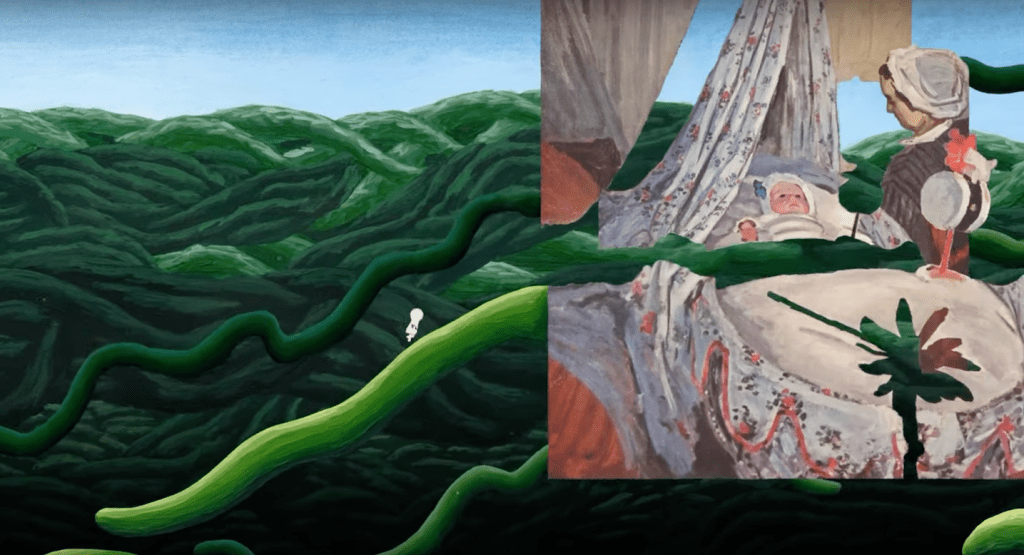
The title can be interpreted as a pun, because pupil means both “a student” and the “center of the iris of the eye.” We need to hone both our intellectual and observational skills to advance in the game. While The Master’s Pupil references and reproduces some of Monet’s best known works, game developer Pat Naoum’s own artistic flair makes this game one of the most captivating and beautiful video games I have ever experienced. Naoum spent the better part of seven years hand painting every single element of the game’s backgrounds, characters and obstacles. The game is a work of art in and of itself, and its nuanced cultural and emotional storyline and challenging puzzles make it one of the more rewarding and thought provoking games I have encountered.
I highly suggest playing the game, which is available to download or stream online, but in the event that you are just interested in observing the lush and immersive gameplay (it is a cinematic and artful experience in and of itself), below is a playthrough of the game in its entirety.
Discover more from Artfully Learning
Subscribe to get the latest posts sent to your email.
 Artfully Learning