
Our DNA, the map of our genetic information (our growth, development, functioning and reproduction), is 99.9% the same for each and every one of the more than seven billion people living on Earth. That said, while we share common genetic bonds, our social, cultural and emotional experiences are unique. This duality is significantly addressed by two of the foremost figures in developmental psychology: Jean Piaget and Lev Vygotsky. The research of Piaget and Vygotsky signified that it is a combination of ‘Nature’ and ‘Nurture,’ that accounts for a person’s development. In other words, while we all have the natural ability to learn and develop, how we perceive the world largely depends on our experience and education.
Being that we are so similar in our genetic makeup, yet quite different due to our cultural variance, the way we address issues that affect health and well-being can be complex and problematic. One of the greatest stigmatized health related issues of the modern era is HIV/AIDS. The fact that HIV is a stigma among civilization is ironic, because a person who is infected can look and feel perfectly fine and may not even know they have the virus for many years. Furthermore, medical breakthroughs have greatly enhanced the prognosis and care for those infected with the virus. With medicine and regimen, an HIV-positive person can live a long and healthy life. In spite of all this, cultural perspectives of HIV/AIDS still discriminate against the individuals living with the virus. Judgemental viewpoints and lack of empathy for individuals living with HIV can be far more traumatic and damaging than the actual virus.
If there is one thing that should be made perfectly clear regarding nearly all physiological concerns, it is that viruses like HIV don’t discriminate and human bodies are ample hosts to these viruses despite a person’s gender, sexual identity, race, or economic status. It is this denial, coupled with sexual and racial biases, that contributes to the greater failure of HIV/AIDS awareness. Society’s struggle to come to terms with the social and cultural issues surrounding HIV/AIDS is clear based on the lack of empathy and understanding for those living with HIV.
While the culture at large is lagging to address these issues, the arts community has had a resounding impact in providing awareness and activism around HIV/AIDS. For example, The AIDS Coalition to Unleash Power (more commonly known as ACT UP) uses visual symbolism and creative expression to stage poignant public protests and interventions (such as ‘die ins’), which call for affordable healthcare and non-discriminatory treatment for people living with HIV/AIDS. Works of visual art by artists such as Hunter Reynolds, David Wojnarowicz, Felix Gonzalez-Torres, Martin Wong and the artist collective General Idea, symbolize the struggle as well as the resilience of HIV-positive individuals and cannot be discussed without mentioning the ongoing pandemic of HIV/AIDS.
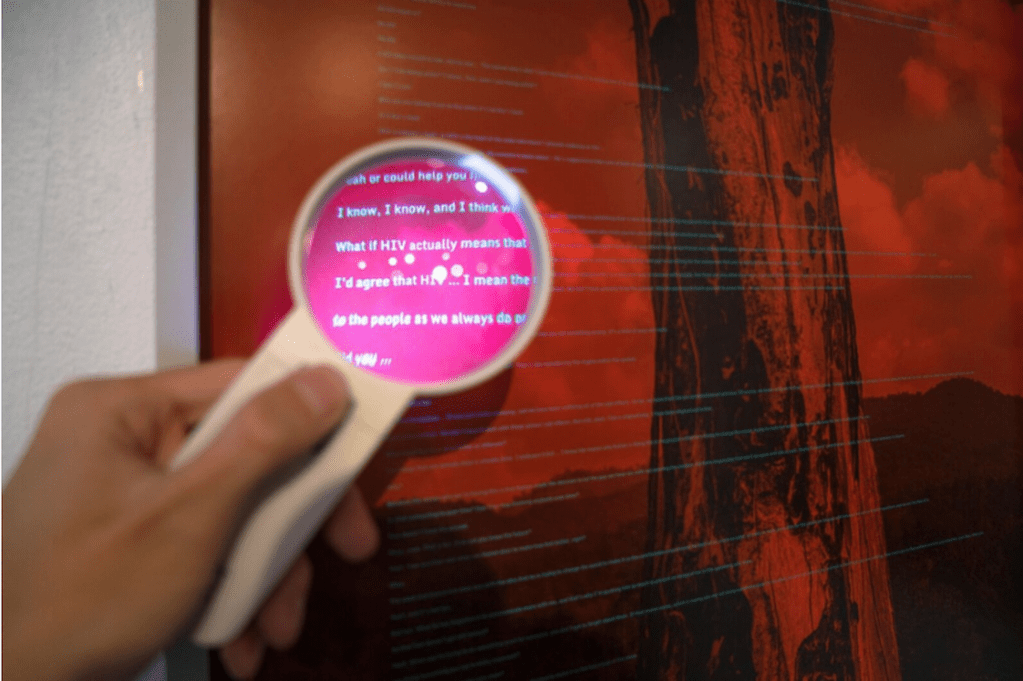
Kairon Liu’s “Humans as Hosts” is a conceptual art series that humanizes a diverse population of HIV-positive individuals through portraiture and storytelling. Liu has been communicating and networking with citizens of Taiwan and the United States in order to present their experiences living with HIV and reflect upon how it has affected their social, emotional, and professional lives. The title of the series has both symbolic and literal meaning, which is significant to the thematic perception. To be a host is defined, according to select definitions provided within several dictionaries as:
- Receiving others as guests.
- A living animal or plant on or in which a parasite, commensal organism, or virus lives.
Furthermore, according to dictionary sources (see: Merriam-Webster), the root of the word host comes from the Latin word, hostia, which refers to an offering, usually of an animal, as a sacrificial victim.
These definitions and the root meaning of host are meaningful in interpreting and discussing “Humans as Hosts” in both a subjective and literal sense. The subjects in the series assume the role as hosts on a social and emotional level, because by participating in the project, they are inviting the viewer into their personal lives. This hosting process includes their agreement to have their photographs taken, their stories written down, and their intimate items displayed to a public audience (both online and in art galleries). They are all hosts to the virus, although it has affected them in different ways. Their stories, the culmination of interviews conducted by Kairon, are both heartbreaking and inspiring. They remind us that humans have an inclination to survive and persevere even when things around them or inside of them seem bleak. Kairon’s impetus for “Humans as Hosts” has powerful autobiographical roots, which symbolize the cathartic nature of his artwork. He has expressed this sense of abreaction through the depiction of his alias, a man named “tree,” who overcomes heartbreak and betrayal to persevere, rebuild his self-esteem, and inspire others to value themselves. This is not just the narrative of survivors, but the story of courageous fighters.

While medical science has made several important advances in HIV/AIDS treatment, individuals who are HIV positive are still victims of ongoing emotional and physical affliction due to the virus. It is because of awareness and activism that the overall condition has improved for those affected by the virus. Both historically and presently, HIV-positive survivors have made significant sacrifices to fight for the equal, equitable, and just treatment of individuals throughout the world. As long as the virus continues to live inside of human hosts, these survivors will advocate for humane and holistic treatment. Art is just one of the many ways that activists have presented their condition to the world, however, it may be the most profound medium to inspire social and cultural change in relation to the AIDS pandemic.
Art has stood the test of time, and because objects of art remain long after the generation that created it, “Humans as Hosts” will preserve the memory and personal expression of each individual for future generations to observe and reflect upon. However, art’s most utilitarian function is to serve as an expression and account of the period it is created in, and in that sense, “Humans as Hosts” serves as a stark and vital reminder of the HIV/AIDS crisis and its effects on generations young and old. Hopefully in the very near future, an all encompassing solution for the HIV/AIDS pandemic will be realized. When it is, it will be in large part, due to the hard work and personal sacrifice on the part of artists and activists who are humanizing this global condition and raising our awareness, understanding, and empathy for our fellow human beings.
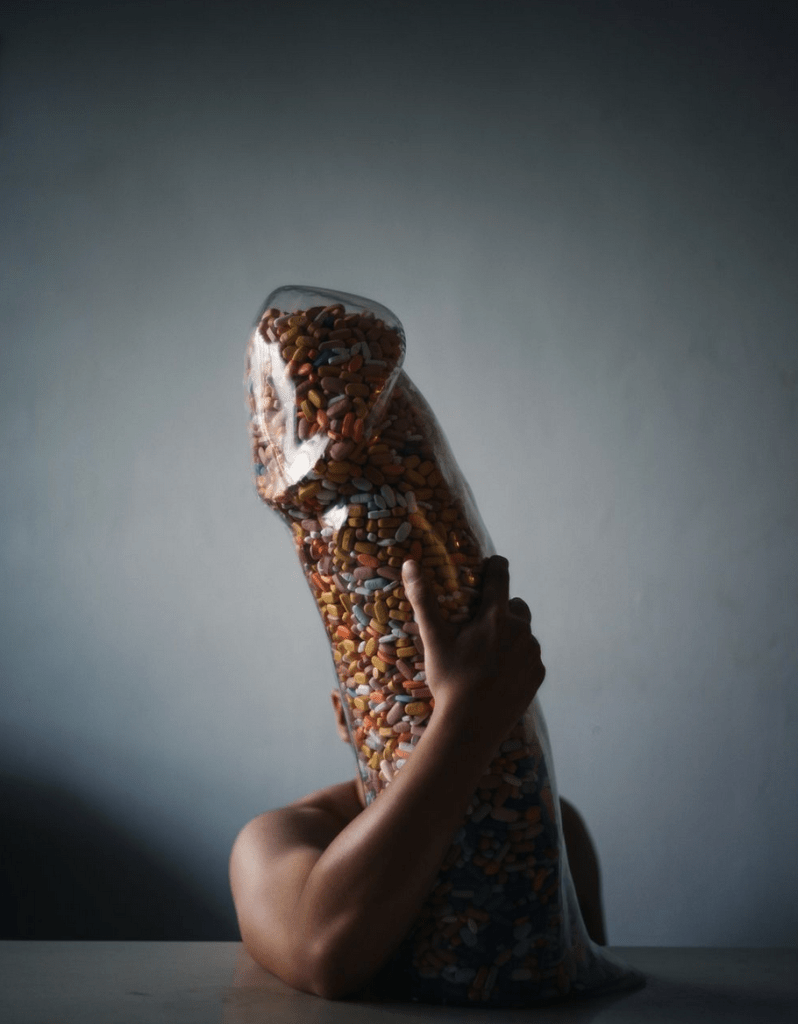
Kairon Liu’s work was one of several captivating images in the exhibition HIV Science as Art, which was on view at Metro Arts in Brisbane, Australia through August 5, 2023. Kairon’s contribution to the group show focusing on how artists and scientists have collaboratively advanced HIV/AIDS advocacy and treatment, is a symbolic self-portrait titled Untransmittable. It is an image that signifies scientific breakthroughs that have made HIV/AIDS non transmissible when treated with a strict regimen of medication and antiviral therapy. While these efforts are presented as giving people living with the virus a normal and stigma free life, the reality is far more complex. Kairon’s photograph expresses the darker and less discussed side of healthcare. Using artistic techniques like chiaroscuro, scale and perspective, Kairon communicates the burden people with HIV still endure despite more mainstream medical and sociocultural understanding about the virus.
At first glance, a large transparent phallus is evident. It is the focal point of the artwork. The phallic sculpture is filled with a medley of pills, representing the cocktail of drugs required for a person’s HIV viral load to remain undetectable and untransmittable. It takes a closer examination to notice Kairon who has concealed himself by posing behind the phallus. His arm, draped in a dramatic contrast of ambient lighting and shadowy darkness, wraps around the pill laden sculpture, thereby embracing the reality that the pills and constant medical treatment is a part of his persona.
For Kairon and many others living with HIV, the healthcare system provides arguably more challenges than solutions. While antiviral therapies and treatments exist, the economic and physical toll is another burden that immunocompromised individuals have to endure. Healthcare, while advanced, is expensive and exclusive in many developed countries. Inaccessibility to getting medical attention is a reality for a lot of individuals for reasons that include the high cost of prescription medicine and the laborious regimen required to treat HIV/AIDS.
In the period leading up to the exhibition HIV Science as Art, Kairon was paired with Kane Race, a professor researching the social science behind HIV treatment. Race studies the aforementioned reasons why healthcare for chronic conditions like HIV remain a privileged and stigmatized issue. He explains that “not only does the person living with HIV have to take one or more pills a day, but it’s also about going to doctors every few months and doing viral load testing” (quoted in Cullen, 2023). This is ostracizing to certain individuals due to a combination of bureaucratic, clinical and cultural conditions impacting access to these life saving treatments. Not only are the doctor’s visits, prescriptions and testing costly, but some national and local laws are prohibitive to certain communities, for whom the aforementioned forms of clinical surveillance could put their freedom and well-being in jeopardy. This prevents many communities and professions such as sex workers, drug users, immigrants awaiting visas/citizenship and anyone living with HIV in some parts of the world (i.e. places where homosexuality is criminalized) from managing their health. Kairon’s work of art addresses this confining duality, he notes that “I wanted to create this invisible wall between two categories of people – who are outside the community or inside the community; or who are detectable and who are undetectable” (Cullen, 2023).
Healthcare should be a collective endeavor, but it is treated as an individual responsibility. Until more united efforts are made to provide and extend care to all members of society, we are faced with the possibility that a day will come when we encounter a medical crisis that rips apart the entire fabric of civilization. This will be due to a combination of lack of compassion because of misinformation and widespread stigmatization, and the scarcity of treatments as a result of underfunded research and/or collective disregard. We do not need to look far back in history to see how this will play out, because with unregulated and minimizing responses to COVID-19, a virus that like HIV/AIDS (but far more contagious and communicable) has been found to have a long term impact on immune response at the cellular and molecular level (Demoliou, Papaneophytou and Nicolaidou, 2022), the great equalizing event is likely to come sooner than later. Exhibiting public displays of compassion and taking on socially engaged actions are as essential to the pandemic response as science and medicine.
Yale epidemiologist Gregg Gonsalves was involved in ACT UP during the 1990s and is currently a vocal proponent of better public COVID-19 mitigation and awareness. He notes that with HIV/AIDS, “we used street activism and protests and the power of art, our own policy papers…You just use every means at your disposal to keep pushing against the silence” (quoted in Simmons-Duffin, 2022). To alleviate the ongoing toll of HIV/AIDS, COVID-19 and any inevitable future pandemic, we will need to rely on a combination of logical and creative responses to ensure that humane and effective care and information is widely available and practiced.
References, Notes, Suggested Reading:
Cullen, Denise. “HIV Science as Art,” Cosmos Magazine, 1 August 2023. https://cosmosmagazine.com/people/culture/hiv-science-as-art/
Demoliou, C., Papaneophytou, C., Nicolaidou, V. (2022). “SARS-CoV-2 and HIV-1: So Different yet so Alike. Immune Response at the Cellular and Molecular Level.” International Journal of Medical Sciences, 19(12), 1787-1795. https://doi.org/10.7150/ijms.73134.
Pollack, Barbara, “Document, Protest, Memorial: AIDS in the Art World,” ARTNews, 5 May 2014. https://www.artnews.com/art-news/news/document-protest-memorial-aids-in-the-art-world-2431/
Race, Kane (2018). The Gay Science: Intimate Experiments with the Problem of HIV, United Kingdom: Routledge.
Simmons-Duffin, Selena. “Despite Effective Treatments, HIV drags on. Experts warn COVID May Face the Same Fate,” NPR, 19 April 2022. https://www.npr.org/sections/health-shots/2022/04/19/1093052484/despite-effective-treatments-hiv-drags-on-experts-warn-covid-may-face-the-same-f
Discover more from Artfully Learning
Subscribe to get the latest posts sent to your email.


This was very interesting to me! The art and photos are amazing as well. Thank you for sharing!
LikeLiked by 1 person