
It takes a lot of artistic skill and understanding of the human psyche in order to be successful as a performer for intergenerational audiences. Paul Reubens, best known in popular culture by his alter ego, Pee-wee Herman, made blurring the lines between highbrow and lowbrow culture and children’s and adult programming look easy in his art-centered career in comedy, film and television.
Reubens’ award winning series Pee-wee’s Playhouse was contemporaneous with my childhood upbringing. I played with the toys marketed after the show, echoed some of his most renowned catch phrases in social situations (“I know you are but what am I?!”) and had the audacity to live out my imagination under the influence of Pee-wee Herman’s distinct persona and propensity to think and act outside of the box; which is a habit of mind called “flexible purposing” that we learn from the arts (see: Eisner, 2002). Pee-wee’s Playhouse was derived from The Pee-wee Herman Show, which is similar in style but contained more adult themes and humor; although now as an adult I still prefer Pee-wee’s Playhouse.
The show’s main appeal came from Reubens’ unbridled ingenuity and playful expressiveness. Pee-wee was the epitome of an adult harnessing their inner-child. His enthusiasm for whatever the universe or society presented him with is testament to the necessity of art and play as a means for living a purposeful life. Whether he was exploring fantastical themes or simply dealing with quotidian occurrences, Pee-wee made each and every circumstance an extraordinary experience.
Creativity was at the forefront of Pee-wee’s environment and identity. His playhouse was a collaborative effort between himself and artists and designers such as Wayne White, Gary Panter, Craig Bartlett, Nick Park, Richard Goleszowski, Gregory Harrison, Ric Heitzman and Phil Trumbo. This was artistic direction and production like nothing the world had seen before on their screens. Bob Keeshan the creator and star of Captain Kangaroo (a predecessor to Pee-wee and Pee-wee’s Playhouse) paid his successor the ultimate tribute saying that “with the possible exception of the Muppets, you can’t find such creativity anywhere on TV” (Keeshan, 1996).
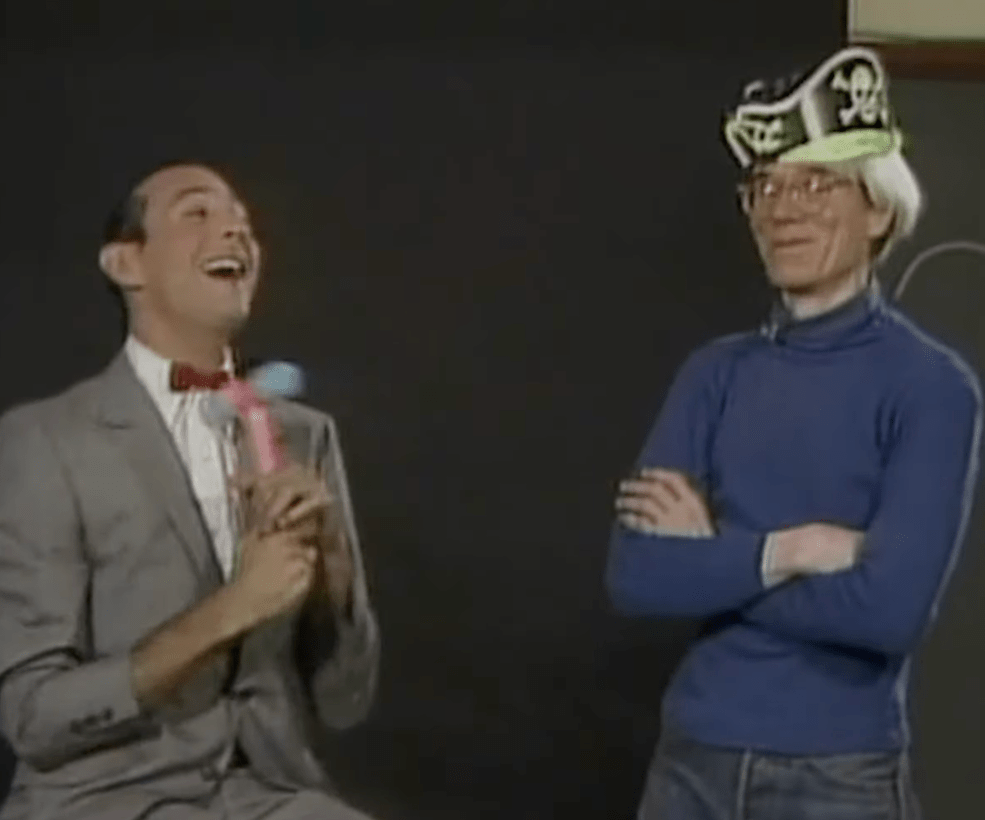
Reubens had a distinguished artistic background prior to creating Pee-wee. Starting at age five, he would act out plays with his siblings on a stage he asked his father to build. He studied acting at the California Institute of the Arts, which has a legacy of producing alumni who successfully integrate the serious undertakings of making art with a prevailing jovial attitude. As he was ascending up the ranks of comedy and show business notoriety, Pee-wee rubbed elbows with established art world figures, including pop artist Andy Warhol. In 1983 Pee-wee visited Warhol’s New York City studio as a special guest on Andy Warhol TV, where he bopped Warhol on the head repeatedly with a toy hammer, and discussed his arsenal of toys that he used during his stand-up routine with author and artist Maura Moynihan.
Pee-wee’s Playhouse is what some in the film and TV industry might call a “Trojan horse,” meaning that it contains a core concept of moralistic and pedagogical guidance under the auspices of entertainment. The pedagogy of Pee-wee is omnipresent throughout each episode. Cultural critic Keith Phipps (2014) writes that, “kids saw Pee-wee as one of their own, an excitable, fun-loving creature of impulse who delighted in wordplay and broad jokes, and lived for playtime. But he also doubled as a tour guide through episodes Reubens and the writing staff filled with lessons about safety, courtesy, hygiene, and other topics.”
Children growing up in the era of Pee-wee’s Playhouse tuned in each week to learn a variety of material and subjects and be entertained and embraced by a world of imagination and inquisitiveness. We bolstered our vocabulary in an embodied manner via “the secret word” segment, which began at the beginning of each episode with a word printed from a robot named Conky 2000. At Pee-wee’s prompting, we screamed loudly at our television sets every time a character uttered the secret word.
We were provided geography, astronomy and history lessons from Pee-wee’s inquiry-based interactions with Globey, an anthropomorphic globe puppet. The show was also formative for introducing myself and others to a variety of art forms such as puppetry and stop motion animation, and cartoons from the Golden Age of American animation (c.1920s through 1970s), which were presented by a vigorous character known as the King of Cartoons.
Like many people from my generation, I was raised on the pedagogy of Pee-wee. His famous catchphrase “I know you are but what am I?” was an assertive and witty retort to standing up to adversity and naysayers. Pee-wee was very confident about who he was, and he presented his own self-assurance in a manner that assured us all that it is powerful and beautiful to express our authentic identities, despite what others or mainstream culture might dictate as being the “status quo.” Going against the grain and being radically bold and unconventional, while showing empathy for others was Pee-wee’s forte. News surrounding his death feels like the end of an era. So today’s secret word is “gratitude.” I would like to emphatically yell out a heartfelt THANK YOU to Paul Reubens for helping us uncover our unbridled creativity and nurture our lifelong inner child.
References, Notes, Suggested Reading:
Eisner, Elliot W. 2002. “What can education learn from the arts about the practice of education?” The Encyclopedia of Informal Education. http://www.infed.org/biblio/eisner_arts_and_the_practice_of_education.htm
Keeshan, Bob. “Pee-wee’s Playhouse,” Entertainment Weekly, 22 November 1996. https://ew.com/article/1996/11/22/video-review-pee-wees-playhouse/
Phipps, Keith, “The Childish Genius of Pee-wee’s Playhouse,” Daily Beast, 14 April 2014. https://www.thedailybeast.com/the-childish-genius-of-pee-wees-playhouse
Discover more from Artfully Learning
Subscribe to get the latest posts sent to your email.
 Artfully Learning
He was a huge part of growing up in the 80’s, RIP. 😔
LikeLiked by 1 person