
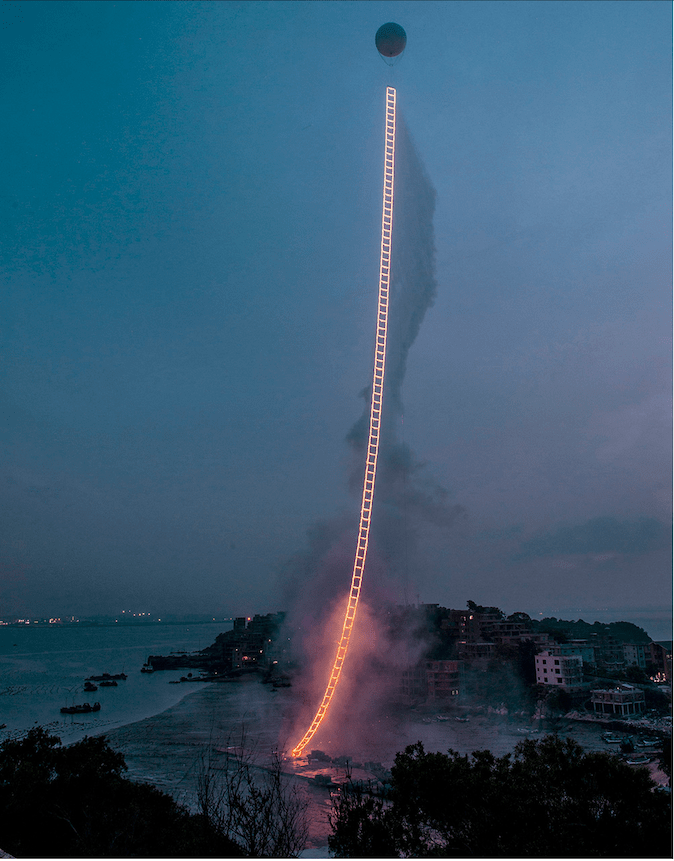
Photos by Lin Yi & Wen-You Cai, courtesy Cai Studio.
Summertime evenings are full of the sights and sounds of fireworks. These displays are a ubiquitous celebratory event throughout culture, but as art historian Janet Owen Driggs notes, “triumph and jubilation are just two of the fireworks’ affect layers. After the blazing peonies of light and color, the smoke arrives, trailing possibilities of pathos and loss….pyrotechnics can evoke a range of emotional, intellectual and associative responses” (Driggs, 2015).
Because of the aesthetic and symbolic impact fireworks have on our individual and collective psyche, they are a compelling medium for artists to utilize. Associating firework displays with empowering notions of identity and culture is the impetus behind works by contemporary artists like Judy Chicago and Cai Guo-Qiang.
In the 2016 documentary Sky Ladder: The Art of Cai Guo-Qiang, Cai asserts that “everyone loves to light fireworks.” The common phenomenon of watching firework displays is evident by the prevalence of events throughout the world. Cai’s use of fireworks not only provides entertainment, it also explores issues that have impact on everyday life and spiritual questions about existence. His commitment to making art that addresses social consciousness was spurred during the Cultural Revolution in the 1960s and 70s where burning of cultural objects and militaristic explosions were commonplace. He also makes references to the history of pyrotechnics and their importance throughout Chinese society, such as their use in medicine, science, philosophy and spirituality. Gunpowder, the key ingredient in fireworks, is one of the Four Great Inventions from ancient China (papermaking, printing, gunpowder and the compass). Therefore utilizing fireworks as performative and site-specific artistic events, and gunpowder as a medium for drawing and painting, signifies both the violent and celebratory aspects of pyrotechnic devices.
The aesthetic qualities of fireworks echo more traditional modes of Chinese art such as calligraphy and ink brush painting, which Cai was exposed to as a boy through his father who was a practicing artist and calligrapher. While these forms were important to Cai’s own artistic development, he wanted to find a personal methodology to express the rich cultural heritage of China, while connecting his art to the overarching human condition.
Traditional Chinese art has a strong association with philosophy, and represents the ideal relationship between the natural landscape, the cosmos and human civilization. Cai has both kept this tradition intact and expanded it by incorporating gunpowder as an artistic medium. An example is Sky Ladder (2015), a 1,650-foot tall ladder equipped with explosives and held aloft by a giant balloon, which was displayed in his hometown of Huiyu Island Harbor in Fujian province, and detonated in front of his family and friends. The artwork sought to create a link between the earth and the heavens, which has both overarching cultural connotations as well as personal meaning to Cai’s own life. In ancient China, Gunpowder was initially explored as an elixir for immortality, so in that regard, Sky Ladder was an allegorical gateway between the mortal and immortal realms. The artwork was specifically dedicated to Cai’s 100-year old grandmother who was too ill to attend the event, but was able to see it in real-time over video chat. She died a week later, making the attempt to forge a pathway to the supernatural world all the more affecting.
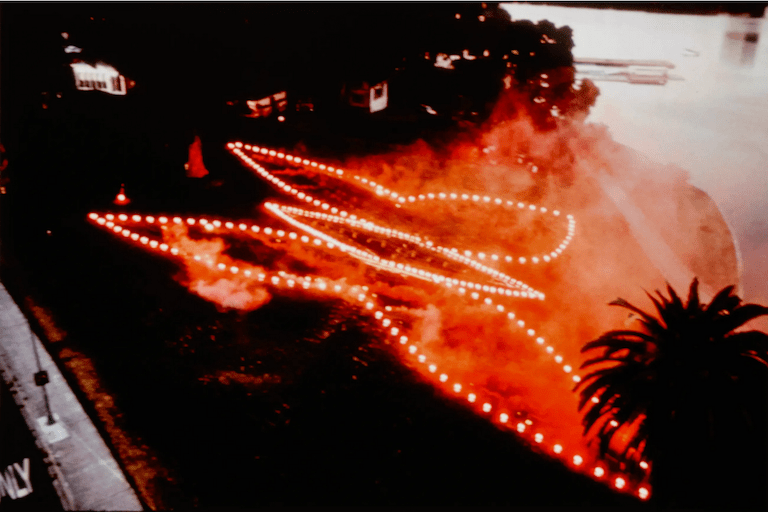
Judy Chicago started working with pyrotechnics and colorful smoke in the late 1960s, beginning with an ongoing series called “Atmospheres.” The focus behind the work is to communicate the connection between feminism and earthly phenomena. It was a direct response to the machismo attitudes Chicago perceived among the artists within the land art and minimalist sculpture movements. She was particularly critical of a show by Richard Serra at the Pasadena Museum where he made an installation using cut-down redwood trees. This sense of entitlement and lack of environmental consciousness to use endangered species as art materials motivated Chicago to develop a feminist and environmentalist centered approach to making and displaying art.
“My work represents a significant challenge to that of many of my male peers whose work involves bulldozers and other heavy equipment and leaves a permanent scar on the land…In contrast, I use environment-friendly smokes that create moments of intense beauty but leave no permanent marks” (quoted in Dinsdale, 2020).
A Butterfly for Oakland (1974) is one of Chicago’s notable works from “Atmospheres.” It was a seventeen minute pyrotechnic performance on the western shore of Lake Merritt which resembled a large butterfly in flight when ignited. The butterfly is a recurring motif in Chicago’s art that symbolizes transformation and liberation. She developed A Butterfly for Oakland using a combination of fireworks and road flares, which were then lit by hand to create a painterly composition of colored smoke. There have been similar performances in other cities such as A Butterfly for Brooklyn, which was presented in Prospect Park’s Long Meadow.
While actual firework displays are a dangerous endeavor that should be left to trained professionals, they are an engaging and informative medium to be discussed in the classroom. The Kennedy Center has developed a comprehensive lesson plan (see: Fireworks and Performance Art) for students to discuss the aesthetic, scientific and cultural motivation behind firework displays, and even design their own virtual pyrotechnic events using Kahn Academy’s fireworks simulator. Coincidentally, Cai and Chicago have also explored the art of pyrotechnics through a digital realm. Cai’s Sleepwalking in the Forbidden City (see: Gaskin, 2020) and Chicago’s RainbowAR (see: Waddoups, 2020) each use augmented reality as a less environmentally and culturally invasive means to spark joy and enlightenment.
References, Notes, Suggested Reading:
Dingsdale, Emily, “Pioneering artist Judy Chicago on turning her art to the climate crisis,” Dazed, 24 November 2020. https://www.dazeddigital.com/art-photography/article/51205/1/pioneering-artist-judy-chicago-turning-her-art-to-the-climate-crisis-atmospheres
Driggs, Janet Owen, “The Fine Art of Fireworks,” KCET, 2 July 2015. https://www.kcet.org/shows/artbound/the-fine-art-of-fireworks
Gaskin, Sam, “Cai Guo-Qiang Explodes Fireworks Over VR Forbidden City,” Ocula, 21 December 2020. https://ocula.com/magazine/art-news/cai-guo-qiang-shoots-vr-fireworks/
Waddoups, Ryan. “Judy Chicago’s Atmospheres Enter the Digital Realm,” Surface, 11 November 2020. https://www.surfacemag.com/articles/judy-chicago-atmospheres-app/
Discover more from Artfully Learning
Subscribe to get the latest posts sent to your email.

