
Summer is here throughout the Northern Hemisphere, and with its arrival is a much needed break from traditional schooling. Enjoying time outside while playing and socializing with friends is a great way to take in the warmer weather, while also learning and developing skills such as creative and critical thinking. Avid readers of Artfully Learning know the benefits of learning through play and recreational activities, as well as the importance of having dedicated public spaces that promote intergenerational activities and leisure (if you need a refresher, check out the archives for posts about playful learning and parks).
If you are looking for low-key, all-ages summer vacation ideas, especially day trips or even just a quick jaunt through the neighborhood, then public parks are generally an engaging and memorable experience. Because of their size and location, parks are a great way to take in the culture and ecosystem of diverse geographical regions.
This post highlights three public parks that are dedicated to the legacy of specific trailblazing artists, and have features inspired by their artwork.
Frida Kahlo Park in Coyoacán, Mexico City
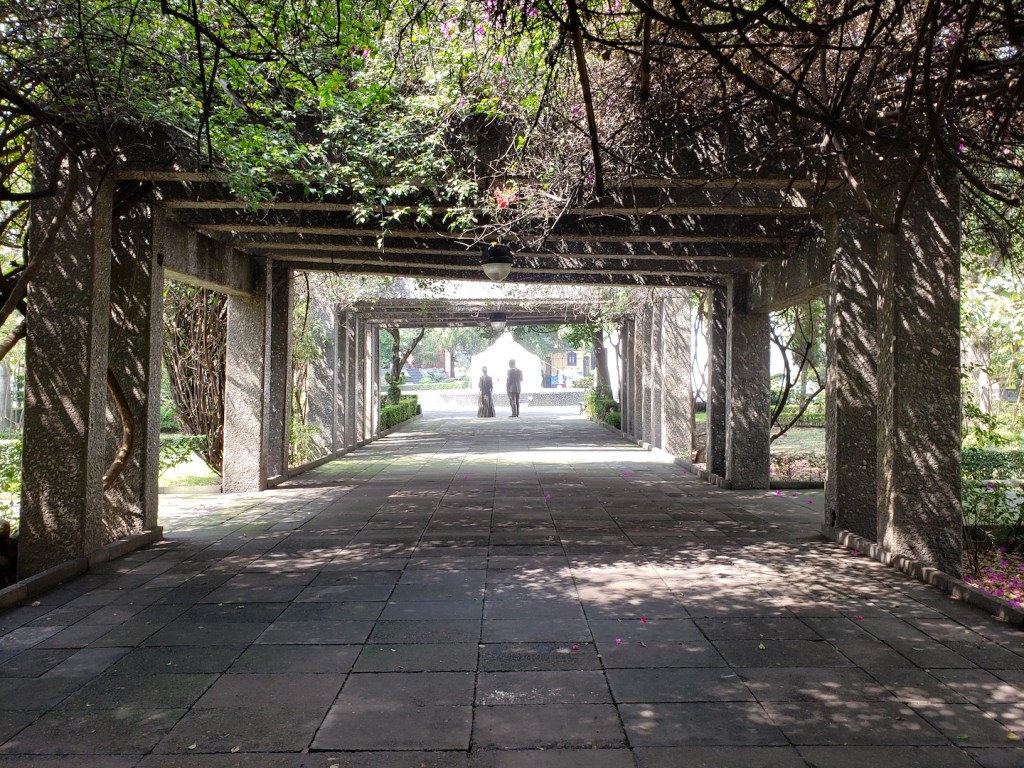
Coyoacán, is a borough in Mexico City that is known for its contributions to the arts and bohemian culture. It is a very popular destination among tourists because it is the site of Frida Kahlo’s home and studio, Casa Azul. After visiting the artist’s former home, which is now a museum, you can take in some fresh air while strolling through Frida Kahlo Park.
The public park opened in 1984 and is a tranquil way to explore Mexico City’s ecology and creativity via several landscaped walkways, which feature topiaries in the shape of fauna. The park also contains bronze sculptures depicting Frida Kahlo and Diego Rivera, created by Gabriel Ponzanelli, a well known Mexican artist whose own artistic development and education is linked to spending time with Frida and Diego at their home and studio. As the story goes, Ponzanelli’s father, Octavio, was an artist and a friend of Kahlo and Rivera. Seeing that his son was also interested in visual art, Octavio arranged for Gabriel to live with them for a month when he was eight years old.
Romare Bearden Park in Charlotte, North Carolina

Photograph by Bz3rk, CC BY-SA 4.0 https://creativecommons.org/licenses/by-sa/4.0, via Wikimedia Commons
During the 1930 through the 1960s, Romare Bearden was one of the most prominent American artists. He was a leading artistic voice during the civil rights movement, and is renowned for his distinct contributions to the medium of collage.
Established in 2013, and located in the heart of the city’s downtown at 300 S. Church Street, Romare Bearden Park addresses the legacy of its namesake (who was born and spent parts of his youth in Charlotte) in a novel way. The park was designed by Norie Sato who is known for her public artwork and light installations. Sato interpreted several iconic forms within Bearden’s collages and paintings, which make use of bold lines, variations in texture and patchwork color combinations. These aesthetic elements create a sense of order and balance among the park’s different natural and human-made features.
The park’s synthetic and organic facets include two gardens, a courtyard of dining tables with chairs on a bed of crushed granite, a green field for hosting cultural events, a play area with interactive digital chimes including dance chimes and several waterfalls. The park’s Maudell and Madeline gardens are named after paintings by Bearden that were inspired by his recollections of Charlotte’s natural ecosystem and the gardens tended by a community members he noted were named Maudell Sleet and Madeline Jones (see: Gilmore, 2021).

Photo by Aidan Hunt, CC0, via Wikimedia Commons
The park also contains Spiral Odyssey, a large sculpture by Richard Hunt, who was a good friend of Bearden’s. In 1971, Hunt and Bearden became the first Black artists to have solo shows at the Museum of Modern Art in New York. The sculpture, constructed from welded stainless steel, is around thirty feet tall. Its reference to Bearden is twofold. Spiral was the name of a Harlem-based art collective co-founded by Bearden during the Harlem Renaissance to determine the responsibility and roles of Black artists within the civil rights movement. The title also reflects one of Bearden’s popular “Odysseus” series of paintings and collages inspired by the Ancient Greek poet Homer’s epic poem, The Odyssey. In Bearden’s reinterpreting of the narrative, he creates an artistic dialogue using symbols and allegorical content that connects Ancient Greece’s classical mythology with modern American Black culture.
The Jean-Michel Basquiat Fitness Court
at Pastor Willie James Ford Sr. Linear Park in Deerfield Beach, Florida
Courtesy of the National Fitness Campaign.
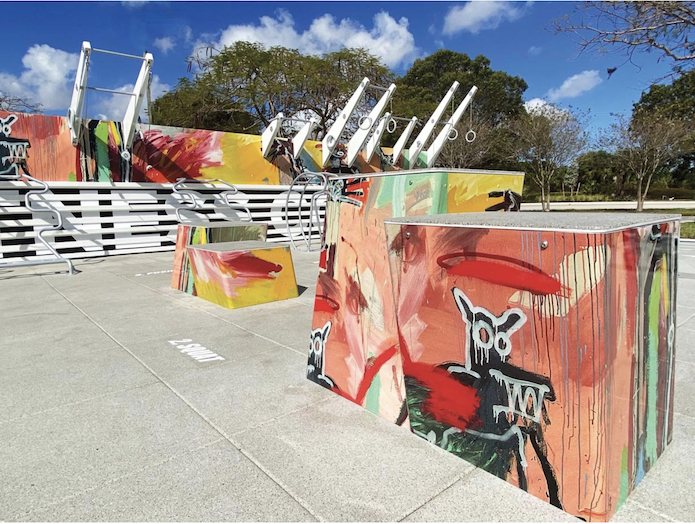
Reproductions of Jean-Michel Basquiat’s paintings on outdoor gym equipment within Pastor Willie James Ford Sr. Linear Park pay homage to the artist whose visionary work includes representations of Black athletes. The artful fitness environment is part of National Fitness Campaign’s Fitness Courts project.
Basquiat frequently portrayed major trailblazers within professional sports such as baseball player Jackie Robinson and track and field athlete Jesse Owens who each helped bring awareness to the overarching fight for civil rights and racial justice through their prowess in their respective sports.
The fight for racial equality is often an endeavor that takes a large physical toll, and boxing is a very common sports-themed reference in Basquiat’s art. Several paintings pay homage to champion boxers Cassius Clay (aka Muhammad Ali), Jack Johnson, Sugar Ray Robinson and Jersey Joe Walcott, who also were strong fighters for civil rights. Untitled (Boxer) is a good example of the merging of social justice and sports in Basquait’s art. An unidentified boxer raises his gloves and flexes his muscles as boxers often do when victorious. An additional interpretation of this gesture is that it resembles the Black power salute.
Basquiat employed athletic themes and subjects to express feats of personal strength and signify collective endurance and determination in overcoming major adversity. Presenting Basquiat’s imagery on fitness equipment is a symbolic and tangible means for toning and strengthening the body and mind.
References, Notes, Suggested Reading:
Gilmore, Glenda. “In Search of Maudell Sleet’s Garden,” Southern Cultures, vol. 27, no. 2: Spring 2021. Published online: https://www.southerncultures.org/article/in-search-of-maudell-sleets-garden/
Vianello, Filippo. “Jean-Michel Basquiat and sports art, an indissoluble bond,” Athleta, n.d. https://athletamag.com/jean-michel-basquiat-and-sports-art-an-indissoluble-bond/
“A Brief Survey Of Basquiat’s Boxing Heroes, Including Muhammad Ali, Vibe, 6 June 2016. https://www.vibe.com/features/editorial/basquiats-muhammad-ali-paintings-feature-426051/
Discover more from Artfully Learning
Subscribe to get the latest posts sent to your email.
 Artfully Learning
It is fantastic to see just how many parks have installed great artwork, sculpture especially.
LikeLiked by 1 person