
It might not be typical to think about commercial art galleries providing profound moments of art education. However, these types of art galleries can be beneficial spaces for us to experience how key principles of artistic pedagogy and visual arts are integrated and working in unison. Unlike some large museums, which have general admission fees, commercial galleries are free. Anyone can walk into them during their open hours (or make an appointment) without spending a cent. Although they might seem foreboding due to their corporate and economic driven principals, commercial art galleries are some of the most intimate spaces to view art and understand the art world.
While museums are often massive, crowded and contain an encyclopedic variety of aesthetics styles, historical periods and artists all at once; the art gallery is more compact, quiet and contained. Unlike the museum, these galleries are easy to absorb in one visit, and the roomy, yet uncrowded atmosphere prompts a more relaxed and hyper-focused contemplation. Galleries are also a great way to keep up with the overarching zeitgeist of the arts industry. Approximately each month is a new exhibition, featuring either the work of one artist, or a group show with several different artists. These exhibitions are reflective of artists, styles and themes that are at the forefront of the visual arts field. The fast-paced and trendsetting operations of commercial art galleries aligns with the final element of Harvard University Graduate School of Education’s “Eight Habits of Mind” (i.e. lessons that we learn through the arts), which is to “Understand Art Worlds.”
When I was beginning my training for a career in the fine arts, galleries were as much of a classroom as the actual classrooms within City College of New York (where I was getting my Masters in Museum Studies). The freedom to view art made by some of the leading contemporary artists at my own pace, and often in near solitude, is a mindful experience that enables me to be in the moment and become immersed by the form, function, content and context of the work on display. Being able to view art without too many distractions is a rare feat in this day and age. The benefits of deep and critical observation when in front of artworks can inspire transformative changes to our overall well-being (see: Mason, 2017). This alone is reason enough to implore everyone to visit an art gallery.
Despite the openness of the physical space, galleries might not be perceived as approachable, due to their associations with haughty lifestyles. There is an abundance of articles, discussions and forums critiquing galleries and gallery staff for coming off as impersonal and unhelpful (see: Farmer, 2014 and Kinsella, 2014). I do not associate this behavior with an aloofness or disdain towards the general public, but rather the status quo of the commercial arts business. Having worked in art galleries, I am aware that gallery attendants might be told by their supervisors to maintain this kind of composure, in order to uphold the idea that the art on the walls are unique and valuable. However, if you feel compelled to approach staff at the front desk with questions about the works of art, they will more than likely be willing to take the time and talk with you. I personally enjoy the freedom I have to myself when I am in a gallery, and therefore, I keep my communication to a minimum. If I have enduring questions after I have finished viewing, or feel inspired to discuss certain aspects of the work with the team behind its presentation, I will not hesitate to approach a gallery attendant. I usually strike up conversations with gallery employees about the artists and artworks prior to mentioning my role as an arts writer, curator and art consultant. Although, if I do mention my affiliation to the visual arts field, I am met with a different type of engagement and eagerness to ensure that I have ample information and context about the exhibition. There is definitely an advantage to being an “insider” within gallery settings. That said, I have witnessed local high school students entering a major commercial gallery in conjunction with an assignment for their art class, and being met with enthusiasm and cooperation from the gallery team. After all, quite a lot of people working in galleries experienced their own art educational journeys and can relate to the inquisitive nature and experiential learning process of art education.
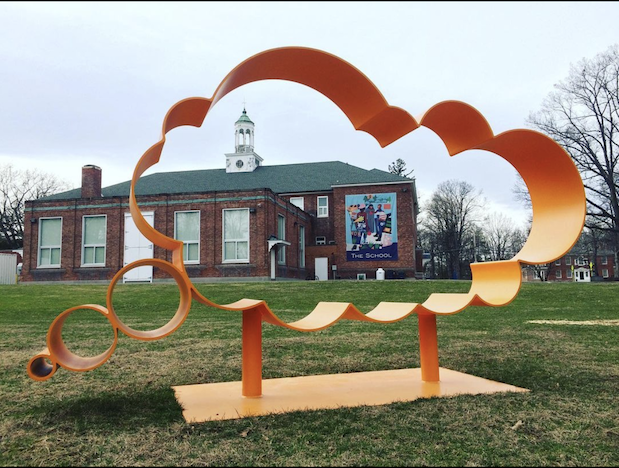
Image courtesy of Jack Shainman Gallery, New York.
There are galleries that go above and beyond to divert the preconceived notions of aloofness in galleries. In 2013, New York City based Jack Shainman Gallery opened an Upstate New York outpost called The School, which is a more experimental focused extension of their esteemed exhibition program. The name is both figurative and literal. It occupies a former high school in Kinderhook, NY, and is a distinct hybrid between the commercial gallery and museum blueprint. While Jack Shainman Gallery is considered a blue-chip commercial art space, it has always had a focus on social justice themes and cultural exchange. They are able to fulfill their commitment to the art market while organizing exhibitions and events that are ambitious, informative and thought provoking.
Another gallery operating between the commercial arts and community-centered art educational experiences is Wild Geese Gallery in New York City’s Upper West Side neighborhood. The gallery is within a block’s radius of The Children’s Museum of Manhattan. Although it is not specifically centered towards children, Wild Geese Gallery is one of the more apt gallery spaces for formal and informal artistic immersion, and is committed to fostering the development of aspiring young artists. The gallery’s multigenerational focus is ingrained into its foundation and operation. It is run by a mother and son, who are both artists and members of the community. Wild Geese Gallery serves as a studio space for its co-founder, Pearce Green, who can be seen working on his own paintings in between gallery shows. Additionally, exhibiting artists have similar opportunities to use the space as a studio and laboratory to prepare for their shows. The storefront offers passersby the opportunity to watch professional artists at work, and they encourage the public to come inside and interact with artists while they are in the midst of their creative process. Additionally, the gallery supports the work of younger and emerging artists by bringing in more established artists as mentors, and a film program that showcases the work of young local filmmakers. This is an excellent example of how commercial galleries can facilitate experiential educational moments, collaboration and community building.
If you are an avid reader of Artfully Learning you are familiar with my philosophy that the “artistic habits of mind” associated with making, viewing and discussing art have overarching benefits on practically every aspect of our daily lives. Art is ingrained within the fabric of human communication, behavior and culture. Critical observations inform our development of knowledge and moral judgements. Therefore, any discussions around a work of art are distinctly related to how humanity functions on a social, emotional and intellectual level. Commercial art galleries are not your typical community center or school. But as I mentioned in a prior post titled “The Gallery as the School?”, they are exploring ways that they can exist as both pedagogical and profitable frameworks. After all, the knowledge and joy that comes from artistic immersion is as valuable an asset as the blue-chip art objects on display.
References, Notes, Suggested Reading:
Farmer, Ann. “Visitors at Chelsea Galleries Encounter Cool Vibes, in More Ways Than One,” The New York Times, 1 September 2014 https://www.nytimes.com/2014/09/02/nyregion/galleries-in-chelsea-give-off-cool-vibes-in-more-ways-than-one.html
Kinsella, Eileen. “Snobbery in the New York Art World?! Say it Ain’t So!” artnet, 2 September 2014. https://news.artnet.com/market/snobbery-in-the-new-york-art-world-say-it-aint-so-90703
Mason, Jane M. “5 Ways Critical Observation Will Change Your Life,” Art in the Center, 20 February 2017. https://artinthecenter.wordpress.com/2017/02/20/5-ways-critical-observation-will-change-your-life/
Discover more from Artfully Learning
Subscribe to get the latest posts sent to your email.


A most interesting post. I enjoy a gallery which is not clogged with people, in order to reflect on the art, take time, and to relax in such an atmosphere. Here in New Zealand, most art museums create programmes especially with students in mind. These are immersive programmes where students can sit, and sketch chosen portraits (for example) and also respond to question sheets about the artist’s style, mediums used etc.,
LikeLiked by 1 person