
“The function of education is to teach one to think intensively and to think critically. Intelligence plus character–that is the goal of true education.” – Martin Luther King Jr.
This quote from Dr. Martin Luther King Jr. resonates throughout classrooms and communities. As human beings, we each have the ability to decipher fact from fiction, and learn to love and respect ourselves and other people. Since these are not innate skills, we must develop this combination of cultural, social and cognitive qualities through both intellectual and lived experiences.
Art is a crucial discipline for synthesizing knowledge and character, in order to present a visual vocabulary that evokes critical thinking and empathetic responses. It often prompts us to question our place within humanity and value the plurality of human expression. This is why the art we choose to pay attention to and consider important, reflects who we are as a collective society. It is essential for us to study our history, so that we can learn from it. However, we are doomed to repeat past mistakes and harmful ideologies, if we continue to give credence to subjects that uphold hegemonies. The prevalence of one type of subject, such as the overwhelming number of white men depicted throughout the European and North American canon of art history, illustrates both the types of people and communities that we value, and the ones we ignore.
On that note, I am pleasantly overwhelmed with the incredibly thought provoking responses I have gotten from both Turning the Dismantling of Monuments Into Teachable Moments and Turning the Dismantling of Monuments Into Teachable Moments, Revisited. A few of the comments and discussions I had with readers and colleagues have led to additional insights and pertinent examples of artists, artworks and exhibitions that aim to redress the wrongs of the past and present, by creating new visions for equal, equitable and justice driven commemorative public spaces.
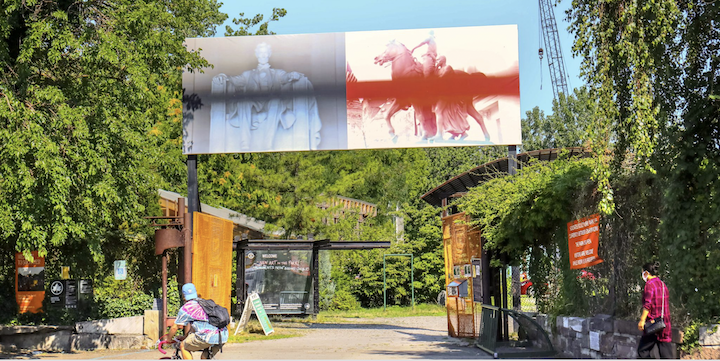
Installation image by Scott Lynch. Courtesy of Socrates Sculpture Park.
For the exhibition, MONUMENTS NOW, Socrates Sculpture Park, in Queens, New York, responded to the lack of diversity among current monuments by commissioning artists to create their own interpretations of monuments that honor underrepresented and marginalized histories and narratives. Artists, including Jeffrey Gibson, Paul Ramírez Jonas, Xaviera Simmons and Nona Faustine, each created a large-scale work of art that was displayed within the public park. Each artwork represented multifaceted perspectives on identity and paid tribute to diasporic, Indigenous and queer histories.
Two striking photographic images from Faustine’s My Country series, greet park visitors via a billboard elevated above the entryway. The photographs are visual critiques of some of the most iconic, yet contested monuments in the United States. Faustine applies abstraction and distortion effects to her photos, in order to shift our perspective and question who and what these monuments serve. On the left side of the diptych is a photograph of the large marble statue of Abraham Lincoln from the Lincoln Monument in Washington D.C. Faustine bisects the 16th president’s likeness with a blurry gray horizontal line. A metaphor for the vagueness about the realities of freedom and the lingering affects of racism, slavery and segregation despite the official historical narrative that Lincoln “freed the slaves.” On the right hand side, a vibrant, blood red line is drawn through the Equestrian Statue of Theodore Roosevelt, which stood outside the entrance to the Museum of Natural History in New York City for decades. Faustine’s treatment of the image is potent symbolism for Roosevelt’s orchestrated violence against Black and Indigenous people. The grainy red line that bisects the photograph alludes to blood splatter and cardiac flatline.
Gibson’s Because Once You Enter My House It Becomes Our House (2020) references the architecture of the ancient metropolis of Cahokia, the largest city of the Mississippian culture, a thriving pre-Columbian indigenous civilization in the Midwestern, Eastern and Southeastern regions of North America. The citizens of the city built monumental tiered earthworks (i.e. mounds) that served both spiritual and utilitarian purposes. Gibson’s colorful pyramid structure pays homage to the architectural forms, ingenuity and concepts of pre-Columbian mounds. Gibson constructed the monument using plywood and decorated the facade with posters that feature geometric design motifs referencing the Great Serpent Mound, an epic serpent shaped effigy created by the Mississippian peoples. The site was also a platform for cultural programming, such as Indigenous dance performances and tributes to the indigenous history of the land where Socrates Sculpture Park exists.
Jonas’ Eternal Flame (2020) is both a utilitarian monument that functions as a communal grill. It acknowledges the act of cooking as a socially engaged event, which expresses a blend of cultural identities, traditions and progressions. Its placement was especially significant in the borough of Queens, which has one of the largest and most diverse global populations of any urban locale. Throughout the borough, a person can practically eat their way through the world. A communal meal provides nourishment to the body, mind and spirit. Coming together, sharing recipes and culinary memories or narratives, is a great way to develop a significant understanding of other people and cultures. This transformative experience was exemplified throughout the time the sculpture was on display. Eternal Flame was open for the public to utilize with friends, family and neighbors. In addition, five local chefs were brought in to activate the artwork by preparing meals and providing their own professional insights about how cuisine is a valuable means for teaching and learning about cultural traditions and heritage.
Through an assertion of both individual heritage and a global zeitgeist, Eternal Flame represents the multifaceted identities of residents living in Queens, and the United States at large. It refutes the cooking metaphor that we are a “melting pot.” On August 25, 1970, author, James Baldwin and cultural anthropologist, Margaret Mead revealed the fallacy of this allegory during a conversation on race and identity (see: Popova, 2016):
“MEAD: It isn’t a melting pot, is it?
BALDWIN: No, it isn’t. Nobody ever got melted. People aren’t meant to be melted.
MEAD: That old image from World War I is a bad image: to melt everyone down.
BALDWIN: Because people don’t want to be melted down. They resist it with all their strength.
MEAD: Of course! Who wants to be melted down?
BALDWIN: Melted down into what? It’s a very unfortunate image.”
In reality, the United States is not a melting pot, but rather an amalgamation of diverse individuals who are living side-by-side with other heterogeneous individuals. Despite where a person ends up geographically they still retain and express their own cultural identity. The benefits of having a society with people from all walks of life is that they often share elements and insights of their cultural and social identity with their neighbors and community. This is a valuable form of experiential learning that builds self awareness for our own identities and the humanity of our fellow human beings.

Installation image by Sara Morgan. Courtesy of Socrates Sculpture Park.
Simmons’ installation, The structure the labor the foundation the escape the pause, consists of three text-based sculptures, which somewhat resemble chalkboards. This is apt, because they provide a revealing lesson on the past and present history of racism and social justice.
One of the texts depicts phrases from the 1865 Civil War military command, Special Field Orders no. 15, which granted recently emancipated slaves temporary access to land and federal protections. This part of the command is more commonly known as “40 acres and a mule.” Instead of providing much needed reparations for the years they were subjected to the brutalities of chattel slavery, this proclamation ensured that Black Americans would still be disenfranchised and unequal to their white compatriots. Special Field Orders no. 15 was effectively the United States’ version of a caste system, wherein the opportunities that Black individuals have had access to largely have been dependent on the rules manifested and enforced by a white supremacist hegemony.
The other text, is a contemporary compilation of calls for reparations to the descendants of Slavery. In unison, the content and context of the sculptures highlight the longstanding activism within marginalized communities to implement social and pedagogical shifts that reflect and acknowledge the historical and ongoing disenfranchisement of Black individuals.
In addition to the public artworks by renowned contemporary artists, an interactive sculpture, titled What’s Missing (2020) was collectively designed, implemented and exhibited by New York City high school students who took part in Socrates Sculpture Park’s Socrateens program. The students (Christopher Bisram, Johnaila Cole, Michela Farella, Sohit Gurung, Farzana Ibrahim, Anabella Orellana, Kate Panasci, Aneesa Razak and Laura Umana) chose to question how “public space and social constructs of visibility or invisibility can shape collective consciousness.” They examined this issue by framing the artwork’s outer walls with photographs of Christopher Columbus statues in New York City. The young artists cut out life-size spaces so that visitors can enter via Columbus’ silhouette. Inside, was a mirrored interior which symbolized a space for reflection. Seeing oneself in the midst of the missing monuments offers contemplation on the overall idea of monuments. The students prompted further assessment by doing field research where they interviewed community members regarding how they value monuments (i.e. what emotions they elicit and whether they felt the subject matter is representative or relatable to their own experiences), or whether they even think of them at all.
Another recent example of re-envisioned monuments, is the roving exhibition, Monumental Tour. The exhibition presents the work of artists Arthur Jafa, Hank WIllis Thomas, Kehinde Wiley, Christopher Myers and Coby Kennedy, each of whom envisioned and implemented public monuments that are a catalyst for civic discourses on race and social justice. The goal of the traveling exhibition is to foster cultural equity across various communities. According to Kindred Arts, a nonprofit arts organization who organized the exhibition, “Cultural equity embodies the values, policies, and practices that ensure that all people—including but not limited to those who have been historically underrepresented based on race/ethnicity, age, disability, sexual orientation, gender, gender identity, socioeconomic status, geography, citizenship status or religion—are represented in the development of arts policy; the support of artists; the nurturing of accessible, thriving venues for expression; and the fair distribution of programmatic, financial, and informational resources.”
I have previously discussed at least one of the aforementioned monuments in prior posts (see: Turning the Dismantling of Monuments Into Teachable Moments). In the interest of keeping things concise while still providing a spotlight for these important public artworks; I am listing a variety of contemporary monuments, in addition to those already featured, that are representative of broader sociocultural experiences, backgrounds and identities.
Building Minnesota (1990) and Native Hosts (1998-present) by Hock E Aye Vi Edgar Heap of Birds: Not many people may know about the largest mass execution on United States soil, which happened on December 26, 1862 in Mankato, Minnesota. After a controversial military commission, President Abraham Lincoln signed the death warrants for 38 Dakota men, who were hanged. The executions were a result of the Dakota War of 1862. These Indigenous men were condemned for defending their already scarce land after forced relocation efforts by the United States government left the tribal nation with scarce resources. Already suffering from traumatic treatment and an uncertain future, the Dakota people retaliated.
To rectify the lack of widespread knowledge about this tragic event, Heap of Birds, an artist from the Cheyenne and Arapaho nations, created a public memorial on the banks of the Mississippi River in Minneapolis, Minnesota. The artwork consisted of large metal signs that mentioned each Dakota individual by name. When installed along the riverfront, it became a site for mourning. Local citizens brought gifts in honor and remembrance for the Dakota men.
Native Hosts is another public art intervention that memorializes and raises awareness about Indigenous American history. Using metal signage, akin to road markers, Heap of Birds informs the public that the land they are standing upon was once the homeland thriving Indigenous nation. For example, Kansas was the site of Indigenous nations such as the Ioway, so Heap of Birds made a sign, which inverted the state’s name as a symbol of historical re-examination. Underneath the distorted name, it reads “TODAY YOUR HOST IS IOWAY.”

A Cypher in Queens (2018-2019) and Going Back to The Meadows, A Tribute to LL Cool J and Performance (2021) By Sherwin Banfield: These two multimedia sculptures pay homage to Queens’ history as a hotbed for hip hop pioneers.
A Cypher in Queens features busts of Jam Master Jay, Phife Dawg and Prodigy. Implanted within each work of art is a recording of their music. From 2018 to 2019, it was on view at Socrates Sculpture Park, which is just blocks away from the Queensbridge Houses where Prodigy and his collaborator, Havoc, formed the renowned hip hop duo, Mobb Deep. The lyrics “I never let a statue tell me how nice I am” are aptly and ironically carved into Banfield’s rendering of Phife Dawg (depicted on the right in the photograph above), co-founder and co-MC of the legendary hip-hop collective, A Tribe Called Quest. It is just one of the many philosophical musings from the duo who frequently explored, expressed and valued their identities.
Banfield revisited a similar concept for Going Back to The Meadows, A Tribute to LL Cool J and Performance, this time honoring LL Cool J. The site of the sculpture in Flushing Meadows Corona Park is significant because the hip hop artist performed iconic concerts there. Now, the beat goes on five days a week via a solar powered golden colored boombox that plays the rapper’s music from midday until to 5pm.

Images courtesy of the artist.
Exquisite Corpse (2017) by Fanny Allié: Using the collaborative framework of a popular art game, known as an exquisite corpse, this interactive sculpture represents a living legacy that honors the multifaceted identities and cultures of a community in Brooklyn (see: Exquisite Community).
Allié’s Exquisite Corpse is a participatory community-based sculpture, depicting life-size photographs of local neighborhood figures from the neighborhood of Clinton Hill. Each of the subjects depicted in the artwork had lived in the neighborhood for 25 or more years. The large format photographs of the community members were segmented and affixed to four large rotating blocks. While the work was on view (from spring of 2017 through spring of 2018), the public was invited to interact with the sculpture by turning the cubes to form composite portraits of physical elements from the community members. The exquisite corpse characterized the intergenerational and multicultural identity of the neighborhood. Allié’s intent was to “create a playful interaction between older and newer residents in this changing neighborhood.” The formal and conceptual aspects of the sculpture became a metaphor for the way a multicultural society can unite different cultures while still sustaining their distinct identities.
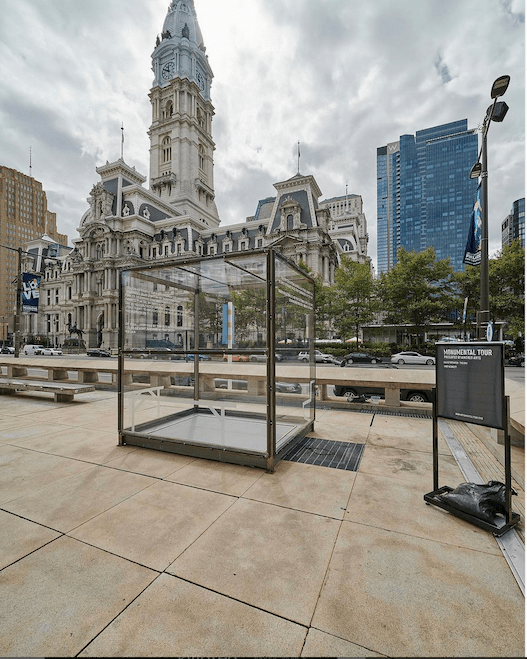
Kalief Browder: The Box (2021) by Coby Kennedy: An enclosure made of steel and glass sits within a public square nearby Philadelphia’s historic City Hall, where it is currently a part of the previously mentioned Monumental Tour. The sculpture pays homage to Kalief Browder, who was incarcerated in solitary confinement for three years without due process or a trial. His alleged crime was stealing a backpack full of valuable content, although this was never corroborated with reasonable proof. Two years after being released from jail, Browder hung himself.
The glass surfaces of Kennedy’s sculpture are etched with line drawings of a bed, barred window and toilet, which scantily decorate the bleak and callous cells in solitary confinement settings. Also carved into the glass are diagrams and text that critique the abuse of civil liberties, such as the maltreatment which Browder succumbed to, within the United States’ prison industrial complex.
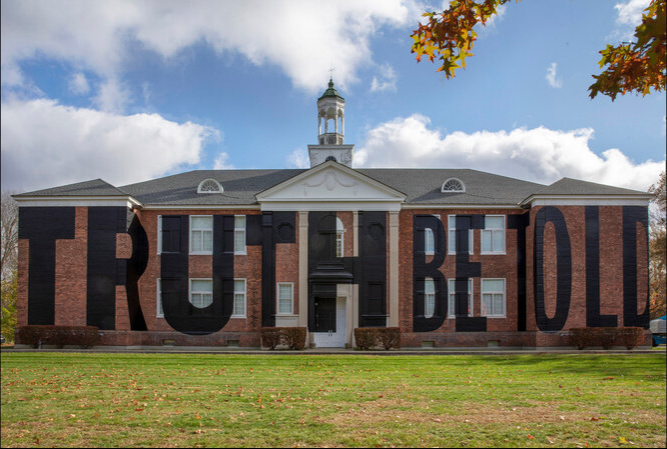
Truth Be Told (2020) by Nick Cave: Cave’s twenty-five foot high artwork, Truth Be Told, initially enveloped the facade of the Jack Shainman Gallery’s ‘The School,’ in Kinderhook, NY. Because of its bold statement, the artwork’s installation was the cause of local controversy (see: van Straaten, 2021). Among calls for the work to be censored, the work became a focal point for a renewed cultural discourse on public art, freedom of speech and art’s power for communicating political and social awareness. Gallerist, Jack Shainman, commented that “We are living in a moment when the distinctions between fact and fiction are often blurred,” and that “This work speaks to those concerns at an especially timely moment for our nation’s future, and while the words themselves may be simple, the message it delivers is anything but. I am proud that just as it was when it first opened, The School continues to be a place of learning, and perhaps today, of reckoning.”
Truth Be Told blatantly draws awareness and conveys a strong sense of urgency for a dialogue around social justice and democracy. It is the epitome of the current social, cultural and political climate where truth, facts and reality are called into question and perceived differently according to partisan demographics. This is all too jarring with regards to unsubstantiated statements, deceptive narratives and bald-faced lies from political figures and media pundits.

Sentinel (Mami Wata) (2020–2021) by Simone Leigh: Leigh’s monument to the African Diaspora was first publicly exhibited in Egalité Circle in New Orleans. The public plaza was once the site of a Robert E. Lee statue, which was removed in 2017. Mami Wata is a water deity, who is notable within West, Central and Southern Africa, as well as the African diaspora in the Americas.
Leigh’s monochromatic and fantastical interpretation of the mythological being sits at the base of the pedestal, below where the Confederate General Lee once loomed. The symbolism of the sculpture and its location is twofold. It stands guard against white supremacy, while representing the diversity of African culture and identity within the city of New Orleans.
The sculpture will be on view in Egalité Circle until July of 2022, but the site will remain a space for public art and activism thereafter.

Fons Americanus (2019-2020) by Kara Walker: Fons Americanus symbolically narrated the spoils of European imperialism, most notably via its exploitation of Africa and the Caribbean. The sculpture, while delicate and beautiful in its design, exhibited a very graphic scene of the Atlantic slave trade and the horrific legacy of slavery in the British colonies.
At the end of its yearlong display at the Tate Museum in London, Fons Americanus was destroyed (the materials used to make the artwork were all recyclable). The act of dismantling it communicates several enduring messages. First, that Black men, women and children who lose their lives at the hands of white supremacy will never get true justice because past and present history continues to devalue and erase them. And if they are portrayed, it is typically in a negative or stereotypical manner, which characterizes them as weak, menacing and/or inferior. Additionally, the destruction reflects the defining attitudes of social justice activists and the plurality of the populace, who believe that the ideals behind the monuments dedicated to racist and oppressive figures should not be memorialized.
As long as racism is ingrained in the mindset and experiences of the American population, a dialectic is needed to weed out its roots and progress toward an equal, equitable and justice driven society. This is precisely what the aforementioned artworks and educational movements like critical race theory (see: Lessons In Critical Race Theory From the Arts) seek to ameliorate. Perhaps, a good point to conclude is with a quote from Martin Luther King Jr. who said that “Freedom is never voluntarily given by the oppressor; it must be demanded by the oppressed.” These words reverberate as much today as ever before.
References, Notes, Suggested Reading:
Annamma, Subini and Stovall, David. “Using critical race theory to understand the backlash against it.” The Hechinger Report, 29 July 2021. https://hechingerreport.org/opinion-using-critical-race-theory-to-understand-the-backlash-against-it/
Popova, Maria. “Margaret Mead and James Baldwin on Identity, Race, the Immigrant Experience, and Why the ‘Melting Pot’ Is a Problematic Metaphor.” Brain Pickings, 26 March 2016. https://www.brainpickings.org/2017/05/24/james-baldwin-life-magazine-1963/
Schilling, Vincent. “The Traumatic True History and Name List of the Dakota 38.” Indian Country Today, 26 December 2020. https://indiancountrytoday.com/news/traumatic-true-history-full-list-dakota-38
van Straaten, Laura. “Nick Cave’s “Truth Be Told” Cannot Be Censored, Says Kinderhook Zoning Board in Unanimous Vote.” Hyperallergic, 4 February 2021. https://hyperallergic.com/619722/nick-cave-truth-be-told-vote/
Discover more from Artfully Learning
Subscribe to get the latest posts sent to your email.
 Artfully Learning
Some really interesting pieces. Is this exhibition ongoing?
LikeLiked by 1 person
“MONUMENTS NOW” closed last year. The “Monumental Tour” exhibition is currently in Philadelphia through the end of the month!
LikeLiked by 1 person