
The subway seems like one of the least likely places to be inspired in all of New York City, especially with apparently endless service delays, cuts and overcrowded conditions. However, if you allow yourself to look past the bureaucratic incompetence and exercise a flair for discovery, you will notice that the subway system is a living museum where New York City’s youth have had a major role in creatively communicating their place within the urban environment.
One of the aspects that keeps the subway system from feeling like a dystopia is its abundance of public art in stations throughout the Bronx, Brooklyn, Queens and Manhattan. There is work by some of the most influential Modern and Contemporary artists like Sam Gilliam, Nancy Spero, Elizabeth Murray, Eric Fischl , Faith Ringgold and William Wegman (who recently contributed mosaics of Weimaraners in human clothes). There is a concise Subway Art Guide, where you can view images and find out the locations of art within New York City’s subway stations.
While all of these great works by well known artists might inspire joy and contemplation during the hectic commute, it is the art of the city’s children that arguably provide the greatest sense of hope and inspiration. The city’s transit system is full of artwork that was realized by the imaginative and insightful nature of kids, both working on their own and collaborating with working artists. A previous Artfully Learning post, Collaborating with Kids: Problem-posing Models for Profound Works of Art, describes how the ‘Four Cs’ of 21st century learning: Creativity, Critical Thinking, Collaboration and Communication, are strengthened when contemporary artists and kids collaborate on projects. These social, emotional and cognitive skills are highly visible in the following examples of youth-centered artwork.
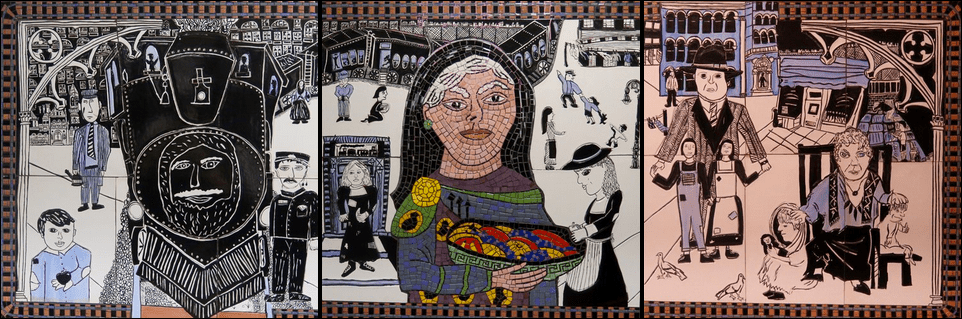
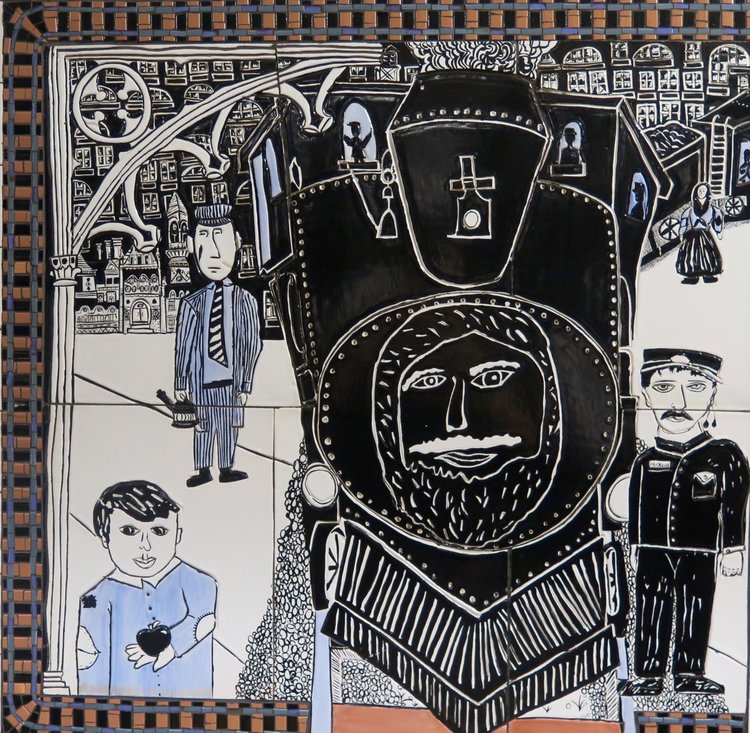
The Greenwich Village Murals by Lee Brozgol, located on the platform of the Christopher St.-Sheridan Square subway station (serviced by the 1 train), is an example of how, with the guidance and expertise of an artist, children learned to break down and synthesize complex ideas into symbolic images. Nine students in the 5th and 6th grade from P.S. 41 were selected to partake in this project with Brozgol. The students were prompted to make composite drawings that addressed the topic of identity by illustrating subjects that reflect iconography and actions that shaped the West Village.
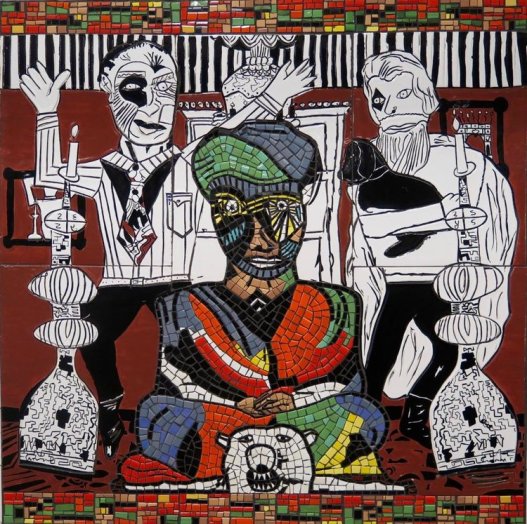
Choosing who to depict was a challenge. The history of such a vibrant community is a vast and multifaceted topic, therefore the figures depicted in the mural are diverse, spanning time, cultural backgrounds and ideologies. The murals are organized by themes, in which each of the figures are assigned. There are the ‘founders’ who include a member of the Lenape people and the 17th-century Dutch land developer Wouter Van Twiller, which considers the Village’s Indigenous and colonial habitation. The ‘providers’ include Mary Simkhovitch, an early 20th century social worker, city planner and co-founder of Greenwich House, which was initially developed to provide services to help the influx of immigrants adapt to life in the City. The ‘bohemians’ feature cultural icons like Mabel Dodge, a noted art patron who hosted a renowned weekly salon in her apartment at 23 Fifth Avenue. Lastly, there is the ‘rebels’ mural, featuring Thomas Paine, the author of Common Sense, a political pamphlet that fueled America’s War of Independence. Paine lived at what is now 309 Bleecker Street.
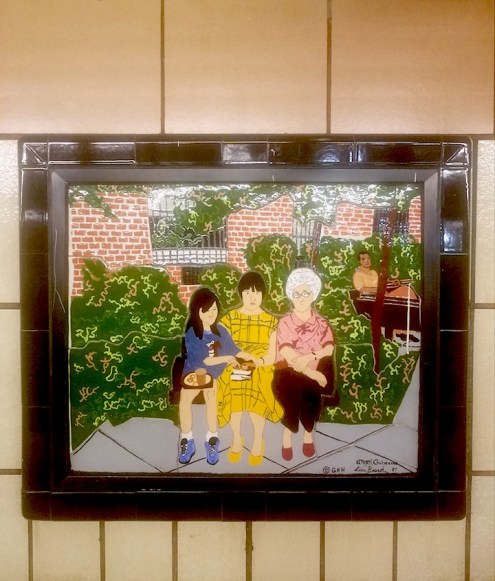
Another large underground display of student-centered art can be seen if you take the 1 train uptown to 86th Street. There you will find a station-wide collaborative art installation titled Westside Views (1989), by Nitza Tufiño and 17 young New Yorker’s, mostly from the Grosvenor Neighborhood House‘s school equivalency and educational program (The Grosvenor Neighborhood House was a local organization that began serving the community as a settlement house in 1916). The installation consists of 40 ceramic glazed tiles, each depicting an adolescent artist’s visual perspective of the Upper West Side. The tiles feature vibrant neighborhood scenes that celebrate diversity and community spirit. They portray prominent landmarks like the Hayden Planetarium (at the nearby Museum of Natural History), and intimate scenes such as two fathers strolling with their babies, three generations of women sharing food on a bench and children playing on the playground. Westside Views weaves together the colorful myriad of people, places and things that make a neighborhood flourish.
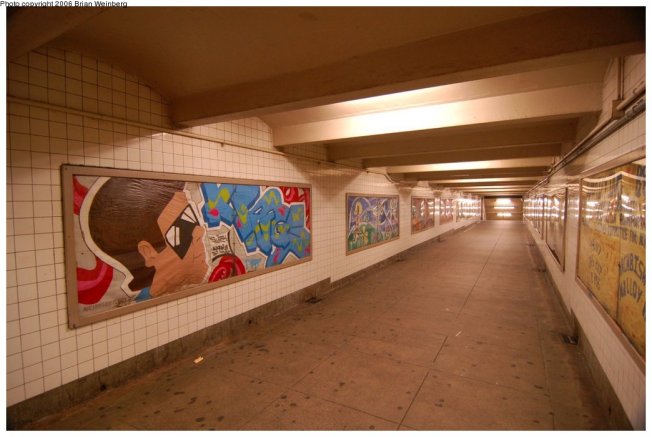
In Queens, students from Briarwood schools made statements on the theme of identity, through a series of mural paintings collectively titled Beautifying Briarwood (displayed at the Briarwood-Van Wyck Boulevard station, serviced by the F train). One of the most unique aspects about this project was that the murals represented the different phases of K-12 artistic development (see: Louis, 2005) because students of Archbishop Molloy High School, M.S. 217Q (middle school) and P.S.117Q (elementary school) all contributed to the paintings. Unfortunately the paintings were removed during station renovation in 2014, although some are archived through installation photographs. From the documentary photographs, it is apparent that these student realized works of art brightened up the dimly lit and monotonous corridors of the station. It also must have been efficacious for students to see their work in such a public setting and to share their symbolic works of art with the community.
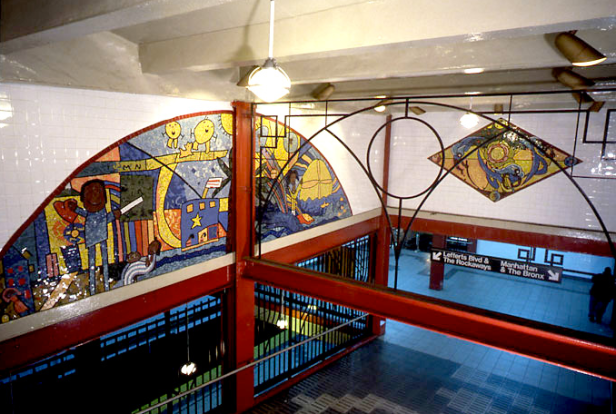
“They were the soloists, I was the orchestra leader,” Jimmy James Greene says about his monumental monumental mosaic mural Children’s Cathedral (1996) in the Utica Avenue station (Brooklyn, A train). The mosaic was created through a discourse that Greene had with local students regarding their modes of playing, learning, faith and cultural celebrations. Then Greene prompted the students to draw pictures based on the dialogue they had. The result is a whimsical and inspiring range of imagery including a mother nurturing her children, a teacher in class, and a large variety of activities performed by children (jumping rope, singing in choir, reading and more). Greene arranged and used the children’s drawings to create his final composition, which adorns the passageways leading to the train platforms.
Besides being great works of art for straphangers to enjoy, these aforementioned artworks reveal the benefits of artists collaborating with young people. The creative process involves many important habits of mind and skills such as making connections between art and daily life, interdependent learning and socialization. These habits of mind (see: Educating Through Art and Costa and Kallick, 1996) have lifelong benefits for developing creative and critical thinking. All of these projects required a cooperative and non-hierarchical structure that fosters teamwork and empowers young people to realize their abilities to communicate symbolically. Their visions provide both a respite for weary travelers and a way to express their place within the City they are a part of shaping and progressing.
References, Notes, Suggested Reading:
Bloodworth, Sandra, Ayers, William. 2014. New York’s Underground Art Museum: MTA Arts & Design. New York: The Monacelli Press.
Costa, Arthur L. and Kallick, Bena. Habits of Mind: A Developmental Series, Victoria: Hawker Brownlow Education Pty Ltd, 2004.
Landrum, Susan. “Subway Station Art: The 1 Train’s 86th Street Station,” Finding NYC, 29 May 2017. https://findingnyc.com/2017/05/29/subway-station-art-20/
Louis, Linda L. “What Children Have in Mind: A Study of Early Representational Development in Paint.” Studies in Art Education, vol. 46, no. 4, 2005, pp. 339–355. JSTOR, www.jstor.org/stable/25475761.
National Education Association. An Educator’s Guide to the “Four Cs.” http://www.nea.org/assets/docs/A-Guide-to-Four-Cs.pdf
Discover more from Artfully Learning
Subscribe to get the latest posts sent to your email.
 Artfully Learning
Happy new year Adam!!
Arlene http://www.arlenerush.com
>
LikeLiked by 1 person
Happy New Year Arlene!
LikeLike
The subway system as a living museum and a place for children to express themselves. Thanks for this illuminating article.
LikeLiked by 1 person
So true. 722 miles of tracks and over 300 works on permanent display! It’s one of the largest museums in the world, and I’m determined to see nearly all of it this year…Thanks for reading this post :)
LikeLiked by 1 person
Good luck with your artsy underground travels then!
LikeLiked by 1 person