
“You have this oasis, this beautiful place that we get to exist together.” These words were relayed to us from our fellow Earthling, astronaut Victor Glover, from aboard the Artemis II as it was traveling around the moon, approximately 238,855 miles (384,400 km) from Earth.
This statement was part of a personal reflection Glover was making on Easter, about the beauty of creation. The overarching tone of his message is that life itself is precious, and that although moments and events like the Artemis II mission are unique, all life on Earth is similarly miraculous in and of itself. He reflects that, “as we are so far from Earth and looking back at the beauty of creation, I think for me, one of the really important personal perspectives that I have up here is I can really see Earth as one thing.”
Most of us will not have the distinct experience that Glover and his crew had, but when it comes to observing and enveloping ourselves in celestial phenomena, we can turn to the time honored tradition of art. Artistic representations of the cosmos dates back to our earliest human ancestors. Prior to NASA and the space race, we already knew quite a bit about what was outside of our own Earth’s orbit due to observations and recordings from ancient artifacts, such as Mesopotamian tablets from around 3000 BCE, which mention the same constellations we are in awe of today.
Throughout human history art and science have been intertwined, and mutually important for our understanding and appreciation for our collective physical environment. Artwork depicts incredible phenomena and observations, like the cosmos, which can sometimes enhance and make scientific date approachable to the masses (see: “The Artful Balance Between Nature and Nurture”). Artists have a knack for capturing our attention and stirring up emotions and sensory experiences that encapsulate the human condition of life on Earth. Humans make and view art because we are naturally inquisitive and imaginative beings. Art gives us the platform and framework to communicate the vast amount of things we see, think and dream on a daily basis. Art also imparts the essential Easter message Glover expressed, which is that from his view, he visualizes our planet as in its totality, and that our existence is precious amongst the near-perfect vacuum of space.
Artistic responses to the cosmos express the value of human ingenuity and our collective identity as Earthlings. While we have vast differences in ideologies, customs and socioeconomic situations, we all see the same single face of the Moon (i.e. the “near side”). We all share this planet, and as far as we know, it is the only place where life like ours exists. Incredible moments like space travel reinforce the importance of bettering the quality of life for all living creatures on Earth. For all of us living in this moment, this is more than likely the only celestial object that we will occupy.
I have previously written about several juxtapositions of art and science that celebrate the beauty of the cosmos and our interest in space exploration. Galileo Galilei, who is probably the most fundamental figure in the canon of observational astronomy. He was also an avid artist, and his drawings of the moon are important as both science and art objects (see: “Rediscovering Astronomy”).
Some artwork, such as The Moon Museum, a minuscule ceramic wafer measuring just one half by three-quarters inches in size, that is inscribed with some of the world’s smallest-scaled artworks by Robert Rauschenberg, David Novros, John Chamberlain, Claes Oldenburg, Forrest Myers and Andy Warhol, might have actually traveled to the moon (for more details on this, you can read my post “Art Spaces: Interdisciplinary and Interplanetary Explorations Through Artful Learning”).
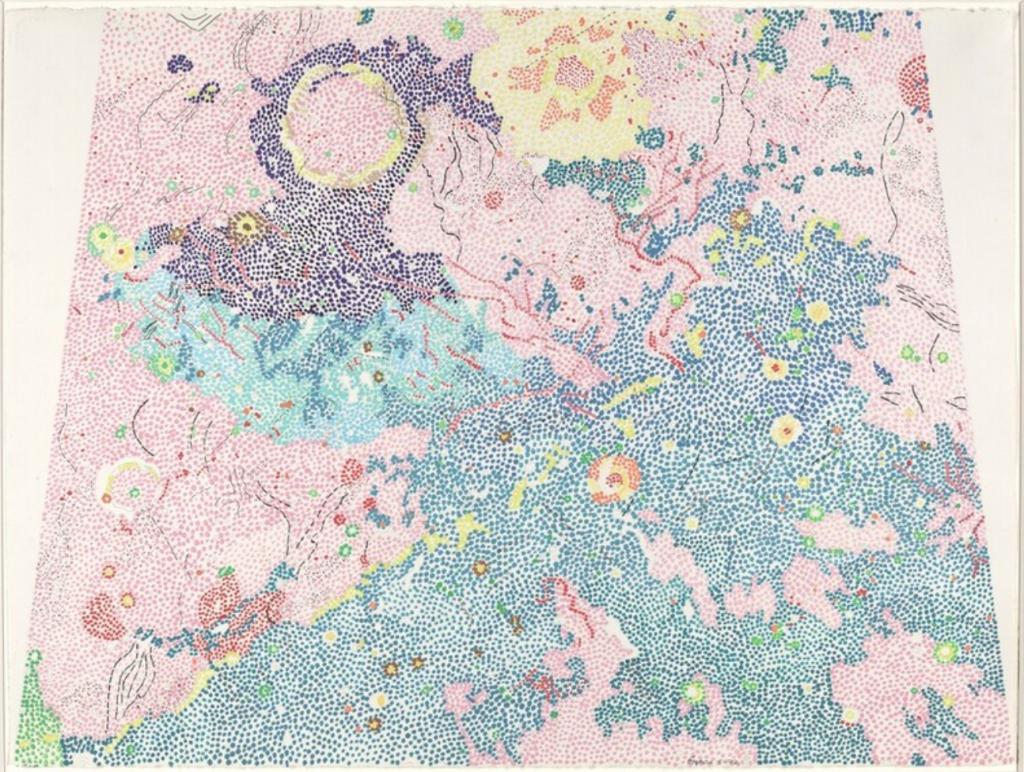
Another example highlighting the confluence of artistic and scientific ingenuity, are Nancy Graves’ drawings that aesthetically reflect technological progressions in cartography, such as satellite imagery of the Earth, Moon and Mars. Graves’ lunar series interprets the moon’s landscape as a work of art, by using a spectrum of pleasing colors, lines and forms to represent its topographic features.
The universality of art comes from our impulse to communicate expressively and explore connection between our lived experiences and the world surrounding us. This drive is distinct to human nature, and has existed across all human societies. Our ability to create and revel in art is exemplary of Glover’s realization of the Earth’s oneness. Art bridges seemingly disparate social and culture gaps; and illuminates the reality that our shared humanity is the most distinguishing element of our existence. It is our greatest responsibility to ensure that we sustain life on Earth by coexisting with one another.
Discover more from Artfully Learning
Subscribe to get the latest posts sent to your email.
 Artfully Learning