
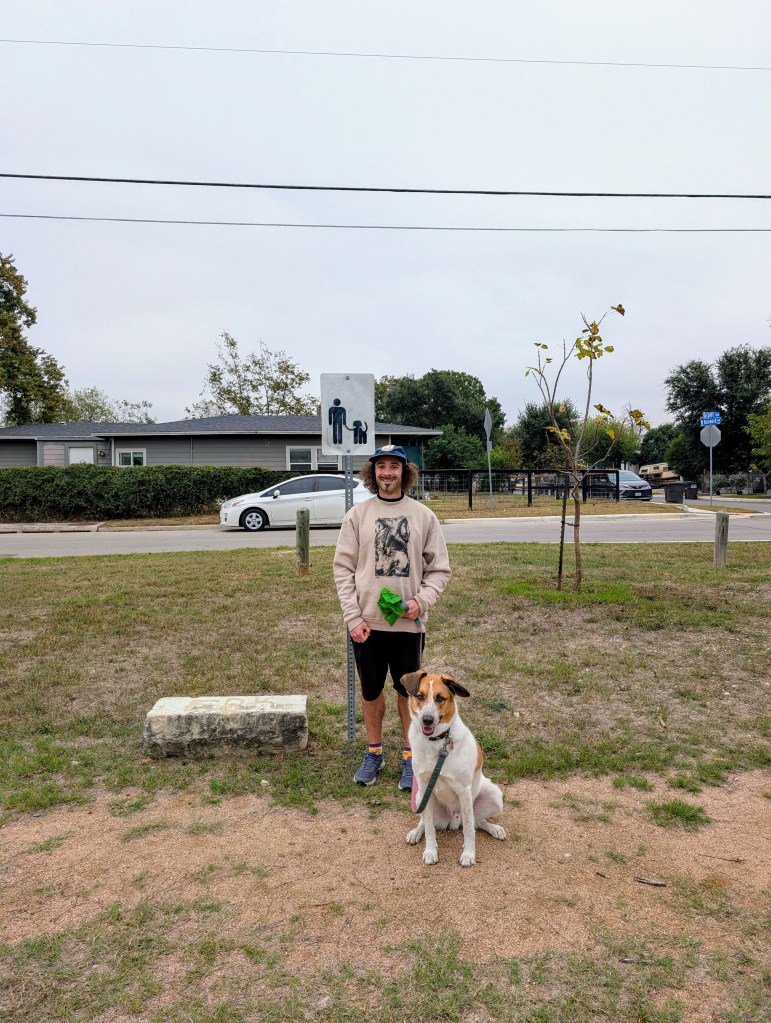
I never thought I would become a “dog person,” but three years ago, a somewhat spontaneous decision to adopt a puppy changed so much about my life. I refrain from getting too personal on this site, but since 2020, I have struggled with recurring OCD symptoms that have stifled and essentially put a halt to much of my personal and professional life. If you feel inclined to read more on my experiences with mental health struggles, I write more extensively about it on other platform, Artfully Exercising,
Long story short, I have had contamination-related OCD since the age of six; however the ongoing COVID-19 pandemic caused me to spiral into a worse state of mind than I have never experienced before with my condition. I am still struggling to figure out how I can regain a semblance of my mental fortitude. For the time being, I have not been able to enjoy the things I typically relished prior to the pandemic. My time is spent largely close to the comfort of home (although I am even triggered by OCD-related thoughts in my own personal environment) and almost exclusively in outdoor spaces if I do venture outside into the world.
On a late summer’s afternoon, my wife and I were walking along the waterfront in Williamsburg, Brooklyn. We decided to do a quick pop-in to a dog adoption event. Getting a dog was something we had in the very far periphery of our minds. It certainly was not the goal on that afternoon. But a very cute puppy changed all that in a fairly short amount of time, and we left Williamsburg with a five month old shepherd mix, who we named Palbert. We actually had no idea he was a puppy when we first saw him (he was already quite big!), nor were we all too prepared for what living with a puppy meant. However, what has transpired in the days and months since then has been a beautiful learning experience for us all. Today is Palbert’s third birthday.
For someone with severe OCD, Palbert has helped me in a fairly significant way; and I have been learning quite a bit about myself and the world in general from him. I am compelled to go outside more frequently because he needs (and thrives on) walks and socialization with other dogs (a la the local dog park). His acute curiosity and sensory awareness has taught me to be more patient and attentive to details, which is a skill that can always use refining in my opinion. Although he is not a service dog, my wife has mentioned the possibility of training him to become one, so that he can accompany me in the places were I feel most anxious and triggered by my OCD. It is efficacious to see how Palbert also feels safe, secure and joyful being with us. He too has developed a more confident persona.
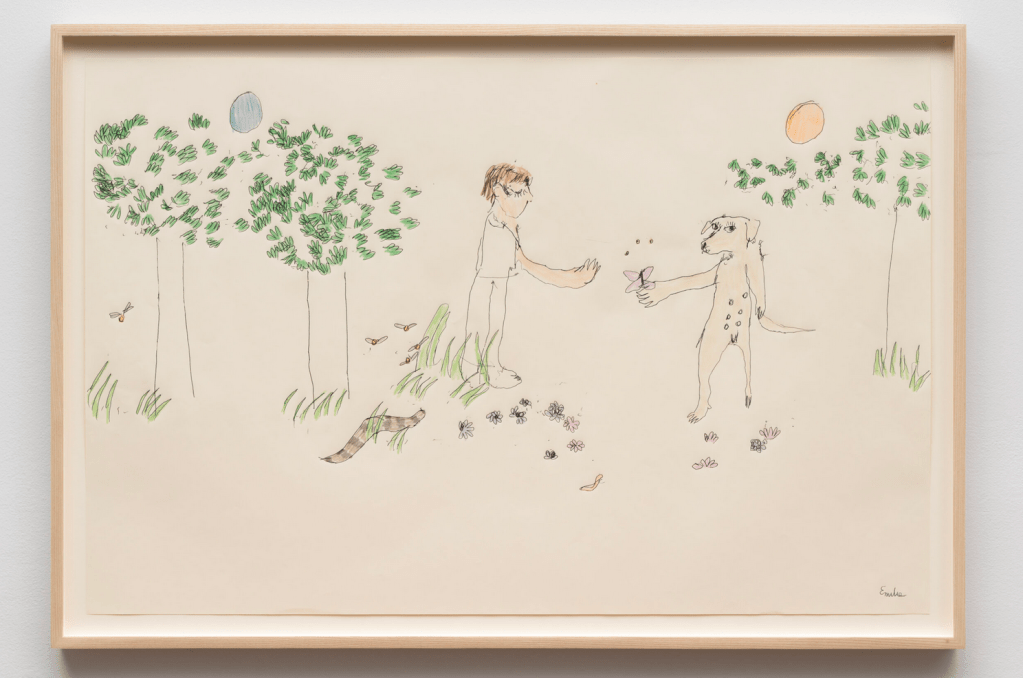
The companionship shared between human and canine is simply beautiful. Emilie Louise Gossiaux’s art, which pays tribute to her late guide dog, London, is the epitome of this mutual bond. In 2010, she was hit by a truck while riding her bike. The accident caused her to lose her sight. Gossiaux began to work in clay due to its tactile qualities (I previously wrote about the use of clay in community art workshops for blind individuals). She also developed a process of drawing that incorporates touching and feeling the lines and shapes as they manifest on paper. But the greatest transformative element in Gossiaux’s work was London’s presence and the impact that the time they spent together had on both of their well-being.
A service dog is an example of mutualism, because both the human and canine offer and derive essential resources within their symbiotic relationship. But with art, we typically only consider the impact it will have on humans. Gossiaux work is distinct in that she accounts for both the perspective of humans and dogs. Kong Play is a colorful spectrum of 100 clay sculptures that are modeled after the popular Kong brand of treat dispensing dog chew toys. The sculptures are arranged in an aesthetic display that Gossiaux considers to be something both a dog and person would find enjoyable. Kong Play assumes a utilitarian role with artful elements, such as color theory and clear signs of hand manipulation, which are in line with a human’s experience of art; as well as the concept of providing a situation that a dog would be elated by (i.e. being surrounded by toys that also are used to dispense treats). Whereas we typically consider human eye level (typically positioned with an object’s center being sixty inches from the floor), Kong Play is installed (currently at the Whitney Biennial) on low circular plinths at a dog’s eye level.
Gossiaux’s drawings envision an afterlife for our animal companions, and the lasting spiritual connection between us and our dogs. They embrace the process of grief, as well as feelings of freedom. An example is In Dreams We’ll See Again, where London, standing on her hind legs like a human, faces Gossiaux and offers her a butterfly. which is a symbol of transformation, personal growth and the soul’s journey.
The arts excel as means for coping with loss. Whether it is the loss of something functional, like our sight, or the passing of a beloved friend, family member or furry companion; art is a utilitarian medium for embodied learning and empathy. Arts integration of physical action and tangible interaction, bolsters personal understanding about our place within world, while also considering and identifying with others’ lived experiences.
Being able to express ourselves through forms of nonverbal communication is paramount to conveying messages, since it makes up approximately seventy to eighty percent of all communication. Art is one particular type of nonverbal communication, as are many of the interactions we share with our canine companions. For Gossiaux, the love language that was shared between her and London, inspired a process of lifelong learning. She professes that, “Understanding how to communicate with a dog and get in the mind of a dog has taught me a lot about empathy… And that bleeds into a lot of things”
Discover more from Artfully Learning
Subscribe to get the latest posts sent to your email.
 Artfully Learning