
Denying children their right to experience childhood is an action that should be unanimously considered an affront to humanity. Yet instances of modern day detainment and confinement of children within harsh and inhumane settings are plentiful. The myriad examples of artwork created by children in internment camp settings is evident that the human spirit is strong and malleable, even under the most extreme conditions. Having access to art materials enables these children to grapple with the bleakness of their situation through a cathartic process; and those who view their work become an empathetic audience that relate deeply to their story, and may further advocate for these children’s right to reclaim their childhood.
In many instances, adult activists have made an incredible effort to try and ensure that these children have any semblance of the childhood experience they are being robbed of. During the Shoah, Jewish-Austrian artist and educator, Friedl Dicker-Brandeis, organized art classes for children in the Theresienstadt ghetto, a hybrid Nazi concentration camp and Jewish ghetto in the Czech Republic. Dicker-Brandeis had been a successful artist and teacher at the renowned Bauhaus school prior to her own incarceration; and she was eventually murdered by the Nazis after being deported to Auschwitz in October 1944. Before she was sent to what she likely understood was a place she would not return from, Dicker-Brandeis packed an entire suitcase full of art supplies. These materials were intended to be shared with the children as a way to lift their spirits in such a dire and dark situation. Her artistic facilitation helped the children cope with their unsettling and uncertain reality, and by prompting them to utilize their imaginations, they created works of art that express hope, joy and an overall emotional transcendence from the miserable conditions inside Theresienstadt.
Simultaneous to the Nazi’s concentration camps throughout Western Europe; the United States forced Japanese-Americans into internment camps under president Franklin D. Roosevelt’s Executive Order 9066. In these facilities, art was a lifeline. Chris Ishii, Tom Okamato and James Tanaka were all well-established Disney animators prior to their incarceration. They were instrumental mentors for students including a sixteen-year-old named Ruth Asawa, who spent a majority of her high school years living in the confines of internment camps. Due to lack of resources, art classes generally involved creating art with found objects that were sourced from around the camp. This ingenuity and flexible resourcefulness anticipated her use of non-traditional art materials as a professional artist. When Asawa became a famous artist, she continued to focus on the communal aspects of art, such as organizing workshops and in-school art programs in San Francisco, California’s Bay Area.
Accounts of the current forcible internment of children at ICE/DHS detention facilities is demoralizing. All the more troubling are investigative reports, such as one from ProPublica, that young children and adolescents, who are already being deprived of their educational experience (both social and pedagogical aspects), are prohibited from utilizing art materials. The children in these contemporary internment camps had found some sense of solace through artistic expression, so this unwelcome information is gut-wrenching. The imagery that the children have been creating is reflective of similar things that the children in Nazi concentration camps and Japanese-American internment camps conveyed. Themes of individual aspirations and sadness permeate the drawings; as well as messages for the outside world. These works of art are first and foremost a form of personal expression for the young artists’ to release their emotions; but they also provide the public with insight into their traumatic ordeal. Perhaps the latter is why the art materials have allegedly been taken from them (despite DHS’ claims that no such confiscation occurred, their penchant for being dishonest and covering up their inhumanity, makes them a completely non-trustworthy entity).
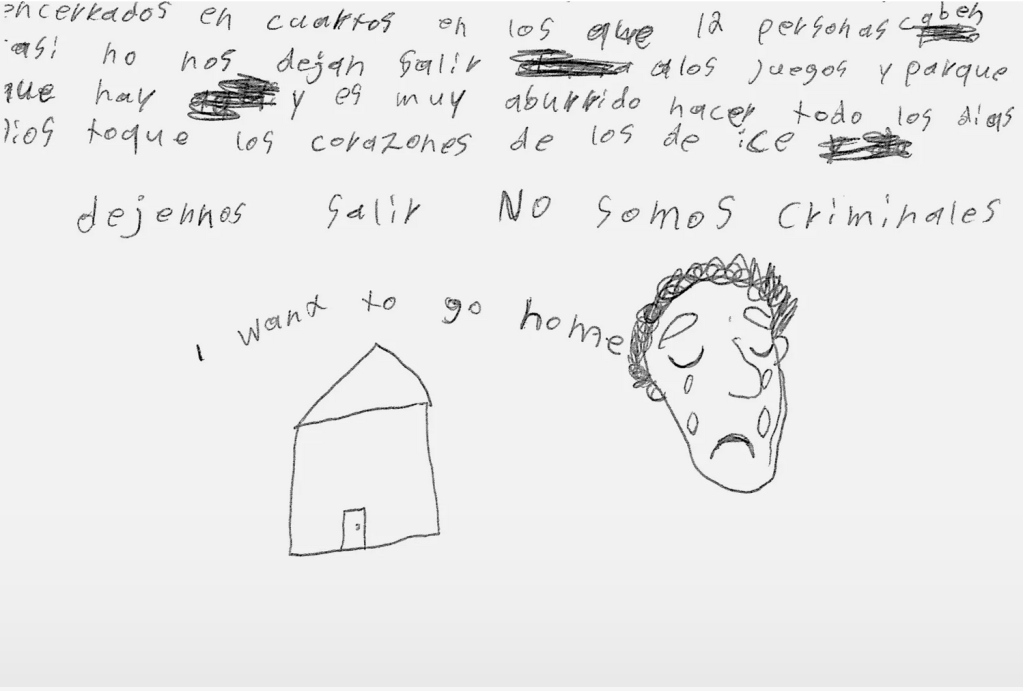
Looking at these drawings, you would have to be absolutely callous not to empathize with the children who made them. Thirteen-year-old Gerson Lopéz Garcia’s drawing is stark and to the point. On plain white letter paper, Garcia drew a simple icon representing a house. The house has a door, but no windows. On the right-hand side of the house is a grief-stricken head, with two large oval shaped tear drops descending from its eyes on each side of the face. Text above the drawing explains that: “We are all stuck in rooms that can hold twelve people they won’t let us go out to the playgrounds and park and it’s very boring to do every day God touch the hearts of those at ICE let us out We are not criminals I want to go home.”
The way these drawings look, gives me the sense that they were done with immediacy. Garcia’s use of easily recognizable symbols, as well as his writing that has words crossed out (showing a self editing process that was happening in the moment), suggests the sheer urgency of needing to record their experience. In most instances, we do not require complex and detailed renderings to feel the power and poignancy of an artwork or design. Art and design provide a nearly universal lexicon that immediately enables the viewer to comprehend what they are looking at. As artist and art critic Joshua Caleb Weibley writes (describing a different set of artworks created by children from Gaza), “the simple fact of a singular piece of paper that a child put time and creativity into is poignant by itself. That’s before even thinking about everything these kids have lived through.”
The emotional impact is undeniable. While the young artists provide content and context, it is the overarching expressions of childhood that make the drawings instantly relatable. We all can acknowledge that childhood is a distinct moment in our lives, which requires a balance of freedom to explore on our own and guided nurture from the adults around us. The children in these ICE/DHS facilities do not have these liberties and opportunities. Their traumatic experience is disrupting their essential phases of childhood development, and causing long-lasting trauma and other detriments to their health and well-being.
These children should be channeling their visual and linguistic expression in school, as well as in the comfort of their homes and communities. It is an abject failure of any so-called “civilized” or “democratic” society to deny them of their universal rights to experience childhood.
Discover more from Artfully Learning
Subscribe to get the latest posts sent to your email.
 Artfully Learning
Sigh.
LikeLike
Heartbreaking.
LikeLike
Indeed it is. It’s hard to be hopeful about anything in this world when the children of society are being traumatized and denied their rights to be children.
LikeLiked by 1 person