
Expressions of love, unity and collective empowerment are more effective than those of division and hatred. When communicated through grand artistic gestures, they have the potency to advance collective empathy, both through discourse and action. A recent example is how Benito Antonio Martínez Ocasio, aka Bad Bunny, used his platform during the Superbowl halftime show to amplify messages and movements of compassion and communal care, which evidently raised the spirits of millions of people across the world.
The sheer amount of reactions to his critical and uplifting performance represents both a qualitative and quantitative analysis of the impact it has had on society at large. The vitriol and push back has been far less prevalent than the praise and substantive discourse around the performance. But nevertheless, in the spirit of the ongoing culture wars, there have been some very biased and insensible remarks from individuals, such as remarks from Donald Trump, Randy Fine (a member of congress), Laura Loomer (a far-right social media influencer), Megyn Kelly (a media figure) and Mark Alford (another member of congress).
The common theme of the criticism was that Bad Bunny performed in Spanish, rather than English, which made it (in their words) “un-American.” As I wrote in a prior post about Bad Bunny’s half time performance, Spanish is a language spoken by one in seven people in the United States (the world’s second-largest Spanish-speaking country), and is far more prevalent than English when taking into account geographical America, which spans North, Central, South America and the Caribbean.
What made these claims even more egregious and uninformed was the context around each complaint. Trump called it “an affront to the Greatness of America,” which is puzzling because the overtones throughout the performance were themes of love and unity across the entirety of the Americas. If Trump is suggesting that those aspects are not what makes America great, then what does? His own messaging is replete with staunchly divisive and hateful rhetoric towards citizens within the United States and its neighboring North, Central and South American nations. As someone who has dragged the Kennedy Center for the Arts into the ground and, he does not come across as an expert in cultural happenings. The diatribe from Kelly, Loomer and Alford are each unsubstantiated and based in racial and ethnic bias. The fact that some members of congress are calling the performance “illegal,” and going so far as to investigate it (on the taxpayer’s dime) without any merit, which they go insofar as to admit, is an affront to our collective First Amendment rights, as well as our intelligence. The efforts to investigate and the intent to criminalize freedom of expression should be blatantly alarming to all citizens.
History is full of examples of nations that regard the arts and enable artistic dialogue to flourish being bedrocks of democratic activity; while governments that eschew and restrict artistic liberty, typically oppress its people as well. An example is the vast contrast in Ancient Greece between Athens, a city-state that valued art and democratic discourse; and Sparta, a city-state that regarded military prowess more than cultural capital. Sparta won a decisive battle against Athens, ending the influential Athenian Empire and establishing Spartan hegemony in Ancient Greece. However, their empire experienced extensive problems due to their oligarchical hegemony, which was highly unfavorable amongst its majority populace of subjugated Helots (whose forced labor was exploited by the much smaller, but powerful warrior class), leading to public resentment and a prolonged period of decline.
Of course, the arts did not cease to exist in Sparta. The work of Spartan artists and artisans has been well documented, exhibited and admired for its skill and aesthetic properties. There were famous poets, musicians, sculptors and expert bronze workers abound. But unlike Athenians, the role of the artist was not something that was as revered amongst the oligarchical ruling class. Agesilaus II, the most powerful and influential Spartan king, lived an austere life. When he was asked what was the greatest benefit the legendary Spartan hero Lycurgus bestowed on his countrymen, Agesilaus II replied, “Contempt of pleasure.”
The Spartans’ strict hierarchical social structure and its exploitation of its marginalized population, has been an influence on several subsequent governments, including the Nazi regime. Hitler was an admirer of the Spartans’ practice of racially based eugenics, militant form of governing and strict sociocultural dominance over their subjugated Helot population.
The United States has also been on a Spartan-esque path since its inception (a nation built on slavery and genocide); and the current right-wing driven culture wars have accentuated the sheer scale of its desire for advancing its ethnocentric Christian identity as the nation’s main governing force. People, historical events and cultural objects that the far-right considers to be critical of their white supremacist hegemony are thereby deemed as “illegal” or “un-American.” These accelerated demands to criminalize artists for expressing their First Amendment rights is a dereliction of democratic ideals and a sign of an authoritarian dictatorship. The behavior of the political right in the United States today is reflective of Hitler’s “Entartete Kunst” (degenerate art) movement, and even more recently, Augusto Pinochet’s stance against artists’ freedom of expression in Chile in the 1970s.
Pinochet, like Trump utilized systems within his own government to benefit and enrich himself significantly, while the working class endured economic inequality, slow and/or stagnated overall GDP growth and high inflation. Pinochet’s most vibrant opposition included Chilean muralists. The murals, which can still be seen in the city of Santiago, were created by Brigada Ramona Parra (BRP), an artist collective whose colorful modernist style featured symbols and themes in support of worker’s rights and other social causes that influenced Chilean culture during the late 1960s. BRP was supported by socialist president Salvador Allende, but after Pinochet superseded him in 1973 via a coup that was backed by the United States, the artists faced significant censorship and persecution.
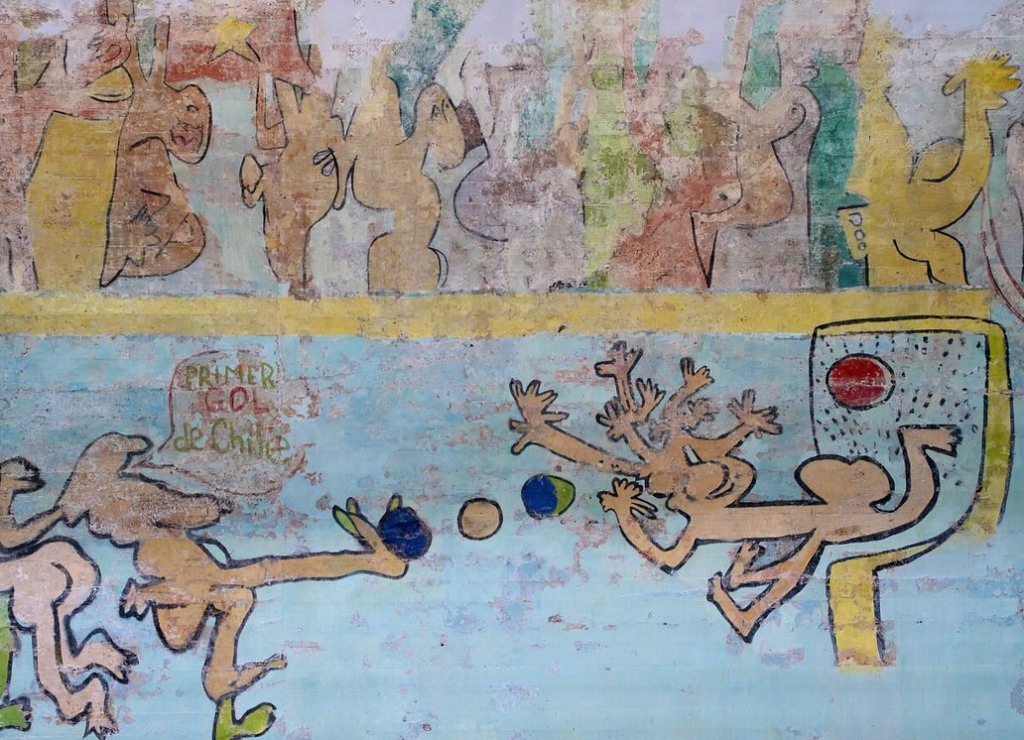
Due to censorship and iconoclastic actions from Pinochet’s regime, many of the murals are no longer in existence, but the ones that remain recount a vivid narrative of democratic socialism in Chile, serving as a reminder that efforts of mutual aid and collaboration by the people can be resilient modes of transformative change. The first Goal of the Chilean People is one such mural that is exemplary of the BRP’s style and messaging. Renowned Chilean modern artist Roberto Matta collaborated with BRP on the mural, which was painted on a municipal swimming pool in the La Granja district of Santiago. Stylized biomorophic shapes resemble human figures playing a game of football (soccer), and performing other cultural actions that are symbolic of Allende’s election in 1971, which brought about reforms to labor rights, public education and healthcare. Cultural historian Paulina Caro Troncoso notes that during Allende’s brief role at the helm of the Chilean government, the arts were valued for placing “emphasis on the redefinition of a local cultural identity.”
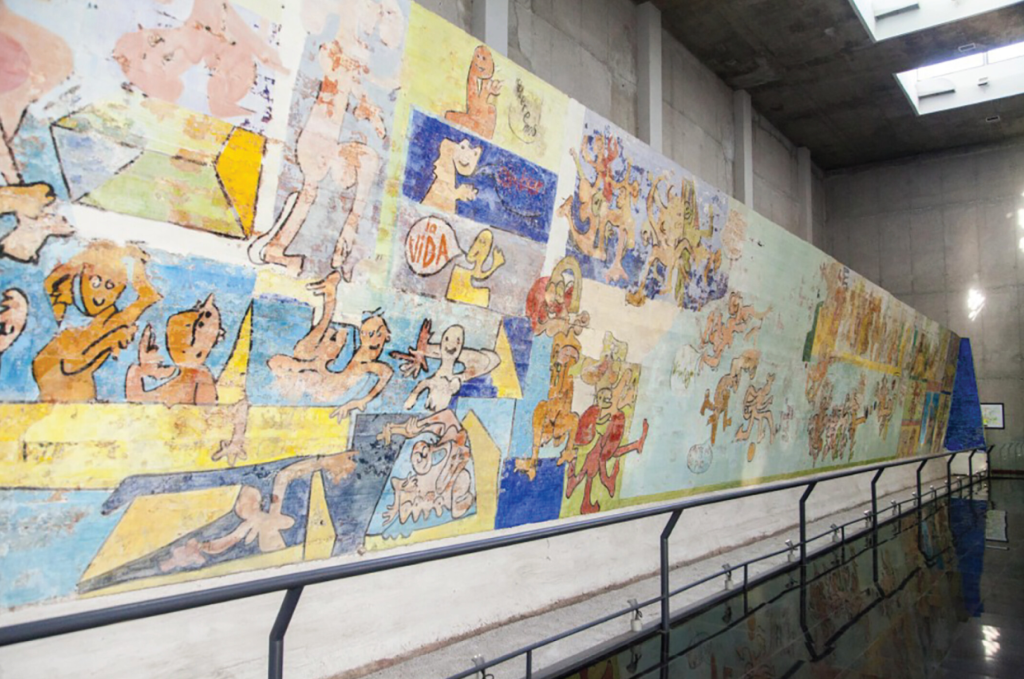
After rising to power, Pinochet’s far-right government covered The first Goal of the Chilean People with sixteen coats of paint. However in 2008, the mural was painstakingly restored and put back on display at the Centro Cultural Espacio Matta for the public to view once again.
The evidence that art generates pride and participation in civic identity and pluralistic perspectives, is indeed a threat to authoritarianism. However, despotic empires and individuals have fallen into historical obscurity and/or infamy, while works of art and artistic movements have stood strong for the entire course of human civilization.
Discover more from Artfully Learning
Subscribe to get the latest posts sent to your email.
 Artfully Learning