
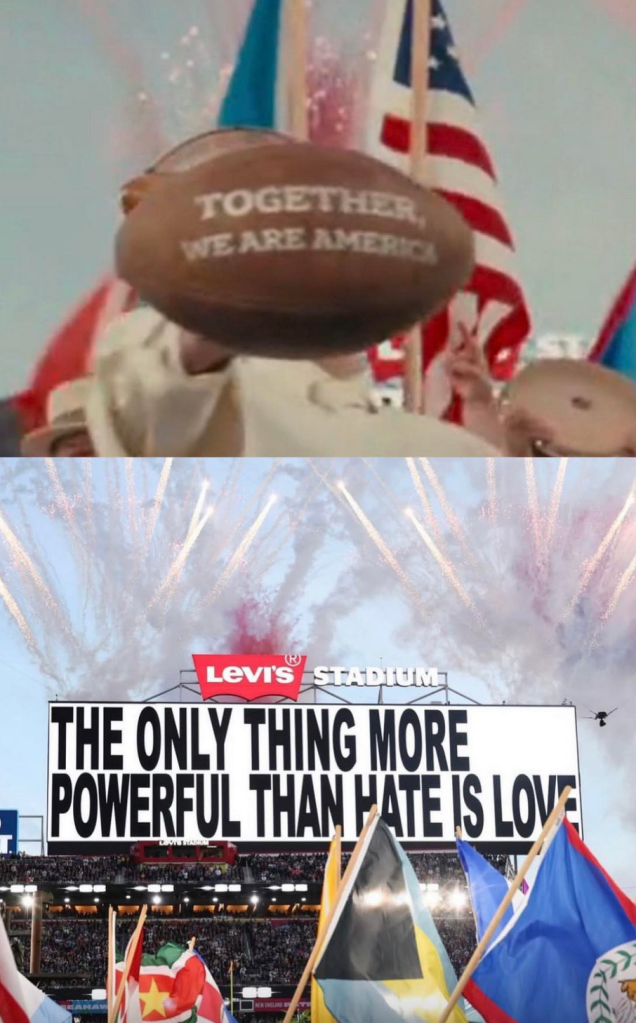
Having never listened to a song by Bad Bunny, and only being familiar with him through the media and word of mouth, his set for the Super Bowl halftime show confirmed the hype and acclaim surrounding him as an artist and individual. This was the best Super Bowl performance I have ever seen. It was clear from the discourse leading up to the event that the show would feature a lot of potent messaging about togetherness. Bad Bunny’s objective was to unite and engage in a display of pluralism, which he made evident through a stunning and vibrant exhibition of cultural diversity and communal spirit.
Unlike prior halftime shows, the lyrics were performed entirely in Spanish, a language that is spoken by the majority of Americans. Bad Bunny made what is evident even more explicit: America is more than the United States, it encompasses North, Central and South America, as well as the Caribbean. The breadth of America means that it is full of people with different backgrounds and identities, living side by side; and Bad Bunny artfully represented that array through a fusion of music, visual art and dance.
This performance was the antithesis of the rhetoric and actions coming from far right factions, including the Trump administration who has sought to vilify and denigrate any form of art that embodies America and its history as heterogeneous and complex. While partisan instigators have attempted to stoke outrage by othering Bad Bunny as a foreigner and “un-American” (a complete misrepresentation, as he is from Puerto Rico, which is a colonial territory of the United States, as well as a structural part of the North American continent), he has risen above their divisive fear mongering and presented an undeniable composition of radical love and inclusivity. It was quite convincingly, the most blatant display of American identity in Super Bowl performance history.
Patriotism is too often communicated and represented through pedantic statements, but Bad Bunny’s form of patriotism is far more open-ended and unconditional. It was a performance that embraces several empowering educational concepts such as Paulo Freire’s Pedagogy of the Oppressed, bell hooks’ teaching to transgress and John Dewey’s Art as Experience. Through specific signs, symbols and gestures, Bad Bunny is redefining the ideology of patriotism by expanding the concept of “being an American” to rightfully include Latino/a/x identities and nations. Viewers were treated to a vibrant expression of pride for Latin America, as well as a rebuke and criticism of colonialism’s harmful legacy.
Before delving into the dazzling set of music, dance and visuals, Bad Bunny began with a proclamation that would set the tone for the new American zeitgeist, stating in Spanish: “Good afternoon, California! My name is Benito Antonio Martínez Ocasio, and if I am here today at Super Bowl 60, it is because I never, ever stopped believing in myself. You should also believe in yourself. You are worth more than you think. Trust me.”
As for the performance itself, it was a work of art and enlightenment. The stage design expertly evoked the essence of Latin America and the Latin diaspora. There was the lush vegetation, reflected in both sculptural props and live dancers wearing costumes of field grass, and moving alongside other performers dresses as jíbaros (rural farmers) in pava hats, who paid homage to Puerto Rico’s agricultural legacy as sugar and fruit farmers. The initial natural landscape transitions to an urban setting, and included a familiar sight to those of us from New York, which are fruterias, bodegas and Latin social clubs.
While performing the song “NUEVAYoL,” Bad Bunny specifically featured one particular South Williamsburg Brooklyn mainstay, which is the Caribbean Social Club, a well known institution here in New York City, situated in the heart of one of the city’s most historic and thriving Puerto Rican neighborhoods. Places like this are more than local businesses, they are community centers where generations of city dwellers proudly congregate in celebration of their heritage. The Caribbean Social Club has survived in situ, despite threats to its existence do to massive overdevelopment, rezoning and gentrification efforts. The resilience keeping it open is community driven.
The song “El Apagón” (meaning “the blackout”) begins with Bad Bunny carrying a flag of the Free Associated State of Puerto Rico, which signifies independence from United States rule. He then mounts the flag and joins three dancers on top of telephone poles. These dancers are the same cane workers from the start of the performance, still wearing their pava hats, but now instead of working in the fields, they are working on repairing the power lines. The song addresses the theme of autonomy at large, with a particular critique of the privatization, corruption and neglect of Puerto Rico’s power grid, which leads to frequent island-wide outages. If you recall from recent history, the island was left without power for months after Hurricane Maria (some residents did not have power for around 328 days) in 2017. It was largest blackout in United States history and the second largest in the world. The incident was the consequence of a power grid that is vulnerable due to decades of crumbling infrastructure. The lyrics reflect the frustration for the island’s structural crisis, as well as a triumphant call for Puerto Ricans to reclaim their land and rebuild it through acts of love.
There are ample moments full of uplifting gestures. One particular instance echoes the pedagogical tone that Bad Bunny set his introduction, specifically his assertion that, “You should also believe in yourself. You are worth more than you think. Trust me.” This message comes full circle via a vignette of a family (a mother, father and young boy) gathered around a TV set watching Bad Bunny’s acceptance speech at the 2025 GRAMMYS. Bad Bunny enters the space and hands his GRAMMY over to the boy, which is both indicative of his own younger self, as well as future generations.
Bad Bunny ended his tour de force with a choreographed outro where he and his ensemble exit the field with flags from across the Americas. He belted out an emphatic “God Bless America!” and held up a football with the words “Together, We Are America” written across it, and the stadium scoreboard boldly projects the phrase “The only thing more powerful than hate is love.” This brand of patriotism challenges traditional, narrow definitions by embracing diversity, celebrating American culture, and addressing the vital process of social transformation through acts of radical love and empowerment.
Discover more from Artfully Learning
Subscribe to get the latest posts sent to your email.
 Artfully Learning
1 Comment