
Alt text (alternative text) is a descriptive form of text used to describe an image that appears online. The use of alt text is an indispensable method for making visual imagery more accessible, and is crucial for visually impaired individuals who use screen readers when online. It can also serve as a backup plan for when an image fails to load, and increase traffic to your site because it helps search engines rank images better in image search results.
Because one of the goals most artists and arts professionals have is making their work accessible and connectable to diverse populations, using alt text should not be an afterthought. In addition to making images ADA (Americans with Disabilities Act) compliant and increasing the likelihood of your visual content being ranked higher in search engines, writing alt text for artwork prompts us to synthesize massive concepts into very concise and concrete terms. Because of this, writing alt text can help artists and art scholars or professionals (i.e. gallerists and curators) talk about art more fluently and clearly.
Being that art is a visual discipline with a distinct lexicon used to describe and analyze it, applying alt text to aesthetic images should come as nearly second nature to the seasoned artist, arts educator and art historian.
Most artists who go through formal art education training are told to “Draw what you see, not what you know/think you see”. This is a pedagogical method that educators use to scaffold students’ skills for observing and translating observations into artistic compositions. This means that when drawing a subject, you rely on what your eyes observe. When we become accustomed to content, context and symbolism, our brains substitute these familiar preconceptions for the actual visual data existing before our eyes. Our goal is to train observational skills so that students can accurately reflect shapes, forms, values and proportions before adding their own interpretation or style. Drawing what we see, not what we think we see, allows us to create more accurate imagery because we are observing rather than assuming.
Alt text for artwork requires balancing objectivity and subjectivity, but it is not a place for personal interpretation. First and foremost, the purpose behind the alt text is to provide a description of what the image actually is depicting. For artwork that would entail all of its compositional aspects, the formal elements (color, shapes, form and texture) and the content (i.e. what are we seeing and how is it arranged and presented?). And because we are describing a work of art, the alt text also needs to convey its subjective nature wherever it is applicable, such as how the formal elements are utilized to express a certain mood or phenomenon. But in doing the latter, it is essential that we do not over analyze or produce interpretations that stray from its sensory qualities.
While we can write essays and even entire books on a single work of art, the purpose of alt text is to give as much sensory detail in as little space as possible. This is where the artist, art educator and art historians’ forte for understanding art and artistic vocabulary comes in handy. Having a background in formally analyzing art is incredibly useful because it provides us with a framework or even a formula that can be tailored to fit any specific work of art.
The following are the main principles to keep in mind when writing alt text for artwork:
- Start with the first thing you see when you look at the work of art. What is it that initially captures your eye. Whatever seems to be the main focal point of the artwork is what you should start with in the alt text description.
- Describe elements of art that are necessary to understand the composition. Mention between three to five aspects that give a concise sense of how the artwork looks and the mood it conveys.
- Only describe what you see and the general information about the work of art from a sensory standpoint. Alt text is not the place for a deep dive into the cultural implication that an artwork might have. Think of it as an overarching guide to what we see in front of us. While it is useful to combine objectivity with subjectivity in describing an aesthetic composition, it is not our place to make value judgements. When writing alt text, only convey what would seemingly be the broad visual consensus about an artwork.
For example, in Emanuel Leutze’s history painting, Washington Crossing the Delaware (1851), the first thing that we center our eyes on is Washington’s boat with the general standing astute and poised next to his lieutenant James Monroe, while fellow soldiers row the boat to shore against the force of the icy waters. Then we look around at the rest of the composition, noting the shifting atmosphere of the sky, the overall snowy conditions on the approaching shore and additional rowboats in the background, which carry horses and munitions. The dramatic nature of the scene is conveyed through the use of fluctuating light, color and gestural brushstrokes.
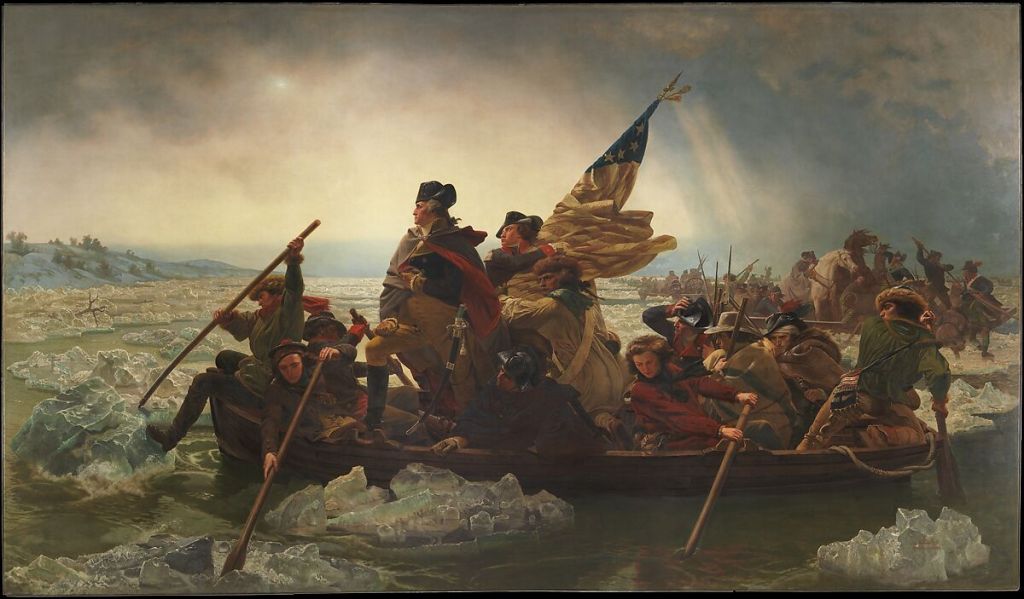
Alt text for this painting could be written as follows: George Washington and eleven of his fellow compatriots are crossing the Delaware River at dawn in a large wooden row boat. The dramatic nature of the scene is conveyed through a painterly application of light, color and gestural brushstrokes. Washington stands poised in a heroic stance with his left leg firmly bent and perched on the bow of the vessel. He is gazing out towards the nearby shore. Next to him is lieutenant James Monroe, who is holding an American flag. The rest of the soldiers are seated and rowing to shore against the force of the icy waters. There are additional rowboats in the background, which carry horses, munitions and more troops. The colors largely consist of murky and muted tones of blue, grey and white. The atmosphere of the sky shifts from left to right as dark grey storm clouds give way to light calm blue and rays of warm sunlight. The bright highlights illuminate Washington as the focal point of the painting.
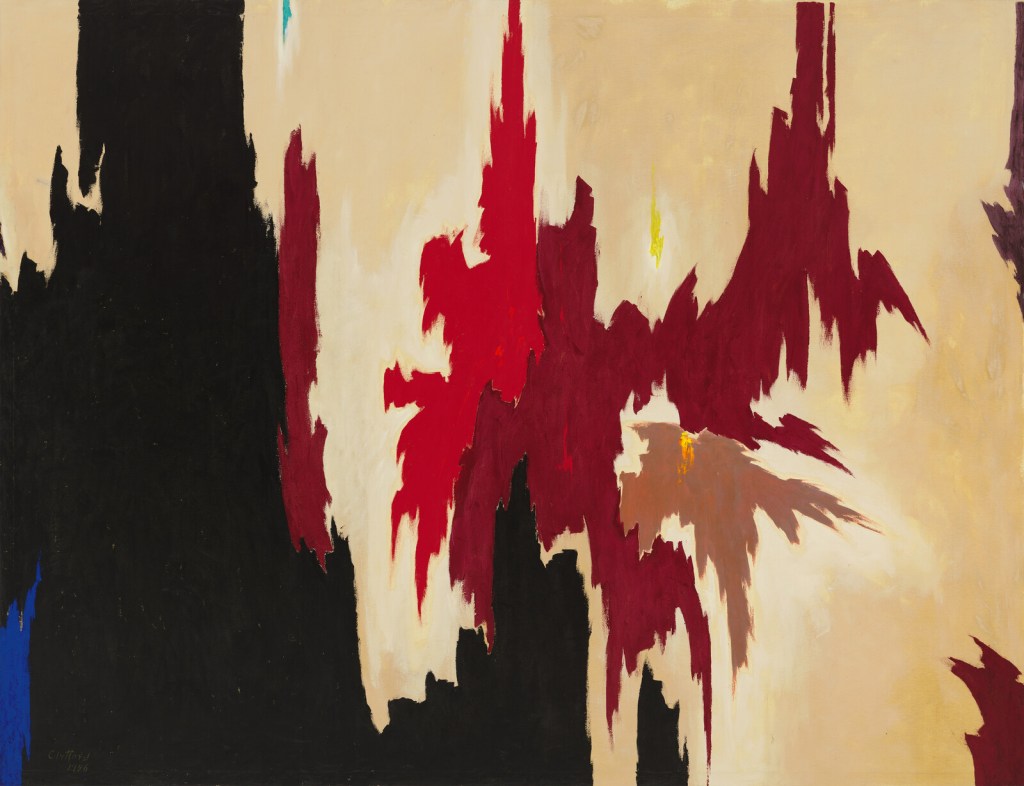
The same alt text writing guidelines apply to abstract and purely abstract works of art, like Clyfford Still’s Untitled (1956). An example of alt text for this modernist work of art is: A large abstract painting, with serrated amorphous forms of viscous color that are layered and arranged as interlocking planes. The color palette is made up of large jagged splotches of dark and earth tones (black, crimson, maroon and ochre) over a beige background. The large and more prominent colors are penetrated by small and thin vertical lines of bright yellow and blue.
If you end up getting lost in the weeds trying to convey a work of art, it is helpful to remember the following words written by Susan Sontag in her 1966 essay Against Interpretation, “reveal the sensuous surface of art without mucking about in it.”
Discover more from Artfully Learning
Subscribe to get the latest posts sent to your email.
 Artfully Learning