
Martin Luther King Day is one of the more complex holidays in the United States, because it serves as a celebration of how far we have come, but also a stark reminder of how little has changed with regards to equality, equity and social justice.
It should not be lost on anyone that contemporary culture is fraught with similar challenges to what Martin Luther King Jr. and his comrades faced. Large numbers of people and communities are still being racially profiled, innocent civilians are still getting brutalized and killed by police on the streets and the wealth gap and income inequality has essentially upheld segregation.
What is happening today in cities across the country would be appalling to the 1960s civil rights figures like King. They would also be right there on the frontlines, standing with protestors and activists who decry authoritarianism and oligarchy; who use their own bodies and spirit to protect their more vulnerable neighbors from harm’s way.
The nineteenth of January is a day that carries significant potential for reflection and action. Although many schools and places of employment are closed for the day in honor of Martin Luther King Jr., our education and labor are some of the best assets we can utilize in order to pay homage to his life and work. The enduring lessons we have learned from activists like King, is that in the face of intimidation and brutality, we must keep working towards a more just and caring future. The strength of protest and civil disobedience is evident. It worked then and it is working now. But in addition to physical strength in numbers, social justice activists wield a powerful characteristic that authoritarianism cannot defeat, which is radical love.
King was a proponent of radical love and sweeping transformative social change. Just as those elements fueled the civil rights of the 1960s, they are two of the most important things we need to meet the moment and inspire confidence and strength.
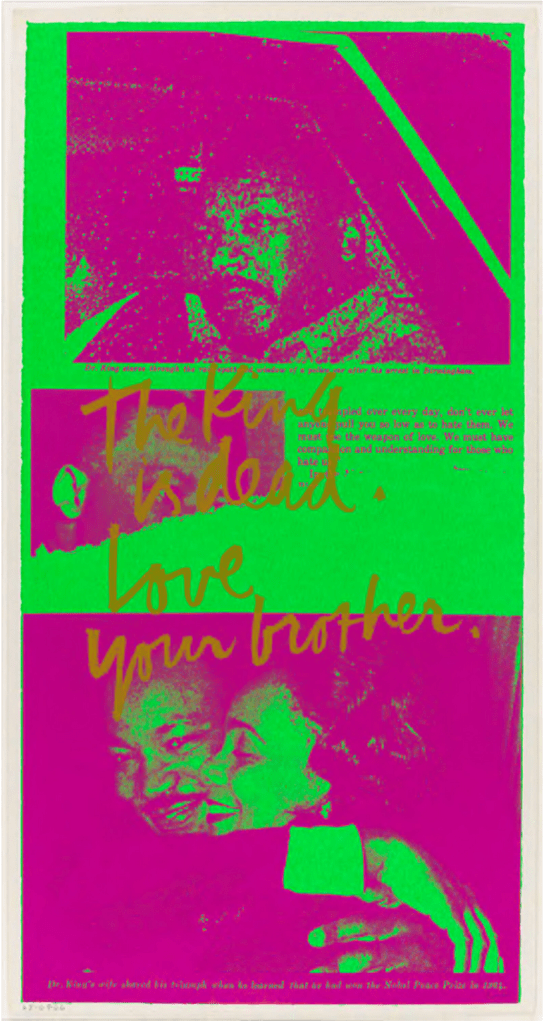
Many artistic compositions have been inspired by King’s life, words and actions, one of which is love your brother, a serigraph print made by artist Corita Kent in 1969. The composition merges together two different images of King from newspaper articles. The first is a photograph of him in the back of a rain spattered police car after he was arrested in Birmingham, Alabama, while the other is a photograph of King and his wife embracing each other in joy after he was awarded the Nobel Peace Prize in 1964. Kent includes text from newspaper clippings that contain King’s own quotes. In this instance a phrase about using love to fight against injustice: “if we are trampled over every day, don’t ever let anyone pull you so low as to hate them. We must use the weapon of love. We must have compassion and understanding for those who hate us.”
Recognizing the life of Martin Luther King Jr. includes emphasizing radical love and supporting equality, equity and justice for all human beings. His words inform us that salvation is not just a metaphor, but an experience that can be realized through tangible displays of care and love for each other.
Discover more from Artfully Learning
Subscribe to get the latest posts sent to your email.
 Artfully Learning