
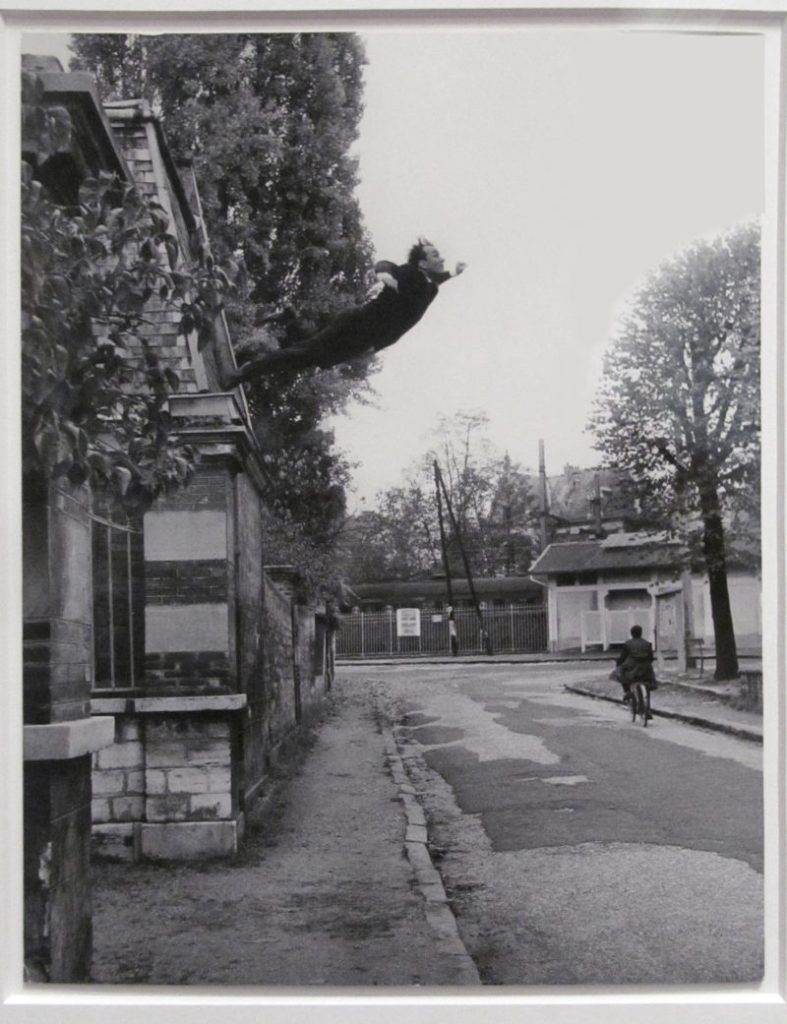
In Yves Klein’s Le Saut dans le Vide (1960), the artist’s body works in tandem with traditional artistic processes to create an otherworldly spectacle. Klein’s iconic conceptual photograph (which was also a piece of performance art), depicts him jumping in mid-air, as if he were trying to fly like Superman out of a second story window. Realistically, the laws of gravity would have him belly flop onto the hard concrete street, but the medium of photography, along with his background in martial arts, makes Le Saut dans le Vide a leap of faith into what is possible within the sphere of human ingenuity.
Klein knew that he could perform a graceful leap because of his training in Judo; and he knew he could create a convincing composition that appeared as if he were in flight because of his knowledge of photography. Although he grew up in a household where both his parents were well known artists, his path for higher education and expression led him to study Judo in Japan, where he became a renowned martial arts practitioner and educator, known as a Judoka. When he later decided to work as an artist, his martial arts background had a profound influence on his minimalist and meditative works of art that involve choreographed bodily gestures and monochromatic sequences.
There are notable similarities in the fundamental aspects of martial arts and visual art. For example, each discipline facilitates an intimate exploration of spatial awareness, in both physical and spiritual realms. Movement is not just confined to objective spaces such as an exercise mat or a canvas. The martial arts and visual arts connect acts of physical exertion and gestural movement to experiences of spiritual abstraction and inner consciousness.
There is also a relational connection between the martial arts and visual arts with regards to the performative nature of skill building and technique. Each discipline abides by praxis, which is the process of putting theory, ideas or skills into real-world action. In martial arts and visual arts, skills are developed through rehearsing and applying fundamental elements within each discipline.
The visual artist and martial artist utilize systems of contemplative repetition, which when they become proficient, enables them to employ creativity and lucidity during unpredictable and challenging moments. In Judo this is enhanced through katas, which are choreographed patterns of movements that a Judoken performs as a means to progress towards the next phase of their training. In art, practicing with the elements and principles of aesthetics give artists the vocabulary and confidence to create their own forms of personal expression.
As Klein started to translate his mastery of Judo within the field of contemporary art, he specifically honed in on the Judo concept of Kuzushi, meaning “unbalancing.” In Judo, Kuzushi is a dynamic and spontaneous motion where the thrower creates a gap by moving out of the way, causing their opponent to lose their balance and fall into the empty space, or void. This movement enables the thrower to achieve Seiryoku-Zenyo, which means they apply the maximum efficient use of energy, while avoiding brute force or wasted effort. Often times during Kuzushi, the thrower engages in Sutemi Waza, meaning sacrifice techniques, by putting their own balance at risk to achieve the throw and create the “void.”
Le Saut dans le Vide, which in English means “Leap into the Void,” is an example of Klein’s implementation of Kuzushi as a contemporary art methodology. His leap, which was possible through his athleticism and photographic manipulation, exemplified how the human body and artistic media can disrupt cultural norms and influence themes of spiritual abstraction.
To execute the composition, Klein’s wife and friends held a tarpaulin to safely catch him as he fell from the air. The illusion of him elevated above an empty street was made possible by photographers Harry Shunk and Jean Kender, who superimposed an image of the empty street with one of Klein’s fall. This illusion was significant for communicating Klein’s desires to express malleability and assert art’s essential non-material elements that signify emotional and spiritual sensibility.
In both martial arts and visual art, the void is not an empty space, but rather a vessel full of opportunity. Jumping into the void means confidently opening ourselves up to vulnerability and being malleable to change direction and goals when we experience imbalance.
Discover more from Artfully Learning
Subscribe to get the latest posts sent to your email.
 Artfully Learning