
The art classroom offers students a unique way of interdisciplinary learning, which is experiential, experimental and enriching for personal and social development. Students are immersed in both critical thinking and materials-based learning, and physically create something that is distinctly their own. In my experience, it is one of the few places in a school where they are untethered from their phones.
Studies have shown that ongoing indiscriminate usage of digital media consumption leads to issues with focus, memory and thinking skills. Art education offers a strategic way to counteract the so called “brain rot” associated with extraneous screen time and overuse of AI.
The artistic process, which starts from exploration, then leads to discovery which then transforms into insightful forms of expression, is something that has been hard to replicate by non-human entities. AI can generate art, but it still struggles mightily with the crux of what it means to be an artist.
AI trains itself of datasets, which means that it surveys and mimics images that are available online. It can reflect rudimentary elements, styles and qualities of art in order to generate user requested compositions. However, it fails to understand and employ the main characteristic of being an artist, which is applying the elements of art purposefully for personal expression. AI limits itself to formulaic modes of art, and is unable to critically include its own judgement and persona into the content it creates.
Artists learn when and how to break or bend the principles of art. They are trained under the tenets of different artistic modes and styles, as well as adding experience and critical thinking into the process. The latter part makes artwork highly personal and/or relatable to other human beings, because it is centered around lived experiences. Machines are not alive, nor have they shown that they are very good at thinking critically or creatively for themselves. Because they are driven by mimesis they are not creating meaningful works of art (if what they create can be deemed art at all).
The push back against AI has been fervent in the arts, as well as many branches of education and academics. The objection to AI’s proliferation into visual culture is a reason why arts education is even more important of a subject to have in schools. AI is widely used as a shortcut to quick and seamless access to information and content creation. But just because something is quick and convenient does not mean it is accurate. And often, AI has trouble sussing out fact from fiction and even more alarmingly, AI-synthesized images influence our belief in misinformation. Art education is the antithesis to AI’s fast, furious and fallacious programming.
Artist-educators like Elisa Strada focus on refocusing digital age natives and converts, so that they become less reliant on generating information and misinformation from AI. Strada and her students take a slow and steady approach when working with materials. Collaboratively they create large scale cardboard collages and banners. They scrutinize refuse such as discarded commercial cardboard boxes and street posters, which help determine the aesthetic and conceptual scheme for their original work of art. The process and resulting work of art represents a plurality of identities and divergent thinking.
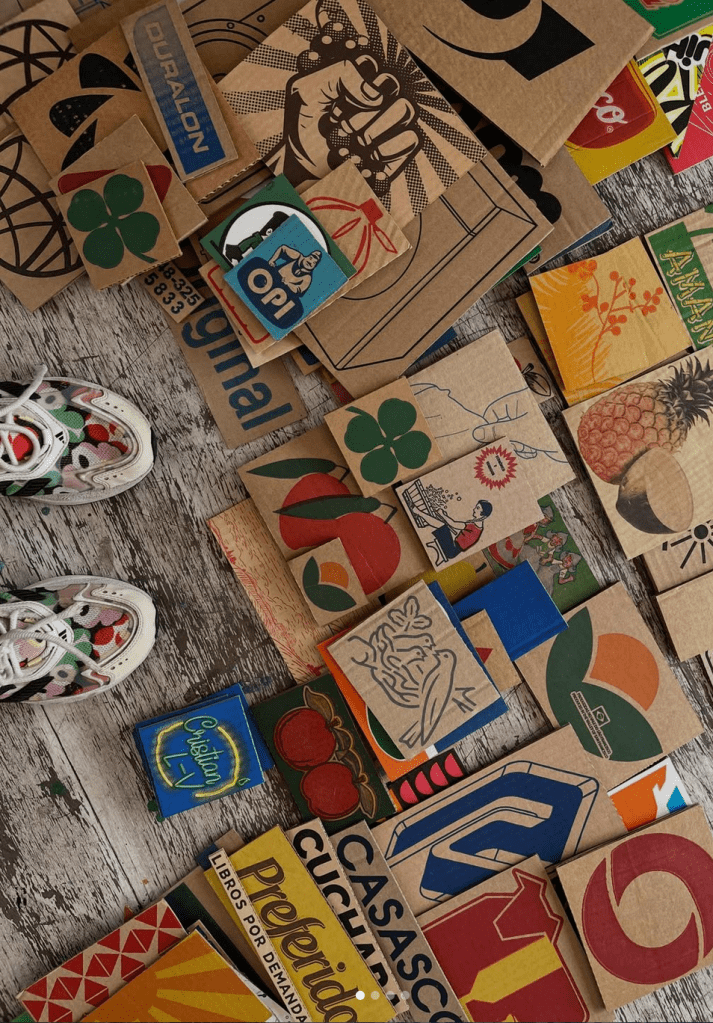
Strada’s mining through cardboard is starkly different to the way AI combs through its datasets. First and foremost, Strada is looking for elements and properties in the cardboard that are not easily discernible without having deeply observed it. In an interview with Beatriz Paz Jiménez, Strada explains, “For me, cardboard is a popular archive. The designs printed on it come from someone I will never identify — that is, from an anonymous creator, not an artist. There is something special about rescuing those encounters between a person and a material designed by a stranger; a kind of power in the joyful passions that arise from such encounters; in the knowledge that comes not only intellectually but also through the body; between one’s own processes and those anonymous ones.”
This kind of art making is intentionally reflective and unhurried, and counteracts the controversial hyperproductivity model spurred on by AI. With various automation practices in place throughout society, the measurement of success and value is frequently based upon the amount of tasks we are able to get done in a day. When hyperproductivity encroaches on educational policy it causes burnout, loss of retention and negative emotional feelings like guilt for not being efficient enough in completing numerous assignments.
Artfully learning is purposeful, methodical and meditative process that connects us with other people and cultures in a meaningful way. This is a stark contrast to machine learning, which can alienate us from interpersonal relationships and hamper our ability to make deep connections with the natural world around us. The prolonged efficacious feelings and skills that are built from tangible artistic practices is something that a machine cannot understand for the simple reason that despite its best efforts of imitation, it will never be human.
Discover more from Artfully Learning
Subscribe to get the latest posts sent to your email.
 Artfully Learning