
Art and labor are intrinsically connected, and the relationship is well documented throughout art history. Examples of artworks within a myriad of global civilizations depict the evolution of the worker and their labor as an essential function of society.
This is a zeitgeist that dates back to antiquity, with ancient Egyptian paintings and artifacts portraying the work of laborers. These artworks and artifacts were discovered within the tombs of pharaohs and noble persons, which means that this was a topic that clearly held reverence throughout society. Although, in many respects, the way that the elite and ruling class has treated and viewed laborers has gone unchanged. While work such as weaving, boat building and masonry is celebrated in artwork adorning tombs and other prominent spaces, there is very well known evidence of ancient Egyptian leaders attempting to exploit the workers whose labor was the backbone of their civilization.

Around the year 1158 BCE, tomb-builders and painters from the artisan community of Deir el-Medina organized three large labor strikes that raised public awareness about the disproportionate rations, or lack thereof in many cases, which they received for their work. The pharaoh at the time was Ramesses III, and he reneged on his ability to pay artisans their agreed upon rations wheat, meat, oil and vegetables. After three very public strikes, where artisans marched in unison to demand their fair share. It is the first example of a strike that has been documented in history, although it was unlikely an uncommon occurrence, especially with what we know about the nature of labor and the many historical and present day instances of how it has been exploited in a classicist environment.
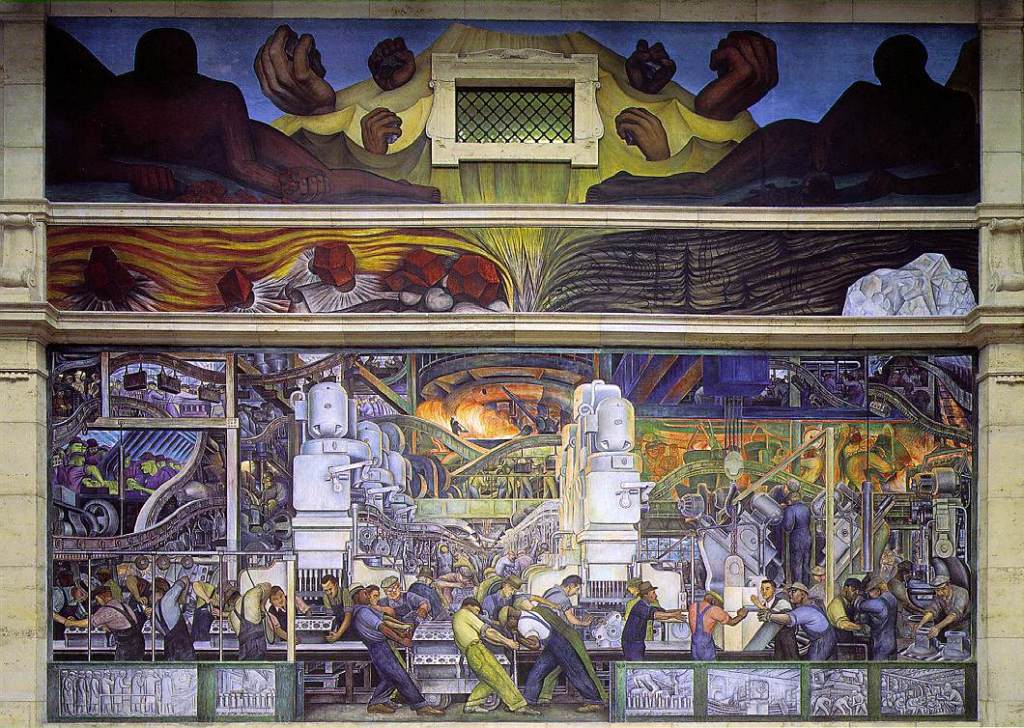
A modern example of art in tandem with labor, is Diego Rivera’s Detroit Industry Murals (1932–1933), a series of frescoes that are on display at the Detroit Institute of Art. Rivera, along with many of his Mexican compatriots dedicated a large portion of his aesthetic oeuvre to championing worker’s rights. In twenty-seven large panels, Rivera’s frescoes portray scenes of modern industry, with a heightened focus on how technology has impacted the humanized aspects of labor. The message is mixed, showing technology having the potential to be both beneficial and destructive. Most importantly, and central to Rivera’s own philosophy, is the way that the empowerment and humanity of the laborers runs the gamut through the panels. The evolution of technology may make certain jobs more efficient, but human power, grit and ingenuity is the heart and sole of industry. Scenes within each panel highlight camaraderie and the respect that the workers have for themselves, their co-workers and their jobs. The mural blatantly sends a message that workers are more than a cog in the machine, and it is their resilience and workmanship which keeps society running.
As a highlight of the Detroit Institute of Art’s collection, the mural has drawn visitors from all over the world who have marveled at its formal and symbolic prowess. But perhaps most relevant and apt, is how the message expressed through the paint has inspired acts of labor advocacy. The Detroit Institute of Art’s staff cited the famous painting as an impetus for them to form a labor union, which represents several key departments and positions such as museum educators. The enduring power of the mural is summed up by one employee’s statement that, “You can’t help but be influenced by that work, how Rivera depicted the dignity of labor.”
Discover more from Artfully Learning
Subscribe to get the latest posts sent to your email.
 Artfully Learning