
When I was teaching art history, I would begin the course with a big and broad question: “Who writes history?”
Before delving into the complex material of global art history, this question helps set up a background for discerning that history is not clean cut; and that a plurality of voices and experiences are a requisite for its understanding. The most common points that the students came up with were: A) historians and B) rich and powerful people. Both answers merit the disclaimer that historical accounts are not immune from bias.
Since my time as a public school student, several concepts and accounts within the history and art historical curricula have progressed to cover a more diverse range of narratives; because there are recorded experiences from both colonizer and colonized after all. Topics like colonialism and the relationship between early European colonizers and Indigenous nations, were largely described with benevolent and symbiotic terms. This perspective neglected to mention the abuses of Indigenous peoples that led to genocide and an ongoing trauma. But a more complete accord of colonization, with input from Indigenous voices and culture has begun to address gaps in the curriculum, leading to a more balanced and critical approach to teaching history.
This is not, as some would charge, due to education being “woke.” History as it has been accounted for in traditional textbooks and popular culture, is not often the result of a democratized survey.
First, the educational materials (i.e. textbooks) that are used and distributed in classrooms have taken a diminished viewpoint of topics that reveal damaging effects of Western-centrism ideologies, and destructive actions taken by the United States onto its own people. Furthermore, the whitewashing of negative events to support nativist perspectives, has been made commonplace by right wing politics and media influencers.
In 2020, the United States engaged in a corrective measure to remove public monuments dedicated to the Confederacy. These monuments, as I noted in a post during that period, serve to uphold the ideology of white supremacy. The fact that the largest campaign to create and display them came during the Jim Crow era, makes it clear that it was an attempt to eschew civil rights discourse and efforts to desegregate the country. They do not educate or inform. They are nothing more than a figurative representation of someone’s likeness. There is little to no explanation of who these individuals are, or most importantly, the pain and abuse they inflicted on others. In all cases these are men who fought sometimes to the death to uphold the right for human beings to own other human beings; while also participating in treason against the United States.
I revisited the topic of Confederate monuments two more times because this issue was and is too dense and complex to cover in one essay alone. And here we are again, because as the maxim goes, “history repeats itself.” Unfortunately there are those of us who refuse to learn from the past (or acknowledge its errors), and due to their status as influencers and policy makers, doom us all to repeat it. What I wrote then is just as true today, “Are they really teaching us about our past and our collective culture, or are they symbolically clinging to a dangerous status quo that is threatened by an increasingly more empathetic and informed society?”
Education invigorates us to be inquisitive and engaged in critical thinking and conscientious consumption of media forms. An educated student of history asks enduring questions about historical narratives, and their inquisitiveness often challenges attempts and instances of revisionism and erasure. That empowerment is, in my mind, the main reason behind budget drastic cuts and censorship of public education programs.
One of the longest continual conflicts waged in this country is the attack on freedom of expression, known as the culture wars. While “war” is used metaphorically in this instance, the culture wars are a battle between opponents. On one side, are the artists who are expressing their First Amendment rights via their artwork; and on the other side are social detractors who seek to politically impose their ideologies as the status quo way of thinking and acting. The latter group encompasses right-wing and conservative groups, especially the religious faction of the right wing movement, which has typically been the main aggressor by waging public relations campaigns against works of art that they find offensive to their agenda. These groups have called for a wide range of artworks (visual, literary and film) to be censored and banned. The 2020 dismantling of the Confederate monuments was a notable exception, because that effort was led by progressive forces.
Artists have had a highly visible role in addressing the symbols of white supremacy and oppression. Five years prior to the 2020 initiative to remove Confederate monuments, an artist named Bree Newsome scaled a 30-foot flagpole to take down the Confederate battle flag at the South Carolina State House. Her daring act was prompted by the racially motivated mass-shooting murder of nine people at the Mother Emanuel AME Church in Charleston, South Carolina. The action resulted in widespread pressure placed on state legislators to permanently remove the flag from the State House, which they did on July 10, 2015.

After the monuments were removed, they were generally transferred to storage sights where they sat in limbo. Some of them re-entered society, but as new sculptural objects. Kara Walker’s Unmanned Drone (2025) was created by physically altering a 1921 bronze equestrian statue of Confederate General Stonewall Jackson. This particular statue is iconic because it could be prominently seen during the white supremacist “Unite the Right” rallies in Charlottesville, Virginia, in 2017. Walker used a plasma cutter to disassemble the statue, piece by piece; and then welded the bronze fragments to form a new sculpture. It is still identifiable as having the formal qualities of horse and rider, but in a surreal and mythological fashion. The monstrous figure is a headless horseman that would give the Hessian soldier version from Washington Irving’s Legend of Sleepy Hollow nightmares. Although it resembles a large beastly figure, Unmanned Drone exudes the feeling of a defeated and depleted ghoul, who is haunted by their past and doomed to walk the land weighed down by their sword, which is dragging through the Earth in shame.
Due to the disputable and traumatic nature of Confederate monuments, perhaps it is time to recontextualize the meaning and intent of a monument altogether. A monument by nature pays homage to a person, place or event; however, as a public work of art, it should be reflective of democratic (not the political party, the ideology) principles like equality, equity and justice. White supremacist iconography, which are what the Confederate statues and sculptures are, is the antithesis of the three aforementioned tenets.

Shellyne Rodriguez’s Phoenix Ladder: Monument to the People of the Bronx (2025), located on Grand Concourse and Morris Avenue in the Bronx, is an example of what a contemporary monument can stand for. The public sculpture is a fitting tribute to the vibrant character of the neighborhood and its resilient population. Rendered in terracotta, brick and steel, the monument resembles a traditional multi-story apartment building, but is distinctly rendered as a pyramid, with ornate facade featuring the letters “B” and “X,” which is the abbreviation for the borough; as well as a graphics of a phoenix, Black power fists and eyes, each surrounded by fanciful flames. Rodriguez has included a fire escape type of ladder at the top of the structure, perhaps as a Jacob’s ladder type of allegory for the spirit and strength that residents are known for, which has enabled them to triumph over systemic duress and bias.
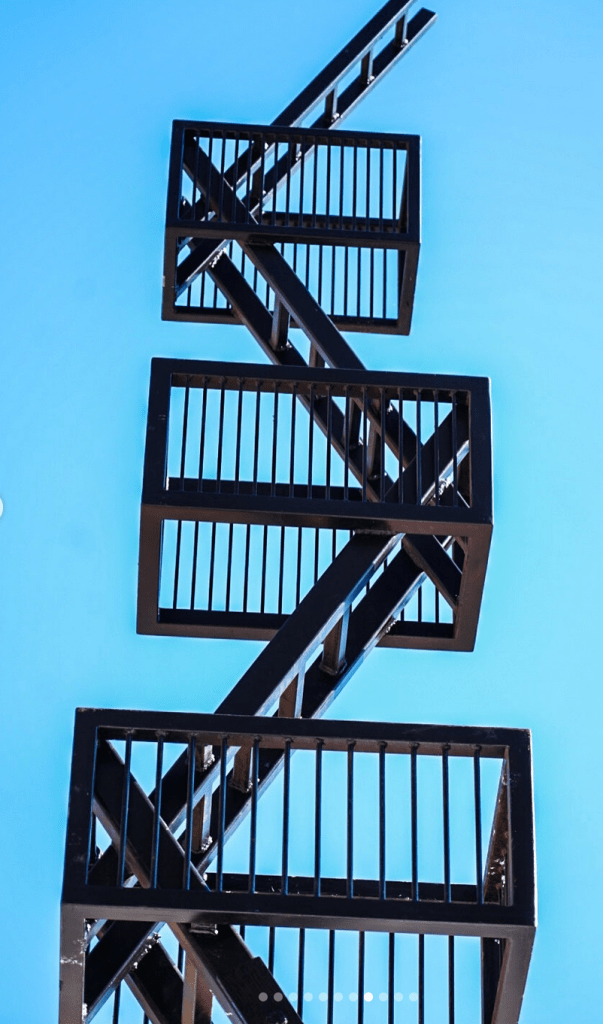
While we art historians are wont to make interpretations about meanings of symbols in art, the fire escape also has a very literal meaning. The monument references a specific historical account, wherein slumlords purposefully let their buildings burn (sometimes setting them ablaze themselves), as a means of collecting insurance payouts. These fires destroyed a staggering 80% of the South Bronx’s housing during the 1970s. It was a massive humanitarian crisis that temporarily displaced many long term residents. But rather than pack up and leave the Bronx entirely, the local community was determined to rebuild. Despite little attention from city agencies, neighbors worked tirelessly together to fix their homes and collectively heal from the trauma they were laden with.
The mythological phoenix, whose name influenced the sculpture’s title, is a bird that rises from its own ashes, signifying renewal and immortality. Rising from the ashes and soaring above adversity, the humans of the Bronx are an actual embodiment of the phoenix’s enduring and eternal spirit. Phoenix Ladder: Monument to the People of the Bronx is an exemplary testament to the valorous and enduring nature of the people who uplifted their community. As a monument it encapsulates stewardship, empowerment, triumph and heroism, while embracing themes of unity and collective care.
Monuments like Phoenix Ladder: Monument to the People of the Bronx indicate that significant moments in history are often prompted by mass organization and collaboration efforts. This is done through a plurality of voices coming together to determine the course of the present and future, thereby writing a collective and diverse history in the process. The massive display of heterogeneous engagement through mutual aid and peaceful intervention, is a powerful counteraction to oppressive political factions and the spoils of oligarchical conquest. We are witnessing an outright rejection of reification, in favor of empathetic endeavors that challenges and seeks to change unsustainable, detrimental and outdated cultural norms. The result of this transformative change is incredibly valuable as a pedagogical model that aims to achieve social justice through collaboration and communal care. Shellyne Rodriguez sums up this enduring lesson by asking us all to consider: “If abolition is not solely about what we dismantle, but also about what we build in its stead, then what monuments or points of gathering will we, the collective body of the dispossessed who make life on the periphery of empire, make for ourselves as stewards of our own histories and futures.”
Discover more from Artfully Learning
Subscribe to get the latest posts sent to your email.
 Artfully Learning