
At one point in our recent past, video games were disparaged for their negative influence on people’s development. But this overarching attitude has clearly changed. Not only are video games lauded for teaching motor skills and cognition (something that is covered extensively on Artfully Learning); they also evoke social consciousness.
The diversity of the video game genre has been tapped into as a means for raising awareness around lesser discussed historical narratives. Using the medium to raise marginalized experiences throughout time and place, opens up the possibility for inspiring transformative changes to social, cultural and historical injustices.
One of these injustices is the looting and removal of cultural artifacts and artworks from their original setting into a museum abroad. This action, often perpetrated by colonial powers, displaces objects that have significant meaning to local populations. Taken out of their original context, they sit on pedestals or behind glass cases at museums, where they are recontextualized as relics rather than items that are part of contemporary cultures and their legacies.
Most, if not all, colonial civilizations have (or had) looted works of art in their museums’ collections. In some cases, ongoing and recent efforts have resulted in the return of certain artwork and cultural objects to their places of origin. However, repatriation is something that remains a point of contention. Some reasons for host countries stalling on returning art and artifacts include conflicting claims to ownership; beliefs that they received the work morally and a concern that the work would be unsafe if it were returned. Another argument in favor of holding onto colonized art and artifacts, is that having these types of artifacts in foreign museums can provide educational insights to an international audience.
As stated by the non-profit Museums Association: “Decolonization is not simply the relocation of a statue or an object; it is a long-term process that seeks to recognize the integral role of empire in museums – from their creation to the present day.”
Having a plurality of cultural perspectives on display at museums is important as a form of education. But objects from outside cultures risk being lost in translation due to their removal from their original context, as well as both colonial misunderstandings and revisionism. It is a salient mission for art, science and history museums to accurately reflect the contributions of different past and present cultures. In a highly globalized world like ours is today, the collection and presentation of objects must be considered as a diplomatic action. By working with advisors who are a part of the society and cultural lineage where the art and artifacts are from, the museum ensures that the narrative is both properly represented and connected to the contemporary life of its originating place.
There are existing exchange programs in museums where forms of cultural collaboration take place, and consenting loans or acquisitions are supplemented with programing such as inviting and commissioning members of the society where the works originate (such as artists, scholars and elders) to lead events or present new works of art within the museum (see Exhibiting Empathy for an example of how the Seattle Art Museum did this with their collection of art from throughout the African continent).
Unfortunately repatriation is not a universal order at this moment, but Relooted, a video game developed by the South African based studio Nyamakop, envisions a future where it is. The premise of this action/adventure game is an African Futurist narrative where a global treaty requires that all art looted from the African continent be returned to its respective places. Western art museums that are unwilling to abide seek to circumvent this directive by moving their collection of said items into private collections. The gameplay of Relooted involves players controlling characters who engage in a heist of these private collections, in order to return the looted items to their rightful destinations.
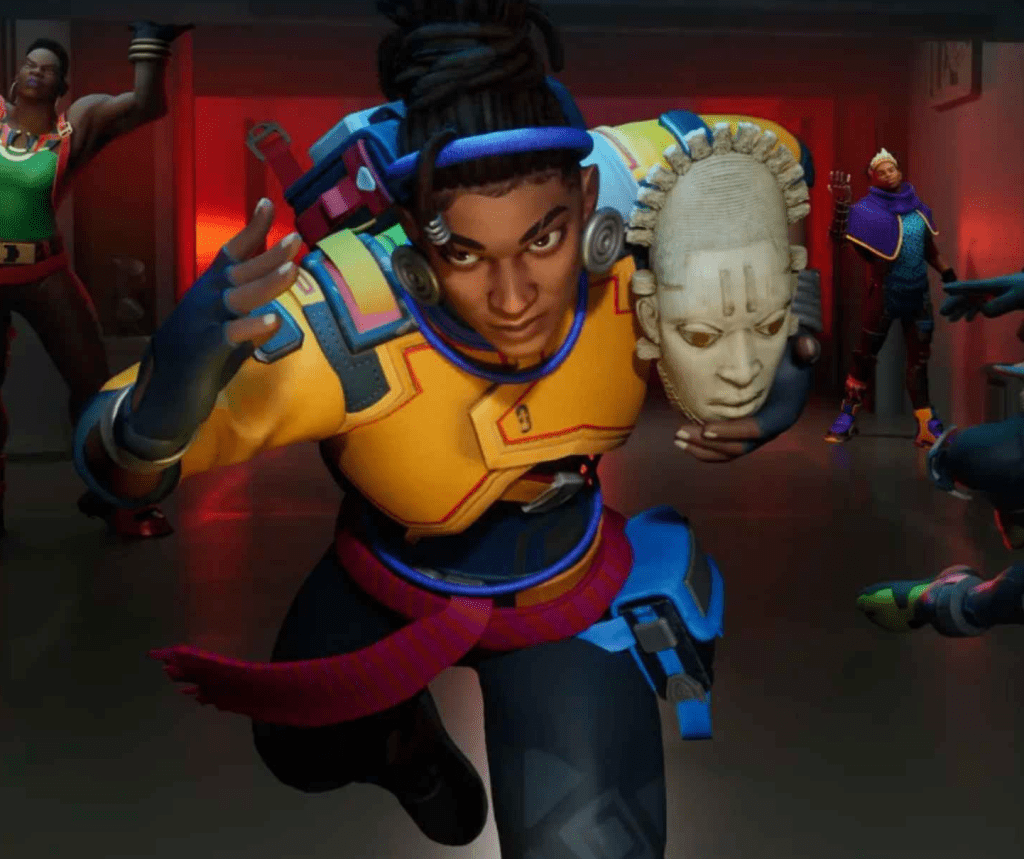
In order to complete the game, players must repatriate seventy works of art and artifacts from Western museums via elaborate heists. Each of the items in the game are actual objects; like the Queen Mother Pendant Mask, which is a sixteenth-century ivory-carving by the Edo people of the Benin court (modern day Nigeria), commissioned by Oba (king) Esigie to honor his mother, Queen Idia. The mask is currently in the collection of the Metropolitan Museum of Art in New York. It was a 1972 gift from financial mogul and politician Nelson A. Rockefeller, but the provenance of the mask reveals that it was looted by the British during the very violent and culturally devastating 1897 invasion of the Royal Palace of Benin.
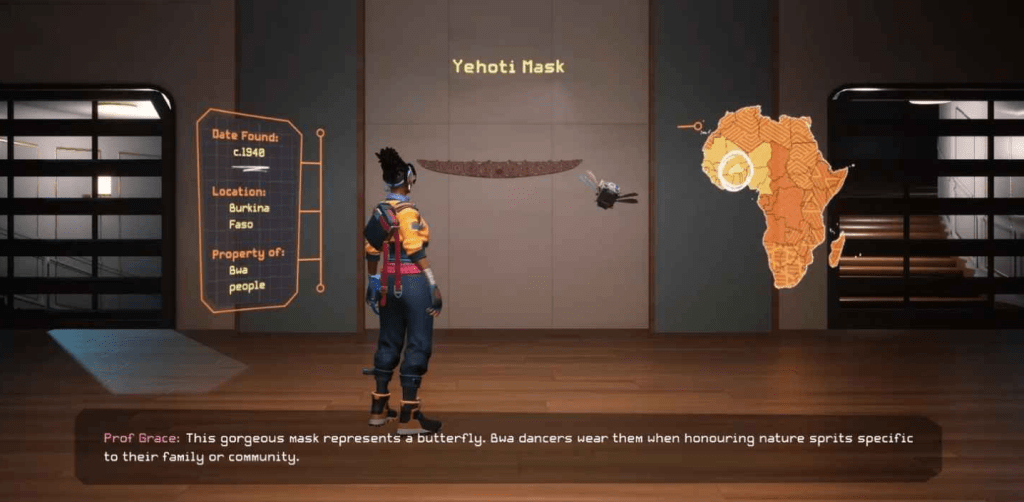
Another object is a Yehoti mask made by the Bwa people of Burkina Faso. Yehoti masks are carved from wood with geometric patterns that resemble motifs from nature. In-game commentary from a character named Professor Grace provides background on each of the items, and she explains that this particular Yehoti mask represents a butterfly, and is worn by Bwa dancers in performances, ceremonies in order to honor nature spirits and cosmology.
Relooted gives players a concise foundational purview into African art; while raising consciousness around the ways in which Westernized hegemony has determined the course of art history and institutional discourse for centuries on end. In 2007, the United Nations agency UNESCO, estimated that 90-95% of sub-Saharan Africa’s art is held outside of the continent. For people playing Retooled outside of Africa, perhaps this glaring disparity will leave a lasting impression. Imagine planning a trip to Greece or Italy only to get there and find out that the majority of their iconic structures and artifacts are no longer in situ, because a foreign power has decided to ransack and remove them. That is the reality for the greater part of sub-Saharan Africa. Africans deserve to have control of their cultural legacy by having ample access and opportunity to view and experience works of art and artifacts from their significant, diverse and abundant history.
Discover more from Artfully Learning
Subscribe to get the latest posts sent to your email.
 Artfully Learning