
A version of this piece was initially posted on my Substack, Artfully Exercising.
I have always stopped and mused in front of a Mel Bochner painting at any museum that has had his work on display while I was there. One major aspect that makes his paintings so engaging is that you can comprehend them as both art and literature. Bochner’s painterly employment of scale, gesture and balance (among other elements of art), emphasizes the breadth and beauty of written language.
As an artist who combined visual and written formulas, Bochner’s aesthetic and contextual work draws our attention to words as both literal and abstract forms. The balanced fusion of literary and visual elements makes his paintings accessible to a wide audience. Due to the captivating response they elicit, Bochner received several major commissions to create art for stadiums and other non-art specific spaces.
One of the growing trends in the design of sporting venues is the incorporation of artwork. Art in sports stadiums needs to be simple, yet effective. It is not the main event so to speak, but a precursor to the action that takes place on the field. When done well, it serves as a motivator for fans to get hyped up to cheer on their team. But placing art in sports stadiums can also be a source of ire and polarization.
Proto-Pop artist Red Grooms, was involved in controversy surrounding the site-specific kinetic artwork he made for Marlins Park (now called LoanDepot Park), home of the Miami Marlins of Major League Baseball. Marlins owner, Jeffrey Loria commissioned Grooms, who is known for his playfully interactive and immersive combines (amalgamation of sculpture and painting), to create Homer, a seventy-three-foot-tall marine life themed sculpture that would spring into motion whenever the Marlins hit a home run. My beloved New York Mets have a similar celebratory element in their ballpark in the form of a giant apple that emerges from center field. While I’ve never heard a Mets fan utter a critique of the apple, Marlins fans were less receptive of Homer. It received mixed responses, and was eventually removed from the field to a plaza outside the ballpark.
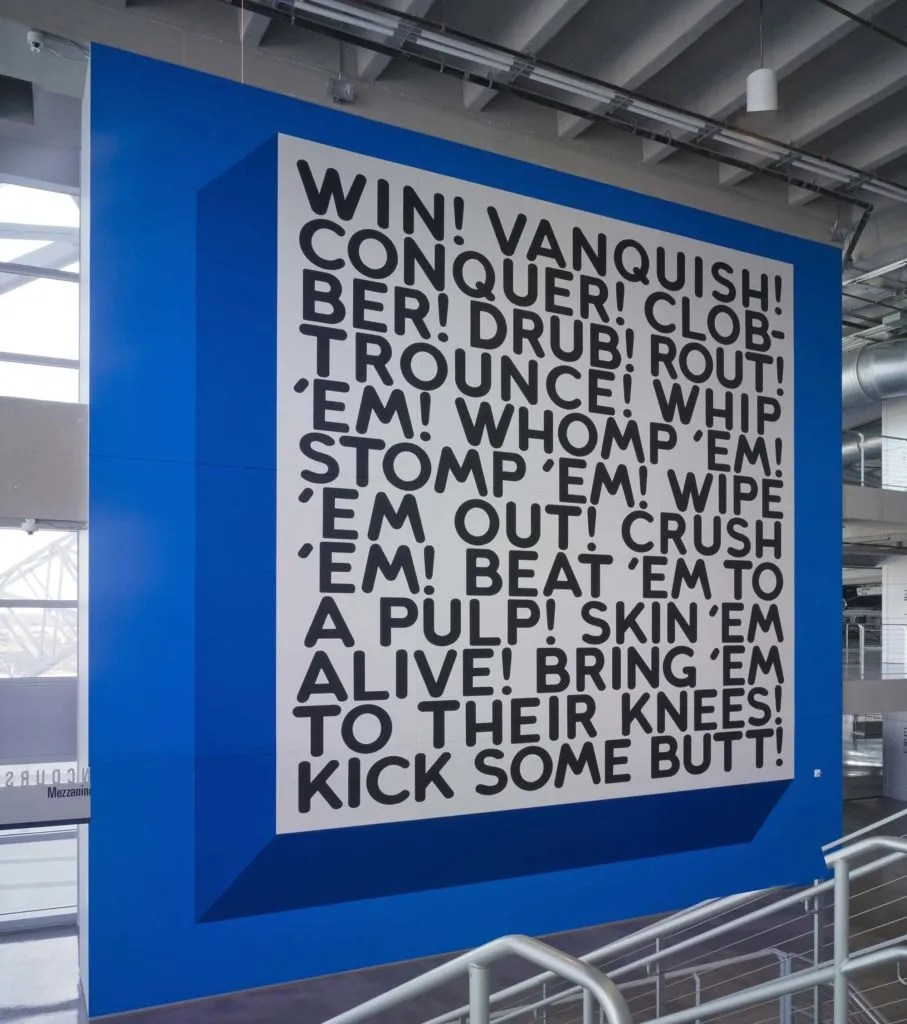
This brief aside brings us to Bochner’s Win! which was commissioned in 2009 for AT&T Stadium, the home of the Dallas Cowboys football team. Win! is a mural-sized painting in Bochner’s signature thesaurus series, containing synonyms of the word “win.” Bochner noted that he conceived the artwork as a form of mantra that would resonate with fans who are coming into the stadium hyped up to cheer on their team. Win! is constructed in a grid format, and begins with comradely words like “Win,” “Vanquish” and “Clobber.” It builds up to more intense and expressive phrases such as “Beat ‘em to a pulp,” “Bring ‘em to their knees” and “Kick some butt.” This escalation is typical of Bocher’s sociopolitical subtext that exposes how language is used to express dominance and status in Western culture.
Bochner’s work encompasses the zeitgeist of bold and provocative language being widely vocalized by influential figures. He’s not making a blatant critique or politicizing such language, but rather asking us to consider how language triggers our thoughts, emotions and actions; and how the nuance and manipulation of language impacts our well-being.
Words are powerful, as we all should know by now. If we choose to understand and wield them with profundity, they can have enormous benefits; but if we let them go unchecked, they can cause immense harm. In Bochner’s own words, he described his art as a means “To confront the barrage of bullshit that daily threatens to drown us. Because, as recent history has painfully taught us, all abuses of power begin with the abuse of language.”
Discover more from Artfully Learning
Subscribe to get the latest posts sent to your email.
 Artfully Learning