
I am about to embark on a miles-long trip to upstate New York, in order to view the solar eclipse within its path of totality. This rather rare event is replete with art and educational references. Artistic depictions of the sun help us to formulate a more intimate relationship with the massive star, and provide us with a multitude of diverse perspectives on our existence on Earth.
Since humans first gazed up at the sky and recorded their observations via visual imagery, the sun has shaped the way cultures understand and express lived experiences and natural phenomena.

Astronomer Ellen Harding Baker’s Solar System Quilt (1876) is one of the premier examples of how art has served as a visual supplement for teaching science in the modern era. The purpose of Baker’s quilt was to be utilized as a visual aid for teaching astronomy. She traveled with the quilt, using it to demonstrate how our solar system functions. The quilt features an account of the solar system as it was known at the time. The sun is prominently depicted at the center of the quilt, with the eight planets of the solar system shown in their path of orbits around it. Also represented is the asteroid belt, and the vast number of stars that exist beyond the solar system are also shown. The moons of earth, saturn, jupiter, neptune and uranus are included as well. On the top left side of the quilt there is a large comet that is likely C/1874 H1, which was discovered in 1874 by astronomer Jérôme Eugène Coggia.
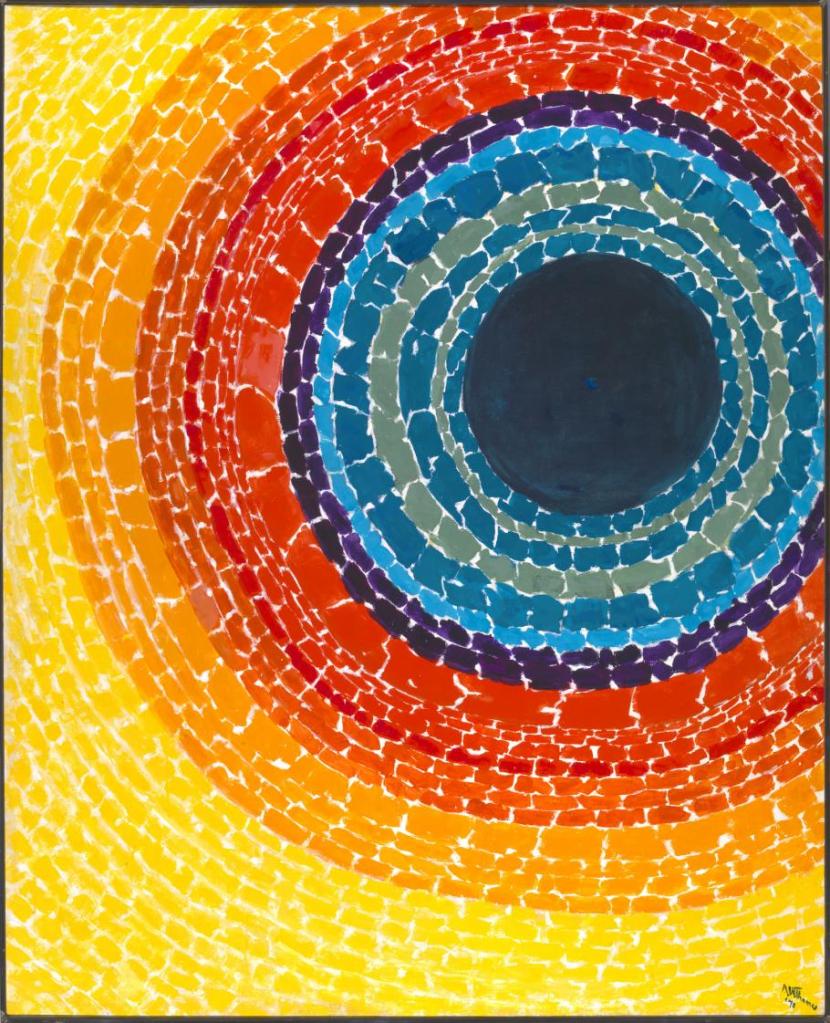
On the event of a somewhat recent total solar eclipse that occurred in New York on March 7, 1970, contemporary painter Alma Thomas drew inspiration from the gradient of light and hue resulting from the moon’s obscuring of the sun. She created an abstraction of the celestial event, utilizing her signature technique of pattern making with rough, painterly blocks of exuberant color. Before her successful career as an artist, Thomas was a teacher. Her background and experience in pedagogy is evident in her work, which is exemplified by her keen sense of observation and astute perspectives on nature and the human condition. Thomas declared that “Art could be anything. It could be behavior—as long as it’s beautiful” (quoted in Shirey, 1972).
My wife and I will be celebrating the solar eclipse of 2024 with a collaborative art project, and I implore you all to do the same. For art educators, this is a good opportunity for making interdisciplinary connections with the science curriculum. We are bringing sheets of Nature Print Paper in order to create cyanotypes. The Cyanotype process is one of the oldest photographic processes, and has an incredible history as a means for expressively depicting and recording nature. You can make some creative compositions by arranging an object or series of objects on paper that is coated with a solution of iron salts (or just buy pre-treated paper, like the aforementioned Nature Print Paper brand) before exposing it to the sun’s UV light and then washing with cool water to develop the image. We will be gathering local materials, and using the cyanotype method to capture the phenomena of the obscured and shifting light created by the eclipse.
Whatever you end up doing on April 8, 2024, I hope that you have a very auspicious and creative day!
References, Notes, Suggested Reading:
Popova, Maria. “Cosmic Threads: A Solar System Quilt from 1876.” Brain Pickings, 6 December 2018. https://www.brainpickings.org/2018/12/06/ellen-harding-baker-solar-system-quilt/
Shirey, David. L. “At 77, She’s Made it to the Whitney,” The New York Times, 4 May 1972. https://www.nytimes.com/1972/05/04/archives/at-77-shes-made-it-to-the-whitney.html
Discover more from Artfully Learning
Subscribe to get the latest posts sent to your email.
 Artfully Learning