

If you venture upon a previously empty lot in the Long Island City neighborhood of Queens, New York (24-17 Jackson Avenue, between 23rd St and 45th Avenue to be precise) between now and October 22, you will find Dexter and Sinister (2023), an animatronic sculpture of a tree named Ash and giant beaver named Bruno conversing philosophically and somewhat sardonically about property rights and land usage. They specifically get into the differences between how European settlers and Indigenous people view ownership of land and private property.
Land in New York City is at a premium and Long Island City is one of the more desirable places to live, which has led to significant real-estate development and high costs of living. However, like every other bustling area of the modern-day city, Queens was previously devoid of skyscrapers and crowds, and full of nature and home to the Indigenous Lenape, Rockaway and Canarsie nations (see: Nichols, 2018). This history has been obscured by the trendy bars, boutiques and cultural venues that make New York City a popular destination. There are hardly any markers or plaques letting us know about the history of these tribes and their once thriving communities. It is as if the settlers who developed New York City into its metropolis sought to erase all traces and memories of the city’s native inhabitants entirely. However, at least for a few more days, we are prompted to consider and remember the consequences of their actions and the cost of colonialism.
Dexter and Sinister, while sometimes humorous in their discourse, are haunting reminders of how colonialist ideology altered a once pristine natural landscape and led to the displacement and degradation of New York’s native people and wildlife. The subjects of the sculpture are symbolic as ghosts of pre-colonial past. They are indicative of the thriving Indigenous cultures and their relationship to their land prior to European contact. Beavers were once a major life force for Indigenous peoples in the Americas. Prior to contact with Europeans there was an ample beaver population on the islands of Manhattan and Long Island (where the modern day boroughs of Queens and Brooklyn are situated). Giant trees that would rival the redwoods of California were also a key facet of the native landscape. While the Indigenous tribes had a symbiotic and empathetic relationship to the natural resources they utilized, the colonialists did not. Settlers quickly depleted New York’s beaver population through a massive trapping and commercial fur trading industry. The old-growth forests also rapidly vanished as a result of their construction projects, such as shipbuilding which required the cutting down of 2,000 oak trees to make a single vessel. Great Britain’s hunger for lumber marked the start of deforestation in the colonies they established across the world (see: Thorne, 2022).
The lives of the Indigenous peoples were forever changed as well. The expansion of settlements and establishment of colonies in the North American continent was enabled by a calculated genocide of the Indigenous population. Land that had long been utilized by diverse tribes was taken from them and became a major catalyst for the development of cities, capitalism and United States imperialism. Privatization of land was another transformative concept that the colonists brought with them. Ownership of land is antithetical to Indigenous peoples who view themselves as stewards of their environment. Land was theirs to nurture and not to own. This ideological dichotomy is one of the many pertinent messages expressed through the whimsical installation titled The World’s UnFair by an Indigenous artist collective who call themselves New Red Order. The project was commissioned by Creative Time, a non-profit arts organization based in New York City. The installation imagines a future scenario where colonized American land is given back to Indigenous populations. Dexter and Sinister are the guides and de facto educators at the center of the narrative with other immersive sculpture, video and art objects providing additional context in support of returning to a sustainable and nurturing means of living.
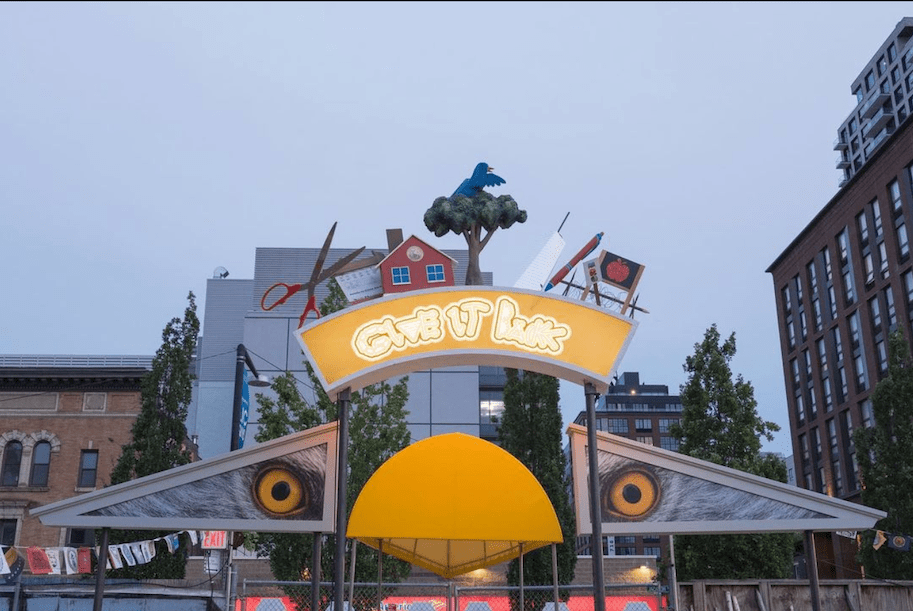
At the crux of the New Red Order’s mission is an effort to give ceded land back to native communities. This does not mean that those of us who arrived here via colonialism have to vacate the premises, but we certainly need to understand and affirm that our origin story involves the displacement of Indigenous cultures. Instead of negating their existence and suppressing their rights to their land as our predecessors did, we could learn a lot from the ways in which Indigenous peoples value natural resources and their symbiotic use of the land. This is especially dire in our current epoch of Anthropocene, where we are experiencing human activity’s significant impact on the Earth’s climate and ecosystems. The New Red Order asserts that “In a time where the future appears bleak or non-existent, giving it back offers a bright path forward, a way for us to survive an apocalypse together. The landmass here is enormous. And its ecological capacity to sustain life is immense if we care for these resources correctly. You can have a place. But first things first: Give it Back.”
The World’s UnFair takes its name from an ongoing mainstream exhibition designed to showcase the achievements of nations. Queens hosted two World’s Fairs in 1939 and 1964. Flushing Meadows, the site of the Queens World Fairs is not too far from the installation. While these fairs enabled countries to showcase their prized objects and cultural experiences, Indigenous culture and representation was largely indistinguishable. The 1893 World’s Fair in Chicago featured a deplorable instance of anti-Indigenous rhetoric that depicted Native Americans through the lens of pseudoscience, revisionist history showing Native American culture as being savage and wild, narratives of Native Americans assimilating into American society (i.e. “the noble savage”) and romantic depictions of Native Americans by actors reflecting a bygone period in United States history. Indigenous people were even brought to Chicago to be put on display for the twenty seven million visitors (see: Beck, 2019). The World’s UnFair seeks to dismantle stigmas and sins of the past calling for Indigenous cultures to get their land back and be unbridled by colonial oppression and influence.
The World’s UnFair is an example of how art can educate in a progressive and non-didactic manner. New Red Order is not shoving their ideology down our throats, but rather artfully presenting a path forward that is more inclusive and justice driven than our current trajectory. It is successful in delivering its message due to utilizing a combination of materials and media to design a fair-like atmosphere full of sights, sounds and experiences. The use of graphics that parody real-estate advertisements is a great tactic to raise awareness around how the legacy of colonialism is linked to today’s real estate market, which also calculatingly displaces people from their longtime housing situations. They cleverly incorporate an array of signs, symbols and infographics to portray a picture of how the privatization of land under colonial influence has impacted the lives of Indigenous peoples. An example is New Red Right to Return (2023), a signpost pointing to contemporary locations of Lenape communities noting the distance of where they were forced to reside from their native land, which encompasses New York City. Walking throughout the fair, which is on the land where the Lenape once thrived, it is hard not to feel an overwhelming sense of grief, anger and motivation to work towards ensuring an end to the predatory marginalization and displacement of people. The atmosphere of doom and gloom is well balanced by encouraging documentations of repatriation (i.e. California’s city of Eureka, which gave Tuluwat Island back to the Wiyot tribe in 2019) and an event on October 8th called the Give It Back Gathering, which was a public forum with a conversation between settlers who have gone through the process of land return.

New Red Order allows enough space between their witty and whimsical critiques of settler colonialism for us to reflect and consider our personal relationship and role in it. In this manner, they are utilizing one of the key components of Paolo Freire’s formative publication Pedagogy of the Oppressed. Most notably, The World’s UnFair embodies Freire’s “problem-posing education model,” a pedagogical methodology that supports critical thinking for the purpose of collective liberation. In this model, knowledge and enduring understanding is constructed through a democratic dialogue between the teacher and the students. The classroom hierarchy is dismantled when both students and educators listen, learn and collaborate together. The same transformative impact applies outside of the classroom within communities of all sizes. The World’s UnFair addresses social injustice through a plurality of voices and perspectives thereby building a framework for making the world more fair and livable.
References, Notes, Suggested Reading:
In addition to the sources referenced in this article New Red Order and the non-profit arts organization, Creative Time have prepared a reading list on issues regarding the past, present and future of Indigenous culture.
Beck, David R.M. 2019. Unfair Labor?: American Indians and the 1893 World’s Columbian Exposition in Chicago. University of Nebraska Press. https://doi.org/10.2307/j.ctvggx4fm
Nichols, Adam. “MAP: See Which Native Tribes Lived Where NYC Is Now,” Patch, 20 November 2018. https://patch.com/new-york/new-york-city/map-see-which-native-tribes-lived-where-nyc-now
Thorne, Stephen J. “The Royal Navy’s War on Trees,” Legion Magazine, 15 February 2022. https://legionmagazine.com/the-royal-navys-war-on-trees/
Discover more from Artfully Learning
Subscribe to get the latest posts sent to your email.
 Artfully Learning