
I recently wrote about artist Jane Housham who collects (mostly) ephemeral items associated with childhood and material culture and presents it in a way that is both aesthetically pleasing and nostalgic (see: “Finding Inspiration and Information in Found Objects (with Lesson Plan)”). My fascination with re-presenting quotidian materials in way that gives new meaning to existing forms, drew me to Jim Condron’s art. Condron is known for his work that merges painting and sculpture, in a manner that is somewhat reflective of Robert Rauschenberg’s modernist “Combines,” and the diverse practice of assemblage art.
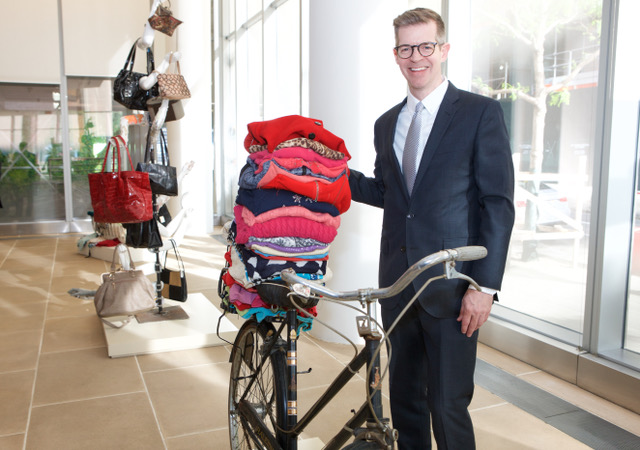
Condron’s assortment of traditional aesthetic elements and found objects, extends the ordinary function and form of these items by associating them with personal identity and sentimentality. An epitome of this is Condron’s 2019 installation of sculptures during the Muscular Dystrophy Association’s “Wings Over Wall Street” event, which are a visual metaphor paying tribute to his mother who had died from complications form amyotrophic lateral sclerosis (ALS) the prior year. Condron explains: “to make the sculptural works, I combined clothing from my mother’s wardrobe — her purses and her shoes and materials from my childhood like a bicycle, a crib and backyard lounge chairs — with mannequin arms or natural materials, such as yarrow or straw. I used my mother’s garments to create forms that express my mother’s ebullience and the challenges of the disease. Each piece expresses the great complexity of nostalgia and embodies my deep grief” (quoted in MDA, 2019).

Courtesy of Art Cake, New York.
Condron’s latest series of work is called “Collected Things,” which are sculptures created from personal and ephemeral objects given to him by other artists. The title of each artful construct informs us of its subject, such as Grace Hartigan’s Things (2022-23), which features items Condron acquired from the late expressionist painter Grace Hartigan who was his teacher in graduate school and an important mentor thereafter until her death in 2008. The combine contains a pair of Hartigan’s bright pink Crocs shoes. These shoes are significant because they were what she wore in the studio while she was painting in her late years. Also included is a paint stick that Hartigan used to mix her paints, and a pillow of hers that resembles the cut-out collages of Henri Matisse, an artist that had significant influence on Hartigan’s own personal artistic style. In addition to paying homage to Hartigan, Condron also credits the legacy and influence of Philip Guston by basing the composition of Grace Hartigan’s Things on his 1970 oil painting Cellar.
Making combines and mixed media assemblages exemplifies how art inspires us to transform everyday materials into profound compositions that express distinct memories and characteristics of the human condition. This extends the definition of art beyond its physical elements and craftsmanship by connecting these elements with experiential moments from real-life, identity and culture. Presenting art as a multifaceted practice that transcends traditional notions of painting, drawing and sculpture is especially beneficial when teaching art in the K-12 curriculum where students come from diverse cultural backgrounds and have variations in learning needs and styles. Artist and arts educator Dana Helwick (2019) explains that “by showing a wide range of artists in terms of both medium and demographics to my students, I’m hoping to combat traditional notions of who gets to be an artist and to explore what it means to be an artist. Changing large, cultural narratives about diversity can start in the classroom if we can empower young students to envision a different future for themselves….Anyone can learn to become a skilled craftsman, but making meaningful art encourages students to think critically as well as creatively about themselves and the world around them.”
Below is a lesson plan inspired by Condron’s methodology of repurposing objects that are meaningful to others within new aesthetic compositions. It promotes the enduring understanding that works of art can be made from nearly any type of material, and that material-based explorations help us to make insightful discoveries about ourselves, others and the environment around us.
Collective Combines
Aim and objectives:
This lesson explores the elements of art and principles of design, while incorporating examples from art history and/or contemporary art to broaden student’s understandings of mixed media art and how artists utilize everyday materials and ephemeral objects as media for art.
Using assemblage and collage techniques along with their choice of painting or drawing for embellishment, students will transform collected materials into symbolic compositions that represent a portrait of one of their classmates.
Materials:
- Ephemeral objects collaboratively sourced from classmates
- A cardboard base (get the heaviest cardboard possible such as corrugated cardboard sheets, which can be sourced from delivery boxes i.e. Amazon Prime, Chewy etc.)
- Glue (any type of strong bonding glue, such as Aleene’s Tacky Glue)
- Masking tape or duct tape
- Paint (acrylic or tempura)
- Scraps of fabric, cardboard, ribbon, buttons etc.
Procedure:
- Introduce the concepts and terms “assemblage,” “mixed media art” and “combines,” showing examples from art history such as Robert Rauschenberg’s Bed, Nick Cave’s Soundsuit), Jim Condron’s Grace Hartigan’s Things and Betye Saar’s Beyond Midnight (Magie Noire).
- Ask the students what objects they recognize and why the artists might have chosen to use the object in that particular work of art. Prompt them to consider whether it elicits any distinct personal memories or feelings from their own lives?
- Tell students that they will be creating their own mixed media artwork inspired by the objects and ephemera they will collect from one of their classmates.
- Review cardboard collage and attachment techniques using glue to adhere a variety of objects to a cardboard surface. Demonstrate arranging found objects on a cardboard background to form an aesthetic composition and adding scraps of materials and paint for embellishment (take into account the application of elements of art and principles of design to show texture, balance, unity, scale, color and form. In addition to the forms created by arranging the object, discuss and point out the use of negative space (the space around your objects). Also demonstrate the effect of shadows created by the height of certain objects and how arranging different sized three-dimensional items impact the quality of the overall composition. Inform students that they should experiment with different arrangements before selecting a final composition; and that they should be documenting this process by taking a photograph with their phone, or sketching the layouts in their sketchbooks (or both!).
- When demonstrating how to glue objects in place, highlight the need to allow ample time to dry. A helpful way to make sure objects dry in place is to use clothes pins or something heavy like a paper weight or books to hold the object in place.
- Pair students together.
- Students will take turns interviewing their partner in order to find out what inspires them and what personal objects are significant to them, as well as what issues, topics and interests are relevant to their lives. Students will ask their partners to bring in specific personal items such as photographs, stuffed animals/toys, clothing and accessories. Other good ideas for collectable objects include drawings or creative writing pieces that the classmate has made. It is important to mention to the students that their items will be transformed into a work of art so the items they share must be something they are OK parting with. If they are bringing photographs, drawings or other works on paper, suggest that they make duplicate copies (using a scanner or copy machine) and use those rather than the original.
- Once the students have a few materials given to them by their classmate, they will start to focus on their assemblage construction. Suggest that they begin by coloring the cardboard base first with a layer of white paint (i.e. gesso) and then a colorful design (which can be either abstract or include symbols and signs). Prompt the students to think about what color scheme will they use to represent their partner’s essence/persona?
- While the students are waiting for the base to dry, they can think about how they want to arrange their objects. What message do they want to convey about their subject, and how will they arrange their collected objects so that their composition conveys significant meaning and reflect what they learned about their peer’s personality?
- After the base dries (might take a class session, which is why having them make sketches and explore different arrangements is a key component of the process), students will place their objects on the base, settle on their desired composition and glue everything down.
National standards:
- Explore uses of materials and tools to create works of art or design.
- Use art vocabulary to describe choices while creating art.
- Use observation and investigation in preparation for making a work of art.
- Perceive and describe aesthetic characteristics of one’s natural world and constructed environments.
- Compare images that represent the same subject.
- Interpret art by identifying the mood suggested by a work of art and describing relevant subject matter and characteristics of form.
- Use learned art vocabulary to express preferences about artwork.
Vocabulary:
- Assemblage art
- Combine
- Mixed media
- Ephemera
References, Notes, Suggested Reading:
Butler, Sharon. “Ideas and Influences: Jim Condron,” Two Coats of Paint, 16 June 2023. https://twocoatsofpaint.com/2023/06/ideas-and-influences-jim-condron.html
Helwick, Dana. “Extending Beyond Craftsmanship, into Inquiry and Exploration,” Art21, 4 December 2019. https://art21.org/read/extending-beyond-craftsmanship-into-inquiry-and-exploration/
Yaniv, Etty. “Jim Condron: Collected Things at Art Cake,” Art Spiel, 1 June 2023. https://artspiel.org/jim-condron-collected-things-at-art-cake/
“Do You Know ALS? Meet Jim,” MDA Quest, 21 May 2019. https://mdaquest.org/do-you-know-als-meet-jim/
Discover more from Artfully Learning
Subscribe to get the latest posts sent to your email.
 Artfully Learning