
One of the drawbacks of compulsory education is its rigid structure. Our educational systems are generally too reliant on metrics like standardized testing, in order to measure the proficiency of students’ learning and teachers’ teaching. While it is useful to have quantifiable data showing whether specific pedagogical methods are effective, this framework can be stifling and stressful on educators and students’ quality of life, as well as a roadblock to inspiring lifelong learning, critical thinking and empathy.
“Teaching to the test” means eschewing other, arguably more essential skills and knowledge (i.e. life skills such as taking care of one’s own well-being and contributing to the progress of their community), as well as forgoing material that hones in on social and emotional learning. Child and Adolescent Psychiatrist Eugene Beresin (2018) states that standardized tests do not provide the equal and equitable outcomes they were intended to provide under the The No Child Left Behind Act of 2001 ( legislation that established the tone for using standardized tests as the key means for evaluating student knowledge and determining their readiness for graduation, secondary and post-secondary education), asserting that “as measure of knowledge and more, standardized tests don’t do what they are supposed to in assessing problem solving and critical thinking. Instead, they tend to measure a specific skill set–namely, the ability to perform well on these tests.”
Beresin advocates for a more well-rounded approach to learning that acknowledges the importance of independent learning and creative thinking. One way of doing this is to break up the school day to give students an opportunity to practice self-reflection and mindfulness. Setting up an environment for students to regulate and manage their emotions and experience awareness about themselves and others can build social awareness, self-discipline and good decision making. These are skills that help cope with navigating personal and professional relationships, and they actually benefit common core learning (i.e. standardized education) by making discipline-specific knowledge relevant and personal to each student’s lived experiences.
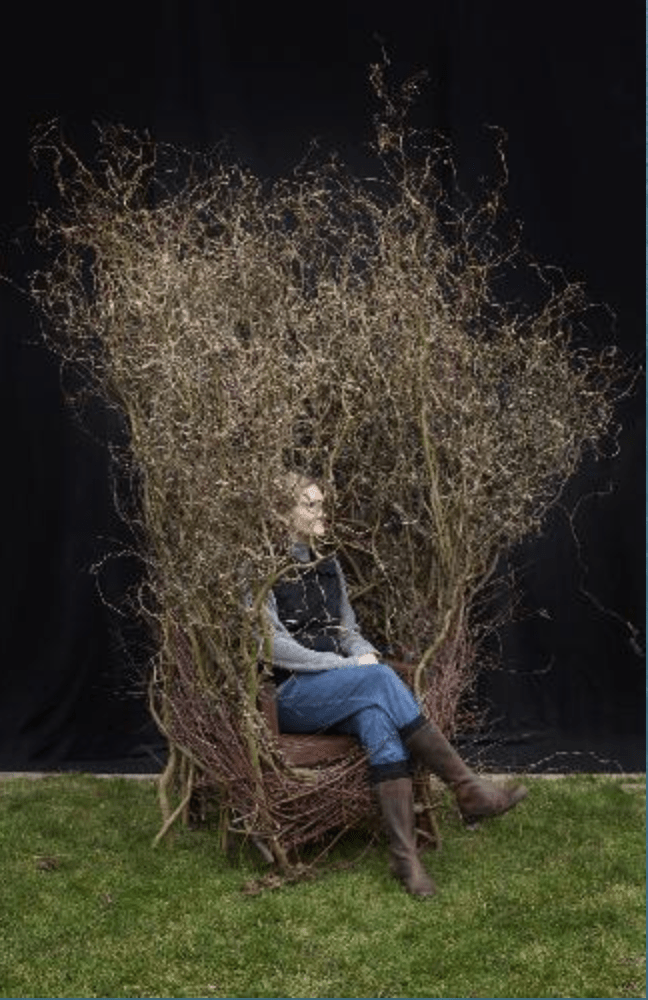
Photo by Bert Janssen.
Artists are adept at merging tangible and abstract thinking and examples of projects such as Basia Irland’s “Contemplation Stations,” address the profundity of learning by honing self-awareness, self-management, social awareness, relationship skills and responsible decision-making. Each of Irland’s “Contemplation Stations” are woven from plant material collected along the banks of local rivers and streams. They provide an opportunity to be immersed within nature, with the objective of becoming liberated from extraneous thoughts or actions. When sitting within one of these installations, an individual’s focus is directed towards natural resources. The sights, smells, sounds and feelings are intended to inspire mindful (being directly present in the moment) reactions and meditations. Irland explains that “in our overly frenetic and busy lives, ‘Contemplation Stations’ create a space where one can step away from the work-a-day world and experience a sense of calm, tranquility and peace. To sit in repose by yourself and view a flowing stream has the ability to quiet the mind, relax the body and feed the soul.”
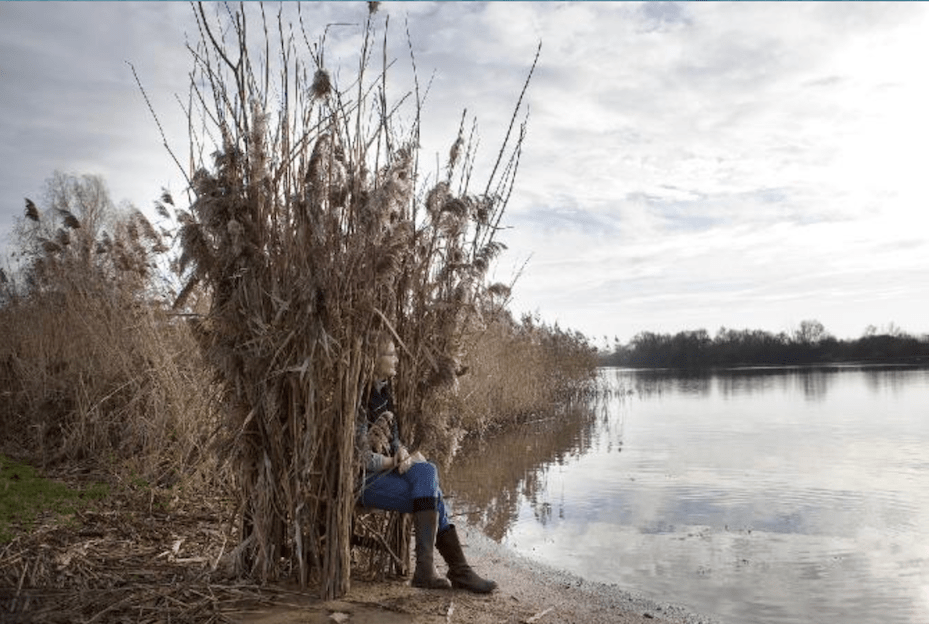
Educator Jonathan Juravich (2021) writes that, “art provides creative opportunities. Through art, students can identify their feelings and process their experiences. School-wide installations are a great art form to support students as they wrestle with all their emotions.”
All schools would benefit from having site-specific spaces where students and teachers could go to refocus and take time to contemplate, while being detached from the stress and demands of standardized schooling.
There are pedagogical models that already incorporate this principle, such as forest schools. These are types of schools where classes are held outside, allowing students to explore natural spaces while learning personal, social and technical skills. Forest schools follow a child-centered and embodied learning process that provides students differentiated opportunities to develop holistically, while associating more traditional school curriculum with real-world experiences and outcomes.
Setting up a contemplation station within a classroom or school setting requires limited materials (you can be resourceful and economical with what you have!) and can be adapted to the surrounding environment. Below is a lesson plan that I developed for students to collaborate on the design and implementation of a space that they can use for reflection and mindful contemplation.
Classroom Contemplation Stations
Introduction:
A contemplation station is a place of refuge and reflection. It is a chance for students who typically experience complex and fluctuating cognitive, emotional and physical transformations throughout their time at school, to relax and relieve themselves from the rigors of compulsory schooling. This lesson explores the concepts of “sanctuary” and “inclusion,” in order to realize a physical space within the classroom or school setting that can serve as a calming and contemplative retreat from the standardized school environment.
Aim and objectives:
In this lesson plan, students will work together to determine and design an immersive work of art that will serve as a space where they can congregate to practice positive self and communal care. The focus on making multiple elements as part of a whole work of art, provides a way for everyone in the class to participate and cooperate in addressing real-world issues. Each student will determine a facet of the installation that they will be responsible for. Their individual contribution will be integral to the final work of art. Furthermore, students will have the agency to determine the types of social and emotional learning inspired activities which will occur within the installation.
Depending on the students’ intentions, the installation might include writings, performance, painting, interior design and three-dimensional sculpture. The concept will center around students’ life experience, prior artistic backgrounds and knowledge of current events, in order to create a space that will have significance to them and represent a safe place they can visit to step away from the stresses of stringent learning and experience the calming effect of self-directed focus.
The three main objectives of this lesson are:
- Students will learn about the concept of socially engaged installation art (i.e. social practice and relational aesthetics), and experience how some works of art are intended to be activated and given meaning through participation between the artist and the viewer(s).
- Students will collaborate on the creation of a socially engaged installation.
- Students will make use of the space to support social and emotional learning.
Procedure:
- Through an interactive classroom discussion, students will identify and define installation art. As a broad and simplified example, you can introduce the medium using Tate museum’s definition, which defines installation art as “large-scale, mixed-media constructions, often designed for a specific place or for a temporary period of time.” Ask students whether they have seen this type of art, and prompt them to suggest places where they think installation art would be most useful either as a way of inspiring the beauty of a place, changing the perspective of viewers/participants as they interact with it or providing a resource that benefits a group of people and/or the natural environment.
- Give a quick multimedia presentation of different types of installation art, showing the potential for this medium to transform or bring attention to nature and natural surroundings (ex. Robert Smithson’s Spiral Jetty or Susan Hoenig’s Ecological Leaf Sculptures); address specific societal issues (ex. Doris Salcedo’s Shibboleth and Susanne Brennan Firstenberg’s In America. How Could This Happen…); or provide social services and experiences that have tangible outcomes on how we live (ex. Mary Mattingly’s Swale and Basia Irland’s “Contemplation Station” series). Be sure to mention whether there are any local art installations students should be familiar with and visit if possible.
- Introduce the concepts of “sanctuary” and “inclusion.” Ask students what those words mean to them, and to share any specific places in their lives that they consider to be an inclusive, sanctuary space. After this discussion, inform the students that they will be designing an installation in their classroom (or a designated place in the school) that can be used to benefit their in-school experience. Let them know they will have the chance to make a space where they can have the agency to learn at their own pace, de-stress from the rigors of traditional schooling and provide support or services in support of their needs and the needs of others in the school. They will have ample choice in what goes into the installation. While they will determine the content and context, you might suggest that they could focus on incorporating writing, performance, painting, interior design, found objects and three-dimensional sculpture into the overall structure.
- Ask students to brainstorm the following when considering what to create: What purpose, issues or concerns are important to your needs and the needs of others in the school? How will they visualize these themes and topics using signs, symbols and graphics? How big will it be? Where will it be situated? What supplies and materials are needed to create the installation and where can they be sourced from? What are the various physical elements (i.e. the parts) that will make the installation feel complete?
- Once students have identified a few themes they want their work to address, the visual elements and media that will represent these ideas and the materials and tasks needed to construct the installation, they will be prompted to delineate specific tasks among the class so that each student has a defined role in the artmaking process.
- Students will embark on the creation of their contemplation station installation.
- After the installation has been created, students will come up with a schedule and plan for utilizing the space throughout the school year. Ask them to consider different types of activities that can activate the space in a way that is educational and empowering. They could have poetry and literature readings, open mic performances, play board games, meditation and attuned movement sessions and student-led discussions on a topic of their choice. Each student should have an opportunity to develop a way for the space to be utilized.
Assessment:
- After the installation has been completed ask students to consider and answer the following questions:
1. Did you find working collaboratively with your artist peers to be successful? If so, how did working with other artists benefit your own process?
2. What were some of the biggest successes you and your fellow artists experienced while collaborating on the installation?
3. What were some of the most challenging moments you and your fellow artists experienced while collaborating on the installation?
4. Did this project influence your opinion about what can be considered art? Do you think that creating an artistic installation can make a positive impact on the lives of individuals? Why or why not?
National standards:
- Understanding and applying media, techniques and processes.
- Using knowledge of structures and functions.
- Choosing and evaluating a range of subject matter, symbols and ideas.
- Reflecting upon and assessing the characteristics and merits of their work and the work of others.
- Making connections between visual arts and other disciplines.
Vocabulary:
- Installation art
- Socially engaged art
- Social and emotional learning
- Sanctuary space
- Inclusion
References, Notes, Suggested Reading:
Beresin, Eugene. “Teaching for the Test or Teaching for Real Life?” Psychology Today, 29 August 2018. https://www.psychologytoday.com/us/blog/inside-out-outside-in/201808/teaching-the-test-or-teaching-real-life
Juravich, Jonathan. “How to Support Students Through Disappointment and Hope with Installation Art,” The Art of Education, 10 September 2021. https://theartofeducation.edu/2021/09/sept-how-to-support-students-through-disappointment-and-hope-with-installation-art/
Discover more from Artfully Learning
Subscribe to get the latest posts sent to your email.
 Artfully Learning