
Jane Housham is drawn to the scale, colors, textures and all around forms of miniature toys, as well as other objects that are typically accumulated throughout childhood, only to be discarded as they are deemed outgrown. Housham finds, collects and archives these objects as a means to rekindle the emotional memories and cultural trends associated with childhood play.
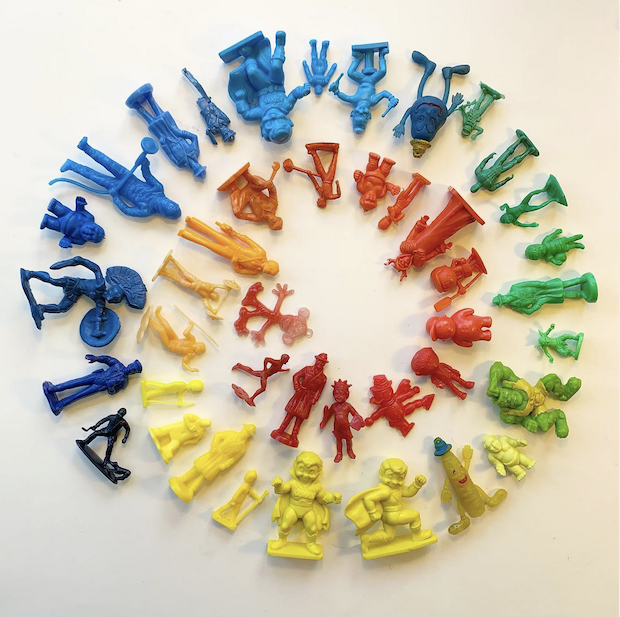
Courtesy of the artist and Found and Chosen.
Housham’s acquiring and cataloging of these objects transforms each item into a raw material for new aesthetic compositions, in a series she calls “Found and Chosen.” Once Housham hones in on a group of miniature toys that peaks her interest, she arranges them chromatically or thematically, sometimes both ways. The project is rooted in personal nostalgia, but also a keen awareness of the need to be environmentally conscious when creatively working in a materials-based method.
Housham notes “I’m not really interested in new plastic things as I don’t want to encourage the continued spewing out of unnecessary plastic bits and pieces, but I like to save old plastic toys and other secondhand bits and bobs and to celebrate their colors and the ingenuity of their design. Although it’s now understood to be so bad for the world, plastic was a beautiful material in its heyday” (quoted in Ebert, 2023).
Like Housham’s “Found and Chosen” series, Brett Day Windham’s installation Cypher (Sunset Park) combines found objects chromatically, in order to reflect the cultural phenomenon of daily objects that are leisurely used and then discarded. Cypher (Sunset Park) comprises objects Windham collected on daily walks around Brooklyn’s Sunset Park neighborhood, an area with a formative immigrant population that has been experiencing the effects of gentrification. Viewed from afar, Cypher (Sunset Park) is a compelling polychromatic composition. While the work is seemingly abstract at first glance, its variety of textures and hues draw us closer. Through a more detailed viewing we begin to parse out the various found objects including spools of thread, rope, dolls and toys and electronics. These disparate pieces are a part of the larger story and sociocultural portrait of a very diverse community.
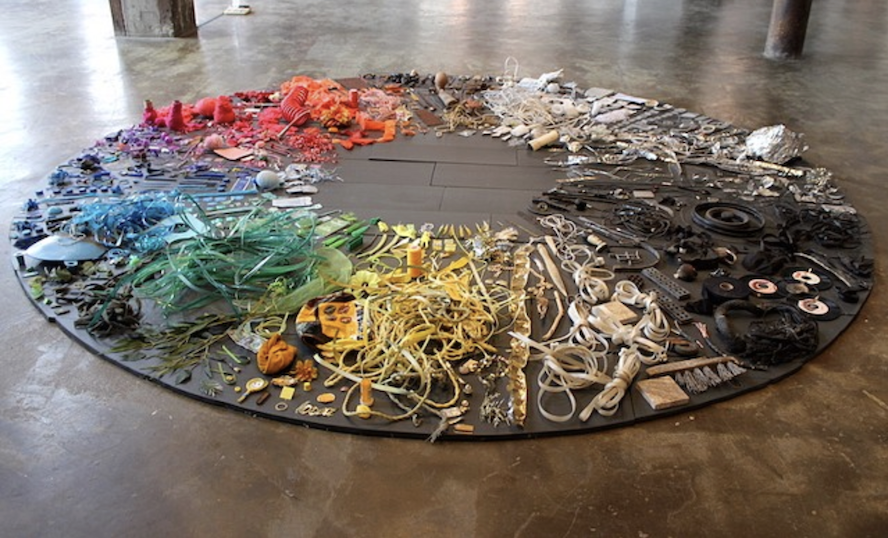
Installation View at Smack Mellon, Brooklyn, NY, 2014. Courtesy of the artist and Smack Mellon
Reflecting upon memories of play, identity and cultural heritage via collecting found objects, while repurposing discarded materials as works of art which might otherwise have environmental implications (if they end up in waterways or other natural settings), is a good lesson in sustainability. Maintaining our personal world (i.e. the things and recollections from our past and present) and our physical ecosystems are key facets to ensuring that our culture continues to thrive. When displaced quotidian objects are re-presented within works of art, they operate as a literary device and visual language that explores their previous history, while also developing new meanings and significance.
Hungarian psychologist, Mihaly Csikszentmihalyi (1993), states that objects help provide direction and purpose to our lives by stabilizing the mind. He describes objects as having positive and negative consequences on our personal lives and within the culture we are a part of. Objects give us power, they become extensions of ourselves, and remind us of social interactions and other significant moments in our lives. They can also become an addiction or a crutch for us to get by more easily, and have detrimental ecological effects by becoming waste products.
Making art with found objects helps to promote critical and creative thinking. It is a practice that can make an environmental, pedagogical and psychological impact. By looking for inspiration and sourcing raw materials from discarded or single-use objects we can produce new work without contributing to the production of additional materials that add to the ecological footprint. This process helps us to realize that there is a significant gap between how fast we consume resources and generate waste compared to the time it takes nature to absorb our waste and generate resources. This enduring understanding has potential to inspire lifelong environmental stewardship. Furthermore, making art from found objects enables artists to connect their own distinct meaning to that item. When these recognizable objects are communicated and re-framed through works of art, their presence may evoke common or differing reflections from whomever views it. This is a substantial and empowering way to share personal narratives, identify common bonds and honor a variety of perspectives throughout our collective culture. Due to these profound outcomes, it is clear that making art with found objects should be an essential component of any art education curriculum.
Below is a lesson plan I have developed, which prompts participants to utilize found objects in a manner that bolsters understanding of artistic foundations and principles. This lesson can be accomplished in school or at home. Although I have intended for it to be used within primary and secondary art educational curricula, this lesson is a fun and informative endeavor for people of all ages.
Found Object Color Wheel
Aim and objectives:
This lesson and activity explores the elements of art and principles of design, while incorporating examples from art history and/or contemporary art to broaden student’s understandings of color theory.
In this lesson, students will be prompted to explore their surroundings and observe different color relationships among common items. Students will learn or build upon their prior knowledge of color theory (primary, secondary, complementary and tertiary colors). Through this formative activity students will explore the concept of ephemeral art, which is a major principle in contemporary art. They will be presented with examples of work by contemporary artists who arrange found materials to create colorful compositions, and use art making to address themes such as memory, identity and sustainability.
The three main objectives of this lesson are:
- Students will review the principles of color theory by observing color relationships in works of art and their surrounding environment.
- Students will recognize that art can be ephemeral.
- Students will create a found object color wheel.
The following lesson can be tailored as an in-class activity or done entirely at home. I initially created this lesson plan during the early days of 2020 to abide with the necessity of remote learning.
Procedure:
- Hold a class time review of color theory (scaffold and differentiate this review based upon the ages of students and their developmentally appropriate phase of artistic learning. I.e focusing on just primary colors for the very little ones, while delving into more complex color relationships with the older students).
- Show students examples of color wheels (see: “The Best Color Wheels for Vibrant Experimentations”). Ask students to make observations about what they see. What are the color relationships they notice?
- Give a brief introduction about the use of found objects in art history. You can use Tate’s definition of a found object, which is “a natural or human-made object, or fragment of an object, that is found (or sometimes bought) by an artist and kept because of some intrinsic interest the artist sees in it.” Show some examples of well known found object artworks (ex. Mark Dion‘s Tate Thames Dig, Marcel Duchamp’s Bicycle Wheel and
- Lead students in a discussion about found objects and how artists have been incorporating them into their work.” Lead students in a discussion about found objects and how artists have been incorporating them into their work. Ask them to describe how the artist’s use of found objects transformed the object’s original intent and thereby created a new meaning and use for the object.
- Show some examples of found object artwork that utilizes a variance of color, i.e. Jane Housham’s “Found and Chosen,” Brett Day Windham’s Sunset Selects, Pat Steir’s Color Wheel and Robert Rindler’s plastic sculptures. Explain how each artist uses color to create an aesthetically pleasing composition, as well as a visual narrative using found objects that have personal and cultural significance.
- Ask students to compare and contrast the different artworks that incorporate the color wheel and color theory. How does each work make them feel?
- Have students search their homes and close surroundings for monochromatic objects that represent the colors of the color wheel. Suggested objects include clothes, toys, stuffed animals, packaged non-perishable food, leaves, flowers etc. Students should select two to four objects representing each color. If you anticipate that students might have trouble finding an ample amount of objects, consider having a classroom treasure chest stocked with found objects. One option for sourcing these materials is a school-wide call (including fellow teachers and faculty, the PTA and even former students) soliciting drop-off donations of small objects associated with the colors of the color wheel. The objects that are accumulated in your classroom will be reused year after year, so they will become an economical and essential teaching resource.
- Once students have their objects, they will put their color wheel together. *tip: demonstrate this using something round as a template to help them maintain a circular shape.*
- Communicate the importance of accurately arranging the colors in the right order. You can choose to give them images of color wheels to reference. *tip: you can let students know that color wheels are a reshuffling of the rainbow: ROYGBIV (red, orange, yellow, green, blue, indigo and violet).*
- Students will take a picture of their color wheel for documentation. They should take pictures from above to get the whole composition in focus. *tip: if done at home, suggest that they create their compositions in a room of their house where they get the best light.*
- To make this project a personalized experience, have each student describe their process, including why and how they chose the objects in their color wheel, making specific references to any memories or experiences they associate the items with.
National standards:
- Explore uses of materials and tools to create works of art or design.
- Use art vocabulary to describe choices while creating art.
- Perceive and describe aesthetic characteristics of one’s natural world and constructed environments.
- Compare images that represent the same subject.
- Interpret art by identifying the mood suggested by a work of art and describing relevant subject matter and characteristics of form.
- Use learned art vocabulary to express preferences about artwork.
Vocabulary:
- Color wheel
- Found object
- Primary color
- Secondary color
- Tertiary color
- Hue
- Value
- Tone
References, Notes, Suggested Reading:
Cslkszentmlhalyl, Mihaly. “Why We Need Things.” In History from Things, essays on Material Culture, edited by Steven Lubar and W.David Kingery. Smithsonian Institution Press, 1993. pps. 20-29.
Ebert, Grace. “Meticulous Flat Lays of Vintage Toys and Miniatures Celebrate the History of Play and Design” 22 March 2023. https://www.thisiscolossal.com/2023/03/jane-housham-flat-lays/
Discover more from Artfully Learning
Subscribe to get the latest posts sent to your email.
 Artfully Learning