
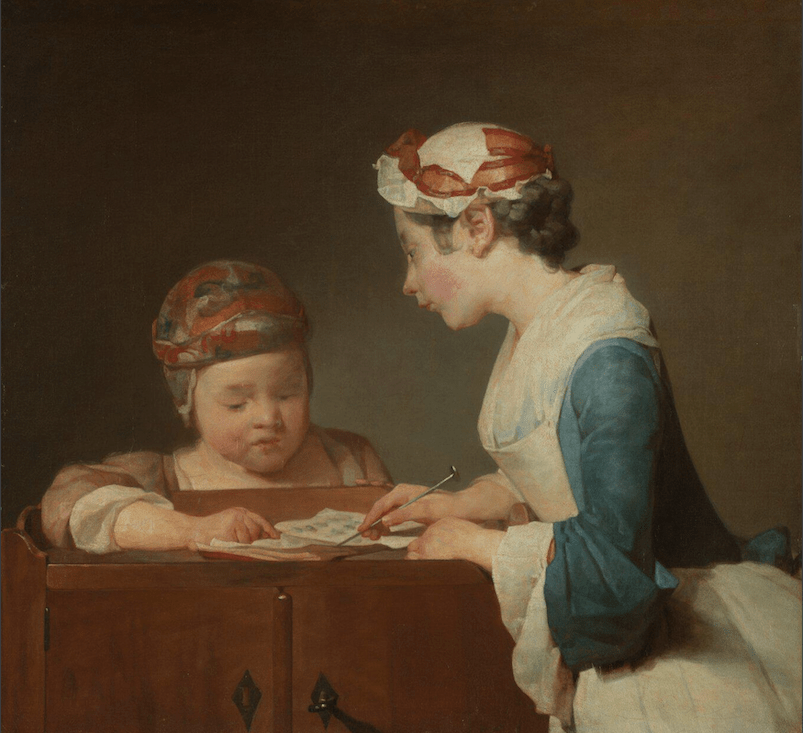
French painter Jean Siméon Chardin devoted his entire career to documenting the quotidian, domestic and laborious nature of life in eighteenth century Paris, France. Aside from his still lifes, some of his best known scenes are paintings depicting teachers and students, such as The Young Schoolmistress (c.1737). In this particular composition, Chardin focuses on the tenderness shared between teacher and student during the act of teaching and learning. Art critic Sebastian Smee (2020) astutely analyzes: “What comes across most powerfully is Chardin’s depiction of a moment so intimate, so absorbed and absorbent, that it has an almost hallowed quality. You can feel a nimbus of attention as much around the painting itself as around the focused scene Chardin depicts….To the young child, so small in the face of all that is knowable, the older girl must seem a repository of wisdom, a kind of angel, even.”
Indeed the painting has a very sentimental and ethereal quality to it. Chardin does a great job communicating how transformative a good rapport between a student and teacher can be. As the title suggests, the teacher herself is quite young. It has been surmised that she is perhaps in her teens and potentially a close relative to the young child, a boy who is likely around the age of a typical kindergarten student. We can be fairly certain that this scene is domestic, rather than a classroom, because the first schools specializing in early childhood education did not emerge in France until 1882 when the government passed a law making education compulsory to children ages six through thirteen (see: Brickman, 1981).
The two figures are engaged in a reading lesson. Chardin’s skilled application of paint enhances the alluring and humane subject matter. The young teacher’s gaze conveys that she is caring and also inquisitive. She too is learning collaboratively with the child. While he is developing his literacy skills, she is building her skills as a maternal figure and educator. The boy’s face is less focused than the well-defined profile of the young woman. This is likely a symbolic and conceptual choice by Chardin to differentiate between their phases of development. He is emergent in both his intellectual and emotional learning; while she is sharpening these aspects in order to grow as an individual who might one day be responsible for raising children either as a mother or teacher, or both.
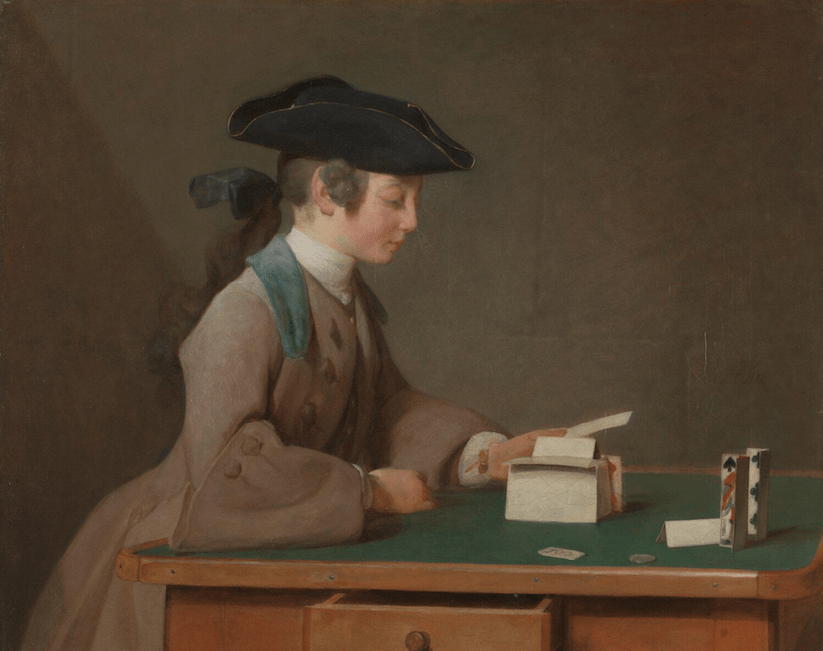
Another important work among Chardin’s genre paintings is The House of Cards (c.1740). This painting depicts a young boy named Jean-Alexandre Le Noir, whose father, Jean-Jacques Le Noir, commissioned several paintings from Chardin. Jean-Alexandre stands at a small wooden table where he is building a house using a set of playing cards. The House of Cards and The Young Schoolmistress have typically been exhibited together, which is an astute pairing since each are representative of the delicate and differentiated aspects of early childhood education.
As previously mentioned, early childhood education was a nascent practice when Chardin was painting his depictions of young learners and their mentors. Access to free, quality education for young children was not a clearly recognized endeavor until nearly one hundred years after The Young Schoolmistress was painted. German educator Friedrich Fröbel established and operated the first example of the modern kindergarten in 1837 in Bad Blankenburg, Germany. The ideas and methodologies soon reached France, the rest of Europe and the United States of America. Chardin’s comprehension regarding the importance of providing age and developmentally appropriate education signifies a bridge between the Age of Enlightenment (c. 1685-1815) and the Fröbelian kindergarten revolution.
Fröbel’s pedagogical philosophy and methods revolved heavily around the concept of play-based learning as the highest expression of human development in childhood. He asserted that learning through playing with materials and engaging in daily activities within their physical environment significantly impacts on how children understand the world and the different social, emotional and intellectual relationships involved with the condition of being human. His own model was based on the work of Johann Heinrich Pestalozzi, who ran several elementary schools for young children in Switzerland during the turn of the nineteenth century.
Pestalozzi’s model of teaching was highly inspirational to Fröbel, and it still carries significance among proponents of constructivist, experiential and social and emotional learning. This framework, which he called “learning by head, hand and heart,” supports holistic and transformative experiences that are associated with education and the three facets that are essential to providing a well rounded education: the cognitive domain (head) for critical reflection, the affective domain (heart) for relational, social and emotional understanding and the the psychomotor domain (hands) for tangible applications of the prior domains, as well as a means to develop fine motor skills.
Another important philosophy, which no doubt influenced Pestalozzi and Fröbel was Swiss philosopher Jean-Jacques Rousseau’s Enlightenment era ideas, more specifically his claim that childhood has a profound and essential impact on an individual’s lifelong development. Rousseau’s concepts, which he outlined in his publication Emile, or On Education (1762), established childhood as a separate and key part of human development. He signified that children are born with innate moral goodness, but can be corrupted through experiencing and reflecting negative social and cultural situations prevalent among human civilization. Rousseau stressed the importance of letting children explore the environments and learn from the many different objects and scenarios that they see and encounter. Rousseau’s message that children should be allowed to enjoy their youth, engage in age and developmentally appropriate tasks and not be stifled with learning how to be an adult so quickly, was incorporated within Pestalozzi and Fröbel’s work and has been imparted through modern educational curricula at large.
Chardin’s paintings depict the informative and transformative outcomes that stem from establishing a patient and compassionate mindset for centering teaching and learning around the aforementioned exploration of environmental and material phenomena. The familiarity of his subject matter and grasp of the realist style of painting is in part why Chardin’s work has inspired subsequent generations of painters, including Lucian Freud who painted his own version of The Young Schoolmistress, titled After Chardin (2000). So in effect, Chardin’s artistic depictions of pedagogical moments have had tangible results through inspiring and promoting the artistic development of succeeding generations of artists.
References, Notes, Suggested Reading:
Brickman, William W. “The Ferry Law of 1881: The Fundamental Law of French Primary Education,” Western European Education,13:3 (1981), pps. 3-5. https://www.tandfonline.com/doi/abs/10.2753/EUE1056-493413033?journalCode=meue19
Smee, Sebastian, “Making a Connection,” Washington Post, 25 March 2020. https://www.washingtonpost.com/graphics/2020/entertainment/jean-simeon-chardin-the-little-schoolmistress/
Discover more from Artfully Learning
Subscribe to get the latest posts sent to your email.
 Artfully Learning