
Several years ago, my wife started reading these small rectangular books, no larger than 4 x 6 inches, each title beginning with the words “How to.” Their simplicity in both design and legibility made for a very productive and accessible introduction to the framework of mindful meditation and practice. The books, with titles such as, How to Eat, How to Love and How to Walk were written by a Buddhist monk named Thich Nhat Hanh, also known by his followers as Thay, which means teacher.
Thich Nhat Hanh was a Vietnamese Thiền Buddhist whose writings, teachings and activism have had a global impact on a variety of disciplines. He was one of the key individuals responsible for introducing the concept and realization of mindfulness to mainstream audiences outside of Asia.
Mindfulness utilizes both cognitive and emotional intellect, honing in on specific body movements and deep observation, in order to construct knowledge and conscious awareness. In pedagogy, this is similar to the method of embodied learning, where students are encouraged to acknowledge the importance and autonomy of one’s body and feelings. Professors David Nguyen and Jay Larson (2015) write that “Traditional pedagogy divides mind and body into a dichotomy that regards the body as little more than a subordinate instrument in service to the mind. Embodied pedagogy joins body and mind in a physical and mental act of knowledge construction.”
Thich Nhat Hanh’s theory of mindfulness is also analogous to the performative nature of art. Anthropologist, Tim Ingold (2013), states that we “think through making” rather than projecting an idea onto a readymade material or environment. Through artful improvisation and experiential activities, we synthesize a series of experiences that lead to mindfulness. Then, during that moment of making, we gain insight to phenomena via an exploration of materials and techniques. In performance art, the whole body is the medium through which actual works of art are made and presented. This mode relies on being attuned to the moment in which the artist is creating. It prioritizes the artistic process over the actual aesthetic product. The idea of process over product is an essential concept in Buddhism, art and education.
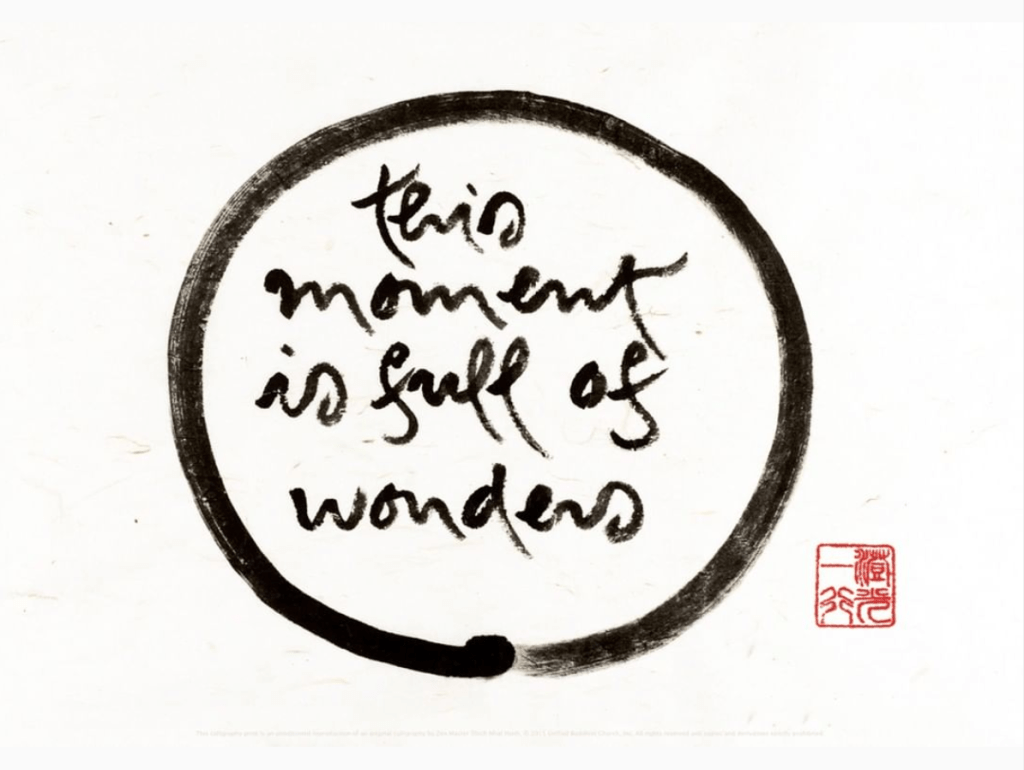
Thich Nhat Hanh employed a minimalist, yet profound approach to teaching mindfulness that incorporated the aforementioned disciplines of art, Buddhism and pedagogy. In addition to his literary prowess, he was a prolific calligraphist. As an art form, calligraphy has significant roots in education and the culture at large. Professors of Asian studies, Cheryl Crowley and Yu Li (2013), conclude that “brush calligraphy can be approached not only as the aesthetic activity that it unarguably is but can also be contextualized within the disciplinary and pedagogical frameworks offered by linguistics, cultural history, ethics and engaged learning. It can serve as a means to help students acquire tools for critical thinking and cultural and linguistic understanding of East Asia, as well as an appreciation of the techniques of brush writing. Finally, it provides a platform for inquiry into the arts and humanities in general in a way that is accessible to all practitioners, irrespective of language ability and cultural background.”
Thich Nhat Hanh’s expressive brushstrokes communicate the tenets of his mindful philosophy. Some of his calligraphic works feature a gestural circular form known as an enso, a sacred symbol in Zen Buddhism meaning circle. The enso is a representation of the artist during the moment of creation when the mind and body are uninhibited. Thich Nhat Hanh’s embodied process was indicative that living became inseparable from the action of making calligraphy. The physical, mental and spiritual facets were in sync. He expounded upon this method by explaining: “Suppose I write ‘breathe’; I am breathing at the same time. To be alive is a miracle and when you breathe in mindfully, you touch the miracle of being alive.”
Bringing mindfulness and embodied learning into everyday life can help us expand our capacity to value and understand ourselves and others. Focusing on transitory meditations and immediate sensory perception during quotidian activities has been shown to reduce stress and bolster our attention spans (see: Tatter, 2019). This empowers us to be emotionally, cognitively and socially aware of ourselves, each other and the space we share.
Thich Nhat Hanh just passed away at the age of 95, but his teachings of mindfulness offer timeless lessons for living, loving and learning artfully. May his memory be a practice that enables us to find vitality, insight and respite in every action and experience we partake in.
References, Notes, Suggested Reading:
Crowley, Cheryl and Li, Yu. “Calligraphy as a Resource in the East Asian Studies Curriculum.” Education About Asia 18:1 (Spring 2013): Asian Visual and Performing Arts, Part II. https://www.asianstudies.org/publications/eaa/archives/calligraphy-as-a-resource-in-the-east-asian-studies-curriculum/
Ingold, Tim. 2015. Making: Anthropology, Archaeology, Art and Architecture. United Kingdom: Routledge.
Nguyen, David J., Larson, Jay B., “Don’t Forget About the Body: Exploring the Curricular Possibilities of Embodied Pedagogy.” Innovative Higher Education 40, 331–344 (2015). https://doi.org/10.1007/s10755-015-9319-6
Tatter, Grace. “Making Time for Mindfulness.” Harvard Graduate School of Education, 23 January 2019. https://www.gse.harvard.edu/news/uk/19/01/making-time-mindfulness
Discover more from Artfully Learning
Subscribe to get the latest posts sent to your email.
 Artfully Learning
Totally absorbing, Adam – so glad I came upon this! I could even relate this to painting, esp experimental abstract ( or even abstract-y art, lol! ) Quieting the mind, poised to observe what’s already on the canvas, aware of the colors on the canvas and in hand on the brush then allowing one’s own personal gesture add to the image, seems now, reading your article, a semi-performance piece in itself, even when alone in the studio! Thay truly was / is a wonderful teacher 🙏 😊
LikeLike