
In the era of 23andMe, Ancestry.com and other personal genomics and biotechnology companies, the age old question ‘where am I from?’ is basically being answered at the click of a button. Knowing the names and locations of our ancestors and contemporary relatives is just the tip of the iceberg, which is basically what these services provide. However, this basic information opens the door for more extensive research. Discovering the social and cultural backgrounds and personal experiences of our relatives, paints a more replete picture of the facets that make up our innate and learned behaviors and identity. Insights into our heritage can impact our outlook on the diversity of culture, ethnicity and race. It can foster a sense of self and communal value and prompt explorations into lineages, beliefs and customs that were previously foreign to us. So while personal genomics is the first step, it is the actual education and participation in cultural experiences that give us a greater and more fulfilling sense of where we are from and the sociocultural traits that have an influence on our development.
Having knowledge of our personal backgrounds includes understanding the ways in which our ancestors were both prosperous and persecuted. In addition to beneficial social, emotional, cultural and economic elements of cultural congruity, diasporic and migrant cultures face significant hardships that affect physical and mental health, due to the “loss of cultural norms, religious customs, and social support systems, adjustment to a new culture and changes in identity and concept of self” (See: Bhugra and Becker, 2005). My ancestors faced significant dilemmas and tragedies throughout the course of modern European history, from the expulsions and pogroms in Russia and the mass murder by the Nazis in Austria, Germany, Czech Republic and Poland. However, their spiritual and physical strength endured, and I am here today because they never lost sight of who they were individually and as part of a cultural community. Jewish culture and faith is something that was essential to my antecedents and has been something I have been rediscovering as I learn more about their experiences and traditions. As I have moved to different Jewish populated neighborhoods (including my current enclave in Queens), I have experienced how Jewishness is not a one size fits all religion or culture. We are a diaspora that is strengthened as a result of ancient traditions meeting with contemporary trends. Jewish people are proud of their Judaism at large, while also practicing and honoring more acute and regional specific aspects of their Jewish identity.
Beyonce Knowles-Carter’s Black Is King is a conceptual film that celebrates individual and collective perspectives and creativity within the African diaspora. The film is rich with cross-cultural references to visual art, music, religion, math and science (all the STEAM subjects), and weaves these disciplines together in a colorful tapestry that is representative of distinctive ancient and modern identities. Mythology and oral lore are major parts of many African traditions, and Black Is King does a compelling job expressing the continuity of culture and ingenuity, using archetypal storytelling and signifiers (sights and sounds). The film draws from the story of the Lion King, a popular tale of a young lion named Simba whose life experiences, prior knowledge and ancestral guidance gives him the agency to exhibit empathetic understandings of cultural identity and community.
Depictions of Black men and women have a long history of being exploited, distorted and negatively portrayed via media outlets (see: Donaldson, 2015; and Jewell, 1993). In Black Is King, Black bodies are beautiful, powerful and diverse, as is the portrayal of language, experience and identity. There are both blatant and more subtle references to a myriad of visual and oral cultural histories. Through art, fashion, design, music and philosophy, the film makes connections to the spiritual, scientific and feminist centered societies of Africa and the African diaspora. Beyonce culls from her extensive vocabulary of visual art, dance and music to present a Black aesthetic that is typically underrepresented in art history. She collaborated with innovative artists throughout the African diaspora (i.e. Malian singer Oumou Sangaré and co-directors Blitz Bazawule and Jenn Nkiru) and showcases works of art by (or inspired by) Derrick Adams, Woodrow Nash, Carrie Mae Weems and David Hammons among others. Black Is King is a form of ‘entertainment justice’ (see: Education and Empowerment via Entertainment Justice) that prompts us to love ourselves, find personal and collective value in our humanity and come together to create and observe beautiful things.
The job of an artist is not to present a didactic overview of global history, politics or other governing frameworks. A successful work of art mines life’s social, emotional and cultural elements and presents them in ways that leave us yearning and excited to continue exploring, discovering and connecting. Beyonce has done just that within Black Is King. As music writer and editor, Timmhotep Aku assesses, the film is Beyonce’s “love letter to the African continent, its people, their origins and her own ancestors.” Aku asserts that “though this was a team effort it’s still the brainchild of an African American woman whose connection to the Motherland comes from self-education and discovery rather than immersion or upbringing — it is her African dream” (Aku, 2020).
There is a confluence of many African cultures represented in the film, which reflects the variance of Beyonce’s heritage and the identities of millions of other Black individuals living all over the world. The content and context for the integration of sights, sounds and experiences from many different African countries, mirrors the mixture of African cultures that represent the African diaspora. As author Joi-Marie McKenzie reveals, watching the film was somewhat of a homecoming for her, as well as a welcome invitation to reflect on the complexities and breadth of her ancestry and Black identity (McKenzie, 2020). McKenzie cites Christer Petley’s book, White Fury: A Jamaican Slaveholder and the Age of Revolution (Oxford University Press, 2018), which is about Simon Taylor, who was once the wealthiest slaveholder in the British empire. In the book, Petley describes a tactic that white slaveholders used to subdue the possibility of rebellion, which involved separating Black slaves on a plantation to ensure they were from different nations and tribes. The forceful and malevolent conflation of Africans from different communities led to the cultural amalgamation of “bits and pieces of lands we might never see but (are) beloved all the same” (Ibid, 2020).
In their respected reviews, McKenzie and writer/filmmaker, Kwesi Jones, analyze some of the prominent nations and tribes that are represented in Black Is King. Homage to the astronomical and metaphysical knowledge of the Dogon people of Mali, is invoked via celestial imagery, such as the young baptized Simba shooting to Earth as a comet, the glimmering star-like effect from materials in some of Beyonce’s bodysuits and in the song Find Your Way Back (“Daddy used to tell me ‘look up at the stars.’ Been a long time but remember who you are”). The Dogon are astutely aware of their place within the universe, and their time-honored rituals and lore involve astronomical calculations and insights, which shape their everyday experiences. The Dogon have an intricate understanding of the location of Earth and other celestial bodies within the Milky Way Galaxy and their theory of how the universe was created in a giant cosmic expansion/explosion is similar to the concept of the Big Bang (see: Jones, 2020 and Farrell, 2018).
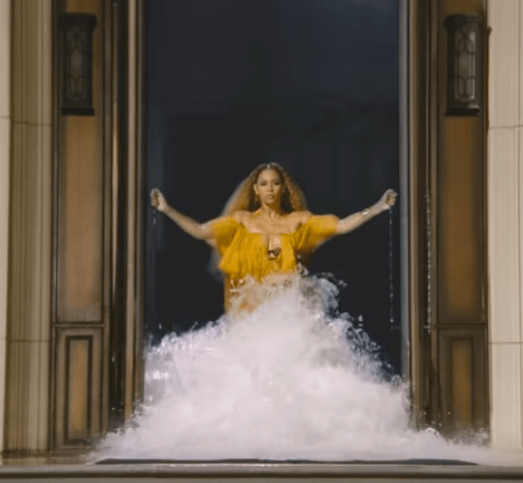
Another cultural and spiritual reference frequently embraced by Beyonce is Orisha Oshun, a powerful river deity in the religion of the Yoruba people from southwestern Nigeria and Benin (see: Grady, 2020). Oshun portrays femininity, fertility, beauty and love, and is connected to destiny and divination (Monaghan, 2014). In artistic representations of Orisha Oshun, the goddess is typically wearing a flowing yellow dress. Beyonce embodies Oshun in both her 2016 conceptual album and accompanying film titled Lemonade and Black Is King. During the cinematic video for the song Hold Up from Lemonade, Beyonce exits a courthouse, powerfully emerging by parting a torrent of water in a yellow dress reminiscent of Oshun’s. This reference can be interpreted as a combination of themes from Western Abrahamic religions and the Yoruba Ifá religion. Throughout her work (in both Lemonade and Black Is King), Beyonce evokes the Old Testament story of Moses, who was sent down the Nile river in a basket in order to escape the Egyptian pharaoh’s persecution of Jewish born boys (see: Exodus 1:15–22, where Pharaoh proclaims that “Every Hebrew boy that is born you must throw into the Nile”). The story of Exodus was important to abolitionists like Harriet Tubman. The narrative of Moses and the Jewish people seeking freedom were reclaimed in the lyrics of Black spirituals from the 19th century, in order to address and galvanize collective voices towards the abolition of slavery (most prominently: “Go down Moses, way down in Egypt’s land, tell old Pharaoh to let my people go”). The combination of Moses and Oshun symbolizes liberation and rejuvenation. Both figures utilize water as a source of protection, life and transcendence from adversity.
The Yoruba and Dogon (and so many more) communities educate future generations on their extensive worldly and supernatural knowledge through works of art, oral storytelling, celebrations and rituals, such as mask making, song and dance. Through connecting spiritual and cultural traditions from diverse African nations, Beyonce is encouraging her viewers and listeners to find a way back to their ancestral heritage and be proud of were they come from and who they are today.
Perhaps the most essential takeaway from Beyonce’s Black Is King is the potential for African art and culture to be an agent of transformative social justice. Beyonce narrates during the film that we should “Be bigger than the picture they framed for us to see.” It would behoove educators and cultural producers to show and contextualize works of art that highlight the plurality of BIPOC identity, in order to shift the paradigm of racial stereotyping and systemic racism and erase the tokenism and colonialist overviews of African art within the Western canon of art historical presentation. Art has the ability to inspire us to think critically and make insightful connections between works of art and our own visions and experiences. It is important that we educate ourselves about our own unique backgrounds and the cultures of others, so that we understand that culture and people from geographical regions are not a monolith.
Regarding the impact and impetus that her film might have on our collective culture, Beyonce writes: “Black Is King” is a labor of love. It is my passion project that I have been filming, researching and editing day and night for the past year. I’ve given it my all and now it’s yours. It was originally filmed as a companion piece to “The Lion King: The Gift” soundtrack and meant to celebrate the breadth and beauty of Black ancestry. I could never have imagined that a year later, all the hard work that went into this production would serve a greater purpose. The events of 2020 have made the film’s vision and message even more relevant, as people across the world embark on a historic journey. … I believe that when Black people tell our own stories, we can shift the axis of the world and tell our REAL history of generational wealth and richness of soul that are not told in our history books.”
References, Notes, Suggested Reading:
Aku, Timmhotep. “Please, Appreciate “Black Is King” for What It Is.” Teen Vogue, 2 August 2020. https://www.teenvogue.com/story/beyonce-black-is-king-review-and-critique-of-criticisms
Bhugra, Dinesh and Becker, Matthew A . “Migration, cultural bereavement and cultural identity.” World psychiatry : official journal of the World Psychiatric Association (WPA) vol. 4,1 (2005): 18-24. Accessed 5 August 2020. https://www.ncbi.nlm.nih.gov/pmc/articles/PMC1414713/
Donaldson, Leigh. “When the media misrepresents black men, the effects are felt in the real world.” The Guardian, 12 August 2015. https://www.theguardian.com/commentisfree/2015/aug/12/media-misrepresents-black-men-effects-felt-real-world
Farrell, Tish. “How The Universe Began ~ The Dogon View.” tishfarrell.com, 18 April 2018. https://tishfarrell.com/2018/04/16/how-the-universe-began-the-dogon-view/
Grady, Constance. “Meet the African goddess at the center of Beyoncé’s Black Is King.” Vox, 31 July 2020. https://www.vox.com/culture/2020/7/31/21349403/beyonce-black-is-king-oshun-osun-yoruba-goddess
Jewell, K. Sue. From Mammy to Miss America and Beyond : Cultural Images and the Shaping of Us Social Policy. London: Routledge, 1993.
Jones, Kwesi. “The African Epistemologies of Beyoncé’s ‘Black is King’.” Medium, 1 August 2020. https://medium.com/@kwesijones429/the-african-philosophy-of-beyonces-black-is-king-530015a42551
Knowles-Carter, Beyonce. @Beyonce ““Black Is King” is a labor of love. It is my passion project that I have been filming, researching and editing day and night for the past year….” Instagram, 28 June 2020. https://www.instagram.com/p/CCAMxfrHjAL/
McKenzie, Joi-Marie. “Beyonce’s ‘Black is King’ Asks the Question We Hate to Answer.” Essence, 3 August 2020. https://www.essence.com/feature/beyonces-black-is-king-review/
Monaghan, Patricia. Encyclopedia of Goddesses and Heroines. San Francisco: New World Library, 2014. p. 15.
Discover more from Artfully Learning
Subscribe to get the latest posts sent to your email.
 Artfully Learning