
What is an appropriate assessment of what makes good educators and good artists? Can the idea of being ‘good’ be quantified by esteemed awards or test results? To some people in both the institutional worlds of art and education, that is probably the key standard for determining successful performance and achievement. Qualitative assessments of what makes educators and artists stand out are far more complex, but it is arguably the more impactful way to recognize the influence that they have within their fields and the culture at large.
Good artists and good educators enable their viewers and students (respectively) to construct additional and experiential knowledge around the material that they present. This means that educators and artists develop a personal understanding of their community and scaffold their work to ensure that they are relating to more than just a controlled group of like-minded individuals. Education and art are transformative disciplines that reflect the contemporary condition and inspire us all to be more human. A good education as well as a good work of art encourages the formation of collaborative empathetic responses to critical humanist issues facing our collective culture. Artists and educators should make space for dialogic relationships that affirm other people’s narratives and ideas towards their work. This is the crux of critical and problem-posing pedagogy (see: Freire, 1970), which suggests that an equitable and liberated education arises through discourse and cooperative construction of knowledge and understanding.
When art and education are explored as acts and expressions of love, they empower socially engaged interactions (see: Freire, 1997). Obtaining a problem-posing pedagogical framework, based on acts and expressions of love is hard to quantify with data. On the other hand, standardized testing and personal achievement is easier to measure with statistics. Our current social structure typifies success with data. It utilizes data to reward and elevate those who score well on tests or accrue significant economic gain. This model doesn’t signify the equal, equitable and justice inspired ideology of our political and educational systems, but it is the reality of our purported ‘democratic’ institutions.
Carla Herrera-Prats addresses this fallacy in her multidisciplinary artwork, which makes humanist inquiries into the purpose of education, labor, politics and economics. Her work can be described as what Pablo Helguera (2011) defines as “transpedagogy.” According to Helguera, this term refers to artistic endeavors that “blend educational processes and art-making in works that offer an experience that is clearly different from conventional art academies or formal art education.”
Within Herrera-Prats’ work, she juxtaposes texts and images, often culminated via archival research, in order to make the underpinnings of institutional oppression visible, and elevate the voices of progressive historians, educators, artists and archivists. In Prep Materials (2008), she addresses the enduring question of what influence quantitative assessments have on both education and politics. Como un Cerillo (2008) depicts an alternative narrative to the oft-negative perspective of one of Mexico City’s neighborhoods, Tepito. Official Stories (2005-2006) reveals the way that the Mexican government has appropriated pre-colonial culture as agitprop to support nationalist interests, and how that contrasts with the way diversity and pre-Hispanic narratives are presented in the public school curriculum.
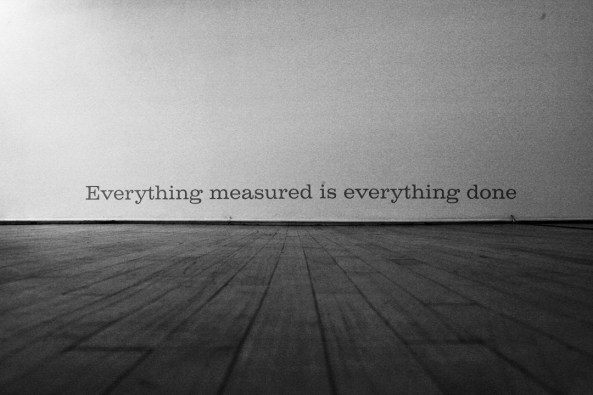
Prep Materials makes connections between the formation and evolution of ‘efficient’ technology to score the SATs, developed by IBM, Educational Test Service (ETS), and the Measurement Research Center. The same technology created for scoring SATs was utilized for the invention of the ballot machine as well as contemporary desktop scanners. Prep Materials displays photographs, text, a slideshow and drawings that refer to the archives of the aforementioned institutions. The saying ‘everything measured is everything done,’ which when installed (in both Los Angeles and New York) was affixed to the lower half of a gallery wall via vinyl letters; is indicative of society’s reliance on quantitative analysis to inform and motivate the way productivity is rewarded. It paraphrases a familiar quote (origins unknown), which is ‘what gets measured gets done.’ Herrera-Prats is clearly not suggesting that this is the most effective way of defining productivity and success within our standards of living. As she states: “moving beyond the common criticism against standardization and its supposed translation into better education, this exhibition focuses on the fallacy of relying on “efficient” technologies in order to realize the principles of democracy.”
How does one measure happiness and the selflessness of serving one’s community? Many altruistic efforts go unnoticed. Herrera-Prats’ work at large investigates the confluence of what is measured and what isn’t measured, in order to show the paradox of measuring data, and how quality of life rejects data driven narratives.

Como un Cerillo is an audio/visual archival presentation based on the work of Alfonso Hernández, a longtime resident of Tepito, who has been creating a living archive of the neighborhood that is free and open to the public. Hernández’s magnum opus has been working to archive and present materials that celebrate the rich history of Tepito and inspire communal spirit among his neighbors. Alongside some examples of Hernández’s archive, are songs that have a cultural impact on the community. They represent music that was imported from South American countries via the neighborhood’s black market. This type of music, which includes cumbias and other tropical rhythms, are played by DJs at night markets. They provide a respite from the hectic urban environment. The fusion of Hernández’s archive and the lively music, present an alternative to the negative perspective the neighborhood receives in the mainstream media.
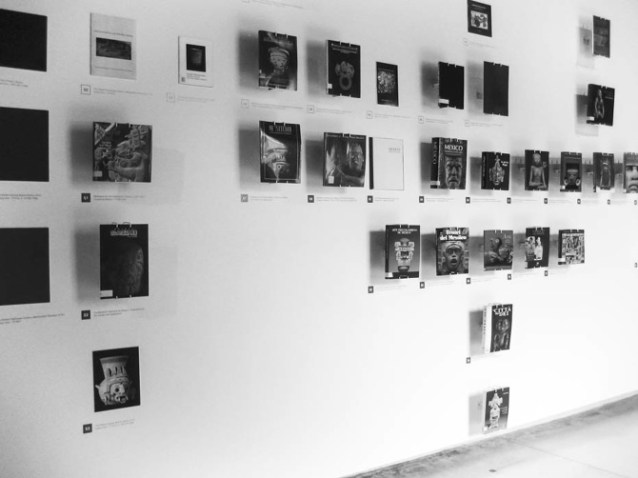
Official Stories displays materials from exhibition catalogues that were sponsored by the Mexican government. These catalogues supplemented major exhibitions that toured the world, promoting the rich history and diversity of Mexico from its Mesoamerican roots to its present day melting pot of indigenous peoples, people of Hispanic decent and immigrants from all over the world. In Mexico, cultural artifacts and art are protected under strict laws. They are not allowed to be sold for profit, but have been used to increase tourism, which is why these exhibitions are held in such high regard and promoted far and wide. In contrast, the textbooks from public schools have seen a decrease in cultural diversity. The images and narratives have experienced a transformation signifying a highly selective pedagogy of pre-Hispanic and indigenous culture. While there used to be images celebrating indigenous and proletariat themes, more recent textbooks have gradually replaced these images with photographs (such as an aerial view of the landscape) that are devoid of sociopolitical context. Juxtaposing materials from exhibition catalogues and textbooks published between the 1950s and 2008, the installation forms patterns and makes connections between the rise of national identity, which celebrates diversity, and the decline of multicultural education. As Herrera-Prats (2008) explains:
“This project was not and is not about forming conclusions regarding how much children today are actually learning about their pre-Hispanic past. The most that we can say, by looking at the chalk indexes, is that they are certainly less exposed to it now than they were in 1959. Rather than measuring their learning itself, my methodology allowed for the display of a paradox in which the Mexican government and its cultural institutions has become entangled. In their efforts to carve a niche in the global scene, they have promoted abroad the very image whose effacement conditions progressive identity, namely: the diversity of pre-Hispanic cultural inheritance”
Archives and historical documents are used as a teaching resource to allow viewers of Herrera-Prats’ installations to spend time with primary and secondary sources, and formulate their own enduring understandings of what they see/read with their prior knowledge and cultural understandings. It is a way of opening a dialogic relationship between the past and the present culture. It is an important and profound experience that enables us to understand how history is used and manipulated for specific ideological interests. Secondary sources and critical/institutional interpretations of archives can establish a narrative that is both implicit and explicitly bias. It takes a discerning and liberated mind to critically examine these literary and visual documents. Prats’ presents her sources, asks us to consider multiple perspectives and leaves the role of making value judgements to us.
Going back to the essential question of what makes good art and good education, one enduring understanding is that both disciplines empower us to think radically within traditional mainstream cultural environments. While employing curricula that focuses on comprehension skills is fine, it needs to be supplemented with the development of liberal knowledge. Traditional methods of ‘reading for comprehension’ can have a devastating affect on marginalized individuals particularly, because they are being asked to read and digest ‘required’ texts in a formulaic manner, without a deeper understanding and a critical discourse around its cultural implications. In other words, the sole purpose is to develop didactic reading skills without much discussion and focus on themes and content that relates to more diverse social and culture issues (see: Wexler, 2019). Good artists and educators know this and provide ample moments for student/viewer reflection. They welcome discourse and take pride in the fact that learning and understanding is a communal act, supported by expressions of empathy and cooperation.
As bell hooks (1994) says, “the academy is not paradise. But learning is a place where paradise can be created.” The act of learning can manifest wherever people come together in collaboration to support and uplift each other’s voices and create informed responses to contextual information. Education and art are labors of love (see: Labor of love: art, activism, collaborative learning) and their impact cannot be neatly managed or maintained. They are both rhizomatic practices in nature and their success relies on the manner in which they inspire collaborative social action and democratic dialogue. While the aforementioned projects were created through Herrera-Prats’ solo practice, she had devoted her creative and socially engaged output in collaboration with artist Anthony Graves and the Camel Collective from 2008 until her recent untimely death. May her memory be a blessing and may her work continue to inspire artful learning and critical pedagogy.
References, Notes, Suggested Reading:
Freire, Paulo. Pedagogy of the Oppressed, New York: Continuum, 2007.
Freire, Paulo. Pedagogy of the Heart, New York: Continuum, 1997.
Helguera, Pablo. Education for Socially Engaged Art, New York: Jorge Pinto Books, 2011.
hooks, bell. Teaching to Transgress. New York: Routledge, 1994.
Herrera-Prats, Carla. “Official Stories,” Invisible Culture, Issue 12: The Archive of the Future / The Future of the Archive, May 2008. Accessed 13 Dec. 2019 https://www.rochester.edu/in_visible_culture/Issue_12/herrara-prats/herreraprats.pdf
Ubanell, Rosana. “Tepito, the Mexico slum where one day you’re alive and the next you’re dead,” efe.com, 2 March 2019. Accessed 14 Dec. 2019 https://www.efe.com/efe/english/life/tepito-the-mexico-slum-where-one-day-you-re-alive-and-next-dead/50000263-3913882
Wexler, Natalie. The Knowledge Gap: The hidden cause of America’s broken education system – and how to fix it. New York: Avery, 2019.
Discover more from Artfully Learning
Subscribe to get the latest posts sent to your email.
 Artfully Learning
“When art and education are explored as acts and expressions of love, they empower socially engaged interactions..” that’s empowering, thankyou for reinforcing that. Fascinating site. Much to take in, will be back to read more!🌻
LikeLiked by 1 person
Thank you so much for your comment and for taking the time to read through my blog posts!
LikeLiked by 1 person
You’re welcome, and those were amazing posts!
LikeLiked by 1 person