
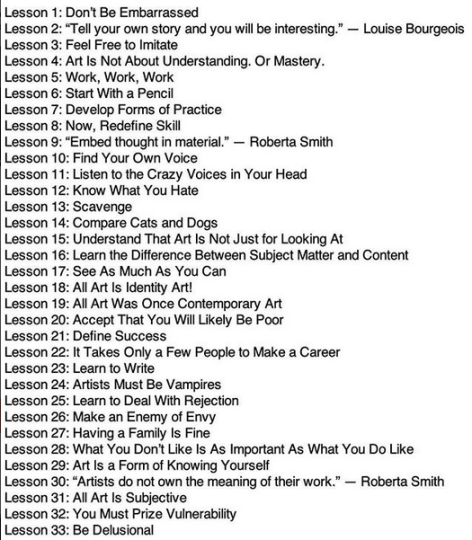
The influential New York based art critic, Jerry Saltz, recently published a list of thirty-three ‘lessons for being an artist.’ Saltz’s teachings range from being lighthearted, frank, sensible and mysterious. They are roughly open-ended guidelines with lots of room for the reader’s interpretation. For example, Lesson 14 Compare Cats and Dogs appears confounding and esoteric, however, it can be comprehended in many ways. Cats and dogs are sometimes compared by pet owners and some might declare that they are either a ‘cat person’ or a ‘dog person.’ Saltz is possibly suggesting that debate, discourse and creating art around topics that are out of your comfort zone or out of the ordinary is an important part of the artistic process. The Greeks invented the expression cata doxa, which translates as ‘contrary to experience of belief.’ One of the studio habits of mind that we learn through the arts is to embrace ambiguity (see: Educating Through Art), which means that artists are aware that at times they will need to make judgements in the absence of any clear-cut solutions. The arts teach us to explore, discover and make insightful symbolic expressions. If an initial process doesn’t pan out, artists understand that issues are complex and can likely be discerned and attempted in several other ways.
Realizations that resolutions to complex problems require patience and multiple steps and endeavors, is reflected in lessons 5, Work, Work Work; 21 Define Success (what is an achievable and meaningful goal in your mind?); and 25 Learn to Deal With Rejection (if at first you don’t succeed, try, try again). The arts enable us to take direct action through creatively assessing/reflecting upon our work and accept risks based on syntheses of what we’ve experienced and learned in prior explorations.
Not everyone will agree with everything on Saltz’s list, which is OK because it is meant as a motivational prompt and conversation starter. It might even be accepted as a work of art in its own right (Saltz certainly takes ample creative liberties). The idea behind these types of lists is to get people to start thinking like an artist. Being an artist means not simply accepting things at face value or making something ‘aesthetically’ pleasing to view. Artists question (studio habit of mind) existing aesthetic, social and cultural structures and push the limitations of their own media in order to communicate symbolically within society at large. Being an artist encompasses (among other things) lessons 10 Find(ing) Your Own Voice; 15 Understand(ing) That Art is Not Just for Looking At; and embracing the idea that Art Is a Form of Knowing Yourself (Lesson 29).
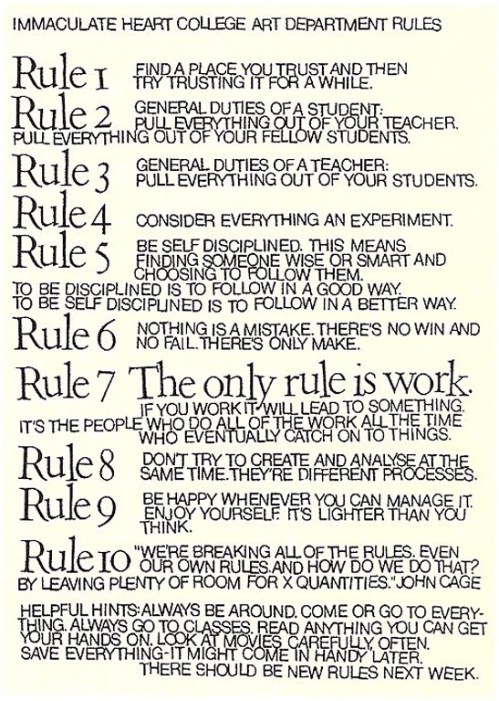
Saltz’s recent list is in the good company of prior lists from champions of artistic learning such as the late artist, educator and nun, Sister Corita Kent, who created Ten Rules for Students, Teachers and Life in 1967-68. The list has been popularized by the composer/artist John Cage, however, while Cage did contribute to the list (see: Rule 10 in the image above), Kent created this list as part of a class project while teaching at Immaculate Heart College, a former private Catholic college in Los Angeles, California.
Kent’s list serves as sagely and flexible advice for living life in a more creative capacity. It incorporates the trials and tribulations, as well as the joys of being an artist (or being artful) and/or an educator. Advice such as Rule 1: Find a place you trust and try trusting it for a while, reflects studio habits of mind like noticing deeply and identifying patterns. In other words, spend time with your concept, trust the process and plan for long term interactions and relationships with intricate layers of details, recognizing that it may change over the course of time. This aforementioned methodology is also significant of Rule 4: Consider everything an experiment, which additionally ties into studio habits of mind such as creating meaning, living with ambiguity, taking action and making connections. Artistic learning, growth and development is dependent upon explorations leading to a plethora of unique discoveries and insights. Rules 2 (General duties of a student — pull everything out of your teacher; pull everything out of your fellow students) and 3 (General duties of a teacher — pull everything out of your students) are in line with educational philosophies such as Paulo Freire’s ‘problem-posing learning’ model, where students and teachers are active collaborators throughout the learning process. In fact, Corita Kent’s rules were exhibited around the same time as Freire’s seminal book Pedagogy of the Oppressed (1968) was published.
In the educational sphere, teachers utilize lists as key visual elements and influential tenets that motivate and support learning. Many art classrooms have lists meant to inspire students to be active participants in class and trust their own creative instincts. A common rule among art educators is that ‘artists turn mistakes into art.’ In addition to being Corita Kent’s Rule 6, this philosophy was made famous throughout the world by Bob Ross, the renowned television art educator whose show The Joy of Painting aired from 1983 to 1994. Ross said “we don’t make mistakes, we make happy accidents.”
Joy is a key component of Kent’s list too. Kent’s Rule 9 states “be happy whenever you can manage it. Enjoy yourself. It’s lighter than you think.”
Perhaps you are an educator who has adorned your classroom with inspirational lists by others or yourself. Or maybe you are a creative professional (or just love creating for fun) and keep influential lists and notes in your studio. These notes and lists might include mental images, which you have not had the chance to record on paper. I am interested in knowing what kinds of tenets are included within your existing lists OR if you have not created one yet, what would some of the core items be if you were to create a list focused on artistic growth, creativity, or artfully learning?*
* Please feel free and inspired to answer the prompts in the comments
References, Notes, Suggested Reading:
Popova, Maria. “10 Rules for Students, Teachers, and Life by John Cage and Sister Corita Kent.” Brainpickings. 10 Aug. 2010. https://www.brainpickings.org/2012/08/10/10-rules-for-students-and-teachers-john-cage-corita-kent/
Saltz, Jerry. “How to Be an Artist: 33 rules to take you from clueless amateur to generational talent (or at least help you live life a little more creatively).” Vulture. 27 Nov. 2018. https://www.vulture.com/2018/11/jerry-saltz-how-to-be-an-artist.html
Discover more from Artfully Learning
Subscribe to get the latest posts sent to your email.
 Artfully Learning